

Kilimanjaro rises above Moshi in clear layers
Published on 08/08/2026 at 15:06 | Editorial responsibility: Rafael Müller, Editor-in-Chief AD HOC NEWS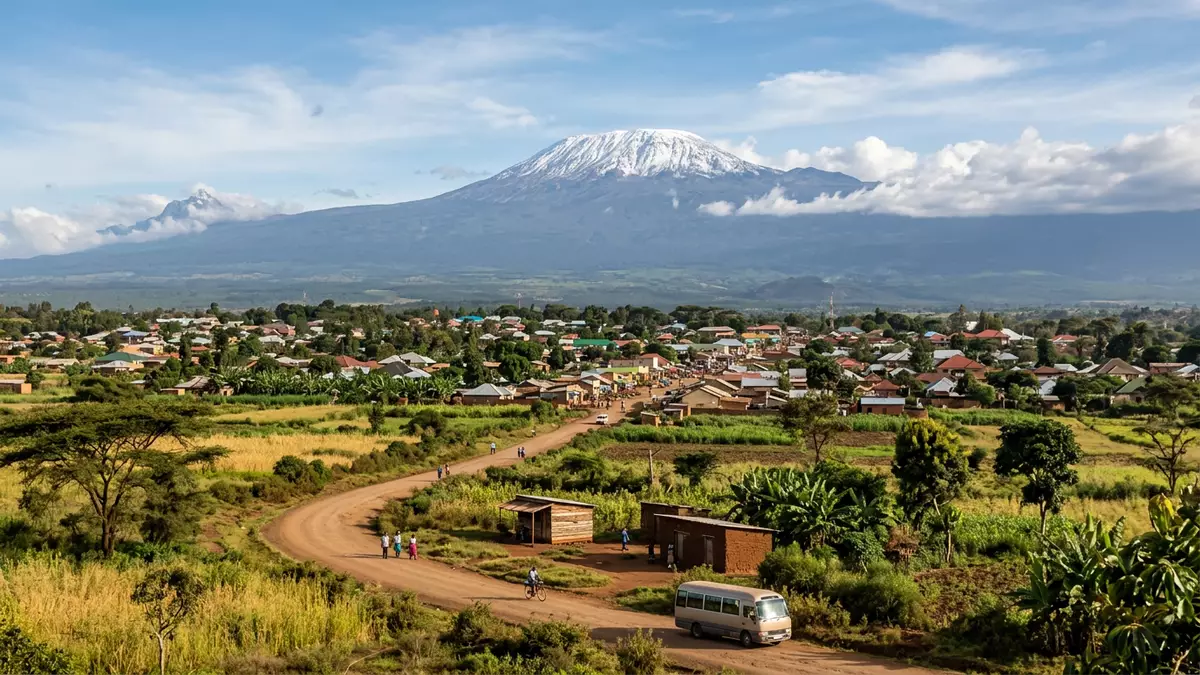
Kilimanjaro rises above Moshi as a mountain of layers: lower slopes, forest, heath, moorland and the high volcanic summit zone. It is the highest mountain in Africa, with Uhuru Peak as its best-known summit on Kibo, the highest of its three volcanic cones.
Kibo, Mawenzi and Shira
Kilimanjaro is a dormant stratovolcano made up of Kibo, Mawenzi and Shira. Kibo forms the central massif and contains the summit area, while Mawenzi and Shira give the mountain its broad volcanic profile.
The mountain stands apart from the surrounding plains because its altitude creates several visible ecological bands. On a clear day, the change from cultivated lower ground to open mountain slopes is one of its defining features.
The mountain above Moshi
Moshi lies on the Tanzanian side of Kilimanjaro and serves as a common base for the mountain region. From the town, the mountain dominates the skyline and remains the most immediate landmark in the area.
The mountain is part of Kilimanjaro National Park, which protects its upper reaches and the natural landscape around them. The protected area includes the main ascent routes and the summit zone around Uhuru Peak.
A mountain of ecological zones
The lower slopes carry farmland and settlements, then give way to forest, shrubland and alpine desert higher up. That sequence gives Kilimanjaro a strong visual contrast that changes with elevation.
The summit zone is permanently cold and exposed, with ice and rock defining the uppermost landscape. The mountain’s profile is also linked to its volcanic origin, visible in the broad massif rather than a single sharp peak.
Visiting Kilimanjaro: what travellers from Western Europe should know
- The mountain is reached from Moshi by road, with access into the national park from the town and nearby gateway points.
- Admission arrangements and opening hours are set by the site's operator and change with the season; the official website is the only binding source.
- The clearer months suit mountain views and photography, while the summit zone remains cold at any time of year.
- Visitors should expect steep gradients, altitude, uneven ground and long walks on foot in the park.
- Swahili and English are both useful in the region, and cashless payment is not something to assume everywhere.
- Entry requirements depend on your nationality. UK travellers should check the FCDO travel advice at gov.uk/foreign-travel-advice; Irish travellers the Department of Foreign Affairs at ireland.ie; EU and EEA citizens their own national foreign ministry.
Searching for Kilimanjaro on social platforms
These links open searches for Kilimanjaro on each platform.
Frequently asked questions about Kilimanjaro
Where is Kilimanjaro?
Kilimanjaro is in north-eastern Tanzania, close to Moshi and east of the Rift Valley. It rises as a free-standing volcanic mountain above the surrounding plains.
What should visitors expect on a visit?
Expect altitude, uneven paths and a strong change in landscape as elevation increases. The mountain is not a city attraction; it is a major highland landscape with park access.
What makes Kilimanjaro distinctive?
Its size, volcanic structure and ecological bands set it apart from the lowland surroundings. The summit area, dominated by Uhuru Peak on Kibo, gives the mountain its best-known profile.


