
Kinkaku-ji and its golden reflection in Kyoto
Published on 09/05/2026 at 13:39 | Editorial responsibility: Rafael Müller, Editor-in-Chief AD HOC NEWS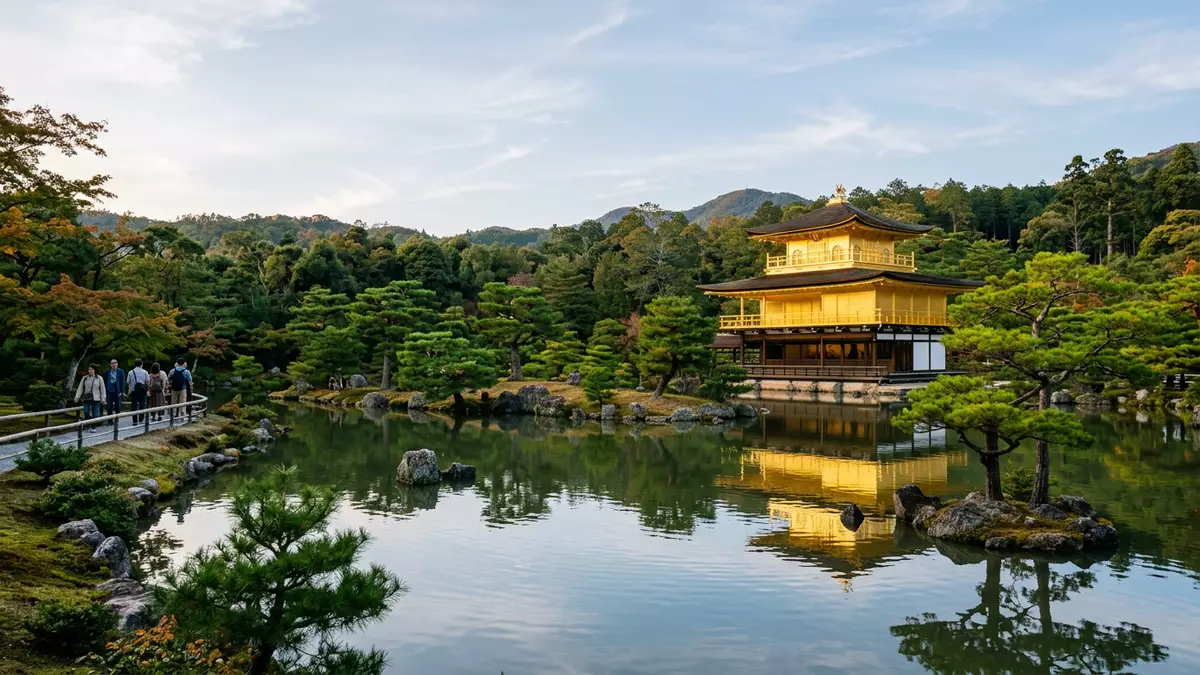
Kinkaku-ji in Kyoto, officially named Rokuon-ji, is a Zen Buddhist temple where a gilded pavilion and its reflection in water define the entire setting. The temple complex links Ashikaga-period architecture with a carefully composed garden in the northern part of the city.
The Golden Pavilion and its setting
The structure known as Kinkaku, or Golden Pavilion, stands beside a broad pond framed by planted islands, stones and evergreen trees. The pavilion’s upper storeys are covered in gold leaf, giving the building its name and catching the light above the water.The top floors are covered in gold leaf and the pond is arranged so that the building appears twice, once as architecture and once as reflection.The temple stands beside a mirror-like pond
Kinkaku-ji’s official name, Rokuon-ji, links it to the Rinzai sect and to Shokoku-ji, the head temple of this branch of Zen. The Golden Pavilion forms part of a wider complex of halls, gates and paths, but its gilded surfaces and the water in front of them shape most visitors’ memory of the site.Rokuon-ji is a branch temple of Shokoku-ji and it is recognised among the Historic Monuments of Ancient Kyoto.Kinkaku-ji forms part of the Historic Monuments of Ancient Kyoto
A Muromachi-era villa turned Zen temple
The origins of Kinkaku-ji lie in the late fourteenth century, when Ashikaga Yoshimitsu, the third shogun of the Ashikaga shogunate, established a retirement villa on this site in Kyoto’s northern hills.The villa was first built in 1397 and the pavilion later became part of a temple complex reflecting the culture of the Muromachi period.The Golden Pavilion belongs to the architecture of the Muromachi period
After Ashikaga Yoshimitsu’s death in 1408, the villa was converted into a Zen Buddhist temple in line with his will.The site became a Zen temple of the Rinzai sect after his death in 1408 Centuries later, the temple and its garden were inscribed among Kyoto’s Historic Monuments, underlining their role in representing the city’s medieval Buddhist heritage.Kinkaku-ji is a Zen Buddhist temple in Kyoto
Architecture, garden and visitor route
The Golden Pavilion itself is a three-storey structure with each level reflecting a different architectural style associated with historic Japanese design.The pavilion has three distinct storeys The ground floor uses palatial elements linked to the shoin style, the middle floor follows samurai-residence patterns and the upper floor adopts features associated with Zen temples. The pavilion was rebuilt in the twentieth century and restored with its gold leaf cladding to match earlier descriptions.The current pavilion dates from the 1950s
Visitors follow a set path through the temple grounds, moving from the main gate towards the pond and the Golden Pavilion, then continuing through wooded sections and subsidiary areas of the garden. The route passes viewpoints that frame the pavilion from across the water and from slightly higher ground, making the geometry of the building and its reflection a repeated motif. Tea houses, smaller shrines and stone features stand along the way, connecting Kinkaku-ji to wider patterns of temple and garden design in Kyoto.The grounds combine buildings, pond and garden
Visiting Kinkaku-ji: what travellers from Western Europe should know
- Kinkaku-ji stands in Kinkakuji-ch? in Kita Ward, in the north-western part of Kyoto, and is reached by city buses from Kyoto Station and other central districts.
- The temple grounds are laid out as a circuit path around the pond, with gently sloping surfaces and several staircases connecting different viewing levels.
- English is widely used for signage in Kyoto and the official language is Japanese; the currency is the Japanese yen.
- Entry requirements depend on your nationality; UK travellers can check the FCDO travel advice at gov.uk/foreign-travel-advice, Irish travellers the Department of Foreign Affairs at ireland.ie.
Searching for Kinkaku-ji on social platforms
These links open searches for Kinkaku-ji on each platform.
Frequently asked questions about Kinkaku-ji
Where is Kinkaku-ji located in Kyoto?
Kinkaku-ji is in Kinkakuji-ch? in Kita Ward, in the north-western part of Kyoto, reached by city buses from Kyoto Station and other central areas.
What should visitors expect on a visit to Kinkaku-ji?
Visitors follow a fixed path through the grounds, viewing the Golden Pavilion across the pond and passing garden features, tea houses and smaller shrines.
What makes Kinkaku-ji distinctive among Kyoto’s temples?
The combination of its gold-covered pavilion, the pond that reflects it and its origins as Ashikaga Yoshimitsu’s Muromachi-era villa gives Kinkaku-ji a particular character.


