
Kinkaku-ji and the golden reflection of Kyoto
Published on 08/25/2026 at 12:08 | Editorial responsibility: Rafael Müller, Editor-in-Chief AD HOC NEWS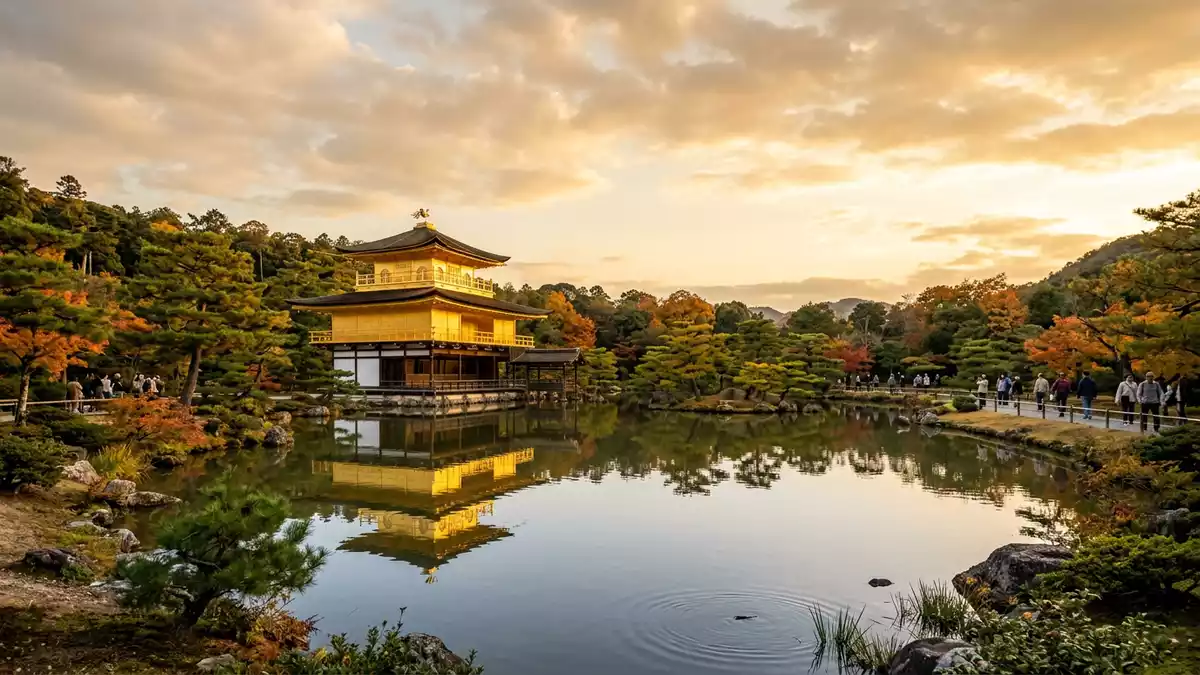
Kinkaku-ji, the “Temple of the Golden Pavilion”, brings together gilded architecture and a carefully composed pond garden in north-western Kyoto. The pavilion’s upper levels, covered in gold leaf, rise above the water while their reflection doubles the building in the surface of the pond, making the relationship between structure and landscape the defining experience of a visit. The temple is officially known as Rokuon-ji, a Rinzai Zen Buddhist temple whose origins go back to the late fourteenth century.
A shogun’s villa turned Zen temple
Kinkaku-ji stands on ground that became closely associated with Ashikaga Yoshimitsu, the third shogun of the Muromachi shogunate, in the late fourteenth century. In 1397 he established a retirement residence here, later known as Kitayama-dono, and the Golden Pavilion formed part of that complex.Ashikaga Yoshimitsu’s residence was converted after his death into a Zen temple of the Rinzai school, and in 1420 the complex took the temple name Rokuon-ji.The renaming to Rokuon-ji in 1420 marked the shift from shogunal villa to religious site.
The temple belongs to the Shokoku-ji branch of the Rinzai sect, one of the major Zen lineages in Kyoto.Rokuon-ji as a branch temple of Shokoku-ji situates Kinkaku-ji within a wider network of Zen monasteries that shaped Kyoto’s cultural landscape during the Muromachi period. The Golden Pavilion itself has given the temple its better-known popular name, but the broader precinct contains halls, sub-temples and gardens that reflect the evolution of Kitayama culture, the aesthetic linked with Yoshimitsu’s era.
The Golden Pavilion and its layered architecture
The Golden Pavilion at Kinkaku-ji is a three-storey structure beside the main pond, and each of its levels follows a different traditional Japanese architectural style.The ground floor adopts the shinden style associated with aristocratic residences of the Heian period, the second level reflects the buke style of warrior dwellings from the Kamakura period, and the top level follows the zenshu-butsuden style of Chinese-influenced Zen temple halls.The pavilion’s three stylistic levels turn the building into a compact survey of Japanese elite architecture.
The pavilion’s upper storeys are clad in gold leaf, contrasting with the plain walls of the ground floor and with the surrounding greenery and water.The top two floors are covered in gold leaf, and the building is topped by a phoenix ornament, a motif long associated with power and protection.The Golden Pavilion as the temple’s focal building draws the eye from almost every point on the main garden path, but the water and carefully placed rocks ensure that the landscape remains as important as the gilded structure.
A pond, paths and framed views
Kinkaku-ji’s garden centres on a broad pond, with the Golden Pavilion set against one edge and small islands placed to create layered compositions between water, foliage and built forms.The temple’s main pond garden belongs to the tradition of strolling gardens in which visitors move along a path that reveals successive views. The reflection of the gilded pavilion in the pond is one of the most recognisable images of Kyoto, and the pairing of building and mirror-image changes subtly with viewpoint and season.
The visitor route through Kinkaku-ji leads past the main pond viewpoint and then ascends through a series of smaller garden spaces, including a teahouse known as Sekkatei and secondary ponds with statues and stone basins.The garden path and teahouse Sekkatei are laid out so that the pavilion is seen from different angles and distances, sometimes framed by trees, sometimes rising above foreground rocks. This combination of movement, shifting views and reflection makes the garden as central to the experience as the architecture itself.
Visiting Kinkaku-ji: what travellers from Western Europe should know
- Kinkaku-ji is located in the Kita ward of Kyoto, in the city’s north-west, with the official address at Kinkakuji-cho in Kita-ku.
- The visit follows a fixed garden path with some gentle gradients and flights of steps, including sections on compacted earth and stone that call for steady footwear.
- The temple lies in a built-up but greener part of Kyoto; nearby sights include Kitano Tenmangu Shrine and other smaller shrines that can be combined with a visit.
- The official language is Japanese and the currency is the yen.
- Entry requirements depend on your nationality; UK travellers can check the FCDO travel advice at gov.uk/foreign-travel-advice, Irish travellers the Department of Foreign Affairs at ireland.ie.
Searching for Kinkaku-ji on social platforms
These links open searches for Kinkaku-ji on each platform.
Frequently asked questions about Kinkaku-ji
Where is Kinkaku-ji and what kind of temple is it?
Kinkaku-ji is a Rinzai Zen Buddhist temple known officially as Rokuon-ji in the Kita ward of Kyoto in Japan’s Kansai region.
What can visitors expect when walking through Kinkaku-ji?
Visitors follow a garden path around a large pond, seeing the Golden Pavilion from several viewpoints and passing smaller garden features, statues and a teahouse.
What makes Kinkaku-ji distinctive among Kyoto’s temples?
The combination of a gold-clad pavilion, layered traditional architectural styles and a reflective pond garden gives Kinkaku-ji a visual character closely tied to Kitayama culture.


