

Knossos: walking through a Minoan labyrinth of stone
Published on 08/16/2026 at 13:24 | Editorial responsibility: Rafael Müller, Editor-in-Chief AD HOC NEWS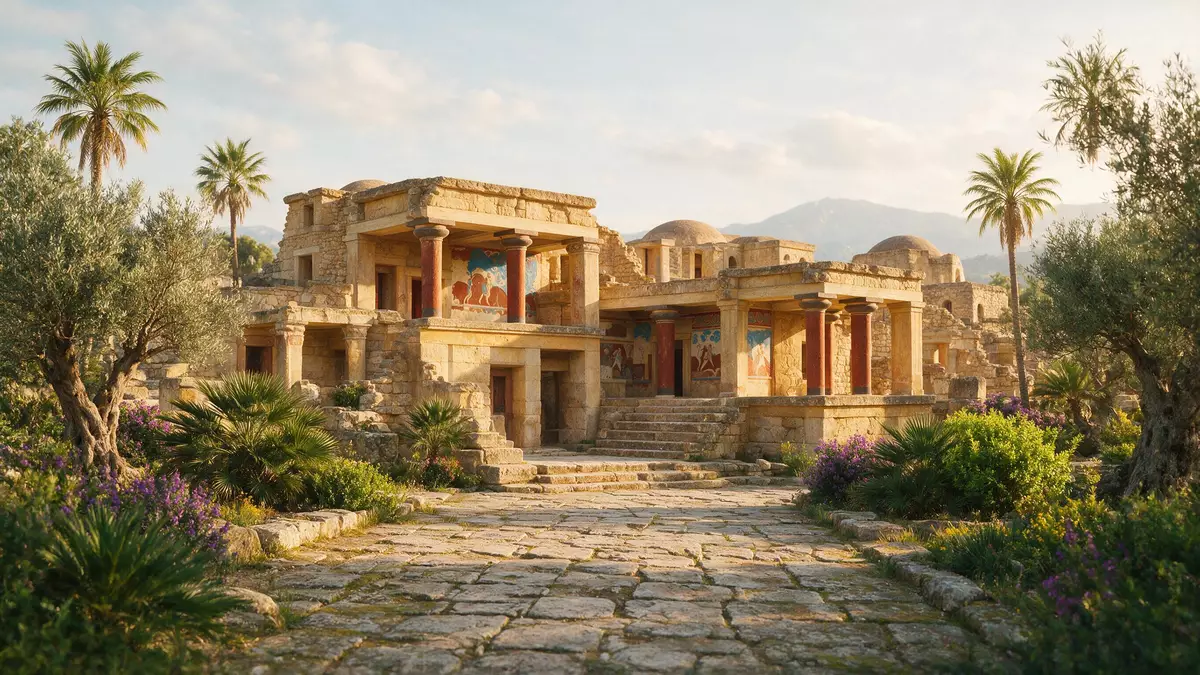
Knossos near Heraklion on Crete is the best-known palace centre of the Bronze Age Minoan civilisation, where a sprawling complex of courts, rooms and stairways still maps out a stone labyrinth on the hillside south of the city.
The Minoan palace at Knossos
The archaeological site of Knossos preserves the largest of the Minoan palatial centres on Crete, arranged around a broad central courtyard with wings of rooms extending to each side.largest of the preserved Minoan palatial centres Excavations have revealed royal quarters, shrines, workshops, storerooms and reception halls grouped within this plan, forming what has often been described as Europe’s first substantial palace in stone.Europe's first palace
The palace complex belongs to the Bronze Age, with its main phases between about 2000 and 1350 BCE, a period when Minoan society flourished in the eastern Mediterranean.dated to 2000–1350 BCE Archaeological evidence points to an earlier palace rising around 1900 BCE and a grander reconstruction after an earthquake around 1700 BCE, with the later palace’s heyday between roughly 1700 and 1450 BCE.first great palace rose around 1900 BCE The site stands at the heart of Minoan cultural identity, and mythology later linked it to King Minos and the famous labyrinth.
Courtyards, rooms and architectural details
Walking through Knossos today, the central courtyard acts as the organising space, with ranges of rooms on each side creating a dense pattern of corridors and staircases.central court flanked by four wings Archaeologists have identified throne rooms, banquet halls and areas with long rows of storage jars, indicating the role of the palace as a hub of ritual, residence and storage. Light wells and staircases show how multi-storey construction was managed, using stone masonry combined with rubble, plaster and timber framing.stone masonry, rubble, plaster and wood
The palace area covers many thousands of square metres and contains a large number of rooms, making it one of the most elaborate architectural complexes of Bronze Age Crete.palace area figure Distinctive pillars and columns with plastered surfaces once carried vibrant painted decoration, and reconstructed sections with red columns and fresco copies give a sense of the colour that would have marked doorways and halls during the height of Minoan power.fresco murals and Minoan columns
From Neolithic settlement to Roman capture
The hill beneath the palace of Knossos carries traces of habitation reaching back to the Neolithic period, with continuous use of the site between around 7000 and 3000 BCE.continuous habitation from the Neolithic During the nineteenth to seventeenth centuries BCE the first palace phase took shape, with luxurious houses and other buildings joining the core complex and forming a dense settlement around it.first and second palaces
After the middle of the second millennium BCE, Mycenaean groups from the Greek mainland settled at Knossos, and the city later experienced renewed activity in the Hellenistic period with sanctuaries and cemeteries spreading across the landscape.Mycenaean settlement and Hellenistic period In 67 BCE the Roman commander Quintus Caecilius Metellus captured Knossos, bringing the long independent history of this Cretan centre into the orbit of Roman provincial rule.captured by Quintus Caecilius Metelus Creticus Modern archaeological exploration began in the late nineteenth century with Minos Kalokairinos and continued on a large scale from 1900 under Sir Arthur Evans, whose long campaigns exposed the palace and much of its surrounding town.excavations under Sir Arthur Evans
Visiting Knossos: what travellers from Western Europe should know
- Knossos lies south of Heraklion on Crete and is reached by road from the city; local buses run from the main terminal area towards the archaeological site under the name Knossos.
- The palace complex stands on a low hill with uneven surfaces, stepped passages and stairways, so walking around the site involves frequent changes of level on stone and packed earth.
- The wider landscape around Knossos includes olive groves and vineyards, and the archaeological area extends beyond the palace into surrounding slopes with remains of houses and cemeteries.
- Greek is the official language and the currency is the euro.
Searching for Knossos on social platforms
These links open searches for Knossos on each platform.Frequently asked questions about Knossos
Where is Knossos and what kind of place is it?
Knossos is an archaeological site south of Heraklion on the island of Crete in Greece, centred on a Bronze Age palace complex associated with the Minoan civilisation.
What can visitors expect to see at Knossos?
Visitors walk through the remains of a multi-winged palace around a central courtyard, with stairways, storerooms, reconstructed columns and frescoed areas illustrating Minoan architectural and artistic style.
What makes Knossos distinctive among ancient sites?
Knossos combines deep Neolithic roots, a major Bronze Age palace in stone and later Greek and Roman phases, all connected to the enduring myth of King Minos and the labyrinth.


