
Kolner Dom and the soaring stone nave of Köln
Published on 08/18/2026 at 14:35 | Editorial responsibility: Rafael Müller, Editor-in-Chief AD HOC NEWS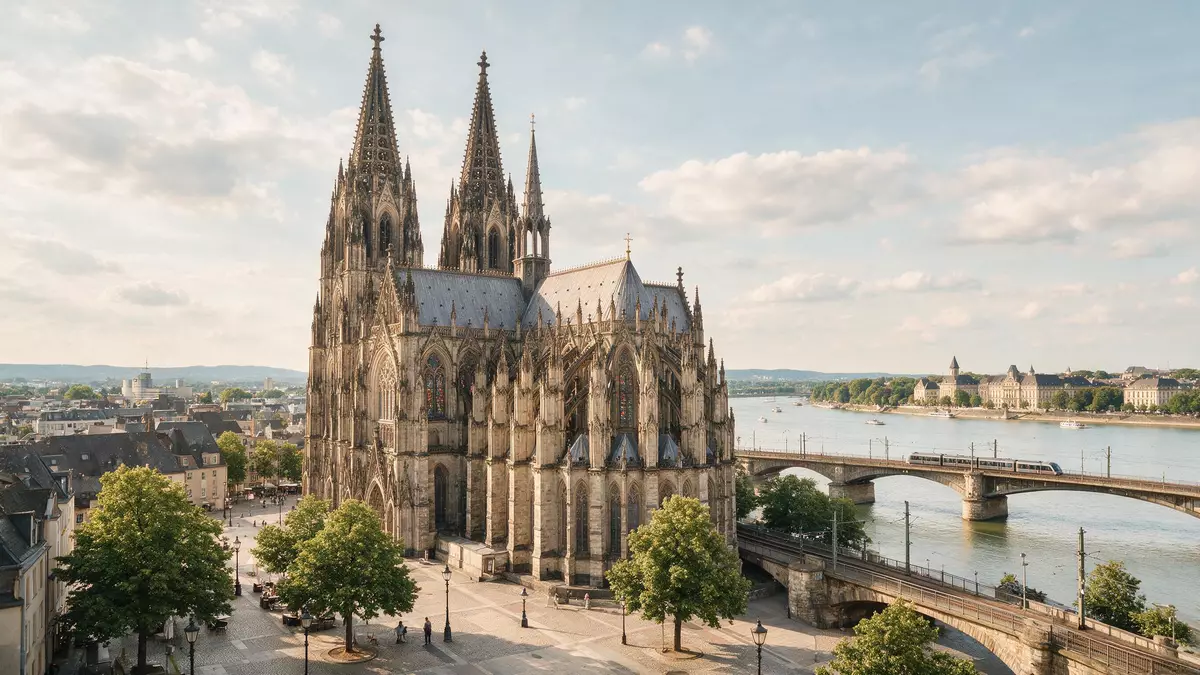
Kolner Dom, known in English as Cologne Cathedral, dominates the skyline of Köln with its soaring stone nave and twin towers shaped by centuries of High Gothic ambition. Begun in the thirteenth century and completed in 1880, it stands as a Roman Catholic cathedral dedicated to St Peter and the Virgin Mary and forms part of Germany’s UNESCO World Heritage list.
A High Gothic cathedral in stone and glass
Kolner Dom is a High Gothic five-aisled basilica, its long nave and projecting transept forming a Latin cross ground plan that stretches across the centre of Köln.
The building measures about 144.5 m (474 ft) in length, with the transept spanning roughly 86 m (282 ft) across, creating a vast interior volume framed by clustered stone piers and pointed vaults that rise to around 43 m (141 ft) above the floor.High Gothic five-aisled basilica The cathedral’s western front carries two stone towers that reach close to 157 m (515 ft), placing Kolner Dom among the tallest church structures built in the nineteenth century.twin towers that stand 515 feet
Much of the external surface is articulated with traceried windows, flying buttresses and pinnacles, so that the façade reads as a dense lattice of stonework rather than a flat wall.facade area 7,000 square meters Inside, light filters through extensive stained-glass windows that together cover around 10,000 square metres, bringing bands of colour into the aisles and choir even on an overcast day.stained glass 10,000 square meters
Centuries of construction and completion in 1880
The foundation stone of Kolner Dom was laid in 1248 under Archbishop Konrad von Hochstaden, and the first master mason recorded for the project is Gerhard von Rile.foundation stone on August 15, 1248 Work on the eastern arm progressed rapidly enough that the choir was consecrated in 1322, setting a model of French-inspired High Gothic architecture that later builders followed with notable consistency.choir was consecrated in 1322
Construction slowed in the sixteenth century and was effectively halted around 1560, leaving the medieval fabric incomplete for generations, with cranes and unfinished masonry forming part of the city’s profile.building period 1248-1880 Work resumed in 1842 under the Prussian administration, and the cathedral was completed according to the medieval plan in 1880, bringing a 632-year building process to its formal conclusion.completed October 15, 1880
A World Heritage landmark in the centre of Köln
Kolner Dom stands beside the main railway station of Köln, close to the Rhine, so that the towers rise directly above trains and bridges that bring travellers into the city.
The cathedral was inscribed as a UNESCO World Heritage Site in 1996, recognition that underlines its role as one of the most complete expressions of High Gothic architecture in northern Europe.declared a World Heritage Site in 1996 Within the interior, the Shrine of the Three Kings forms a focal point behind the high altar, a large gilded reliquary associated with the biblical Magi and linked in tradition to medieval royal pilgrimage.Shrine of the Three Kings
The building’s sheer volume, vault height and the density of its sculptural detail create a consistent architectural language from the west front through the nave to the choir, so that a visitor walking from the entrance to the east end experiences a single continuous Gothic space rather than a patchwork of styles. Stone surfaces bear traces of weathering and restoration side by side, giving the exterior a range of tones from darkened original blocks to lighter replacement pieces that gradually blend into the whole.
Visiting Kolner Dom: what travellers from Western Europe should know
- Kolner Dom stands in central Köln beside the city’s main railway station, and regional and long-distance trains stop within a short walk of the cathedral square.
- The interior rises to more than 40 m (131 ft), and visitors who climb the tower follow a narrow spiral staircase with a sustained sequence of steps and limited passing space.
- The cathedral square opens towards the Rhine, and stone paving around the building can be uneven in places, particularly near the buttresses and steps leading to side entrances.
- Köln lies in western Germany on the River Rhine, and German is the official language while the currency is the euro.
- Entry requirements depend on your nationality; UK travellers can check the FCDO travel advice at gov.uk/foreign-travel-advice, Irish travellers the Department of Foreign Affairs at ireland.ie.
Searching for Kolner Dom on social platforms
These links open searches for Kolner Dom on each platform.
Frequently asked questions about Kolner Dom
Where is Kolner Dom located?
Kolner Dom stands in the centre of Köln in western Germany, beside the city’s main railway station and close to the River Rhine.
What should a visitor expect inside Kolner Dom?
Visitors encounter a tall Gothic nave with clustered stone columns, extensive stained glass and a long processional route leading towards the choir and the Shrine of the Three Kings.
What makes Kolner Dom distinctive among European cathedrals?
Kolner Dom combines a thirteenth-century High Gothic design with nineteenth-century completion, creating a single, consistent stone and glass interior beneath twin towers rising to around 157 m (515 ft).


