
Kronborg Slot and its Renaissance walls at Helsingör
Published on 09/23/2026 at 08:03 | Editorial responsibility: Rafael Müller, Editor-in-Chief AD HOC NEWS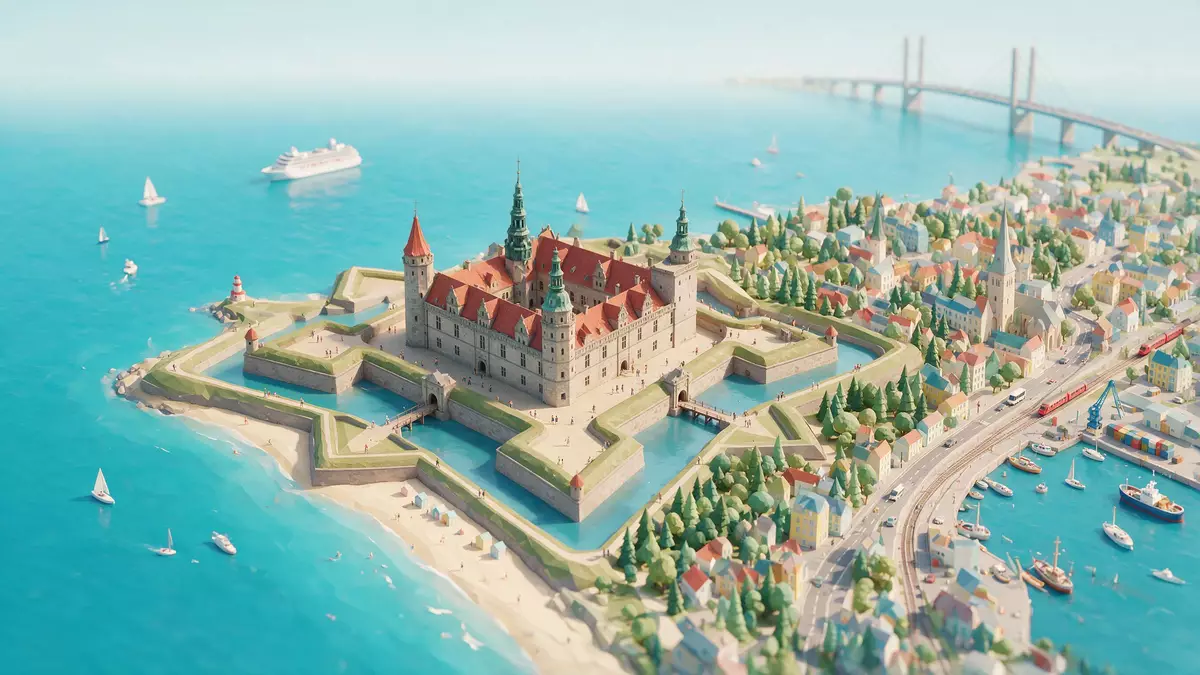
Kronborg Slot stands at Helsingör beside the narrow Øresund, where Denmark faces Sweden across the water. Its visible character comes from a rare combination: a Renaissance royal castle enclosed by ramparts, bastions and maritime views. Frederik II began the present castle in 1574, and its connection with Shakespeare’s Elsinore gives the fortress a second life in literature.
Kronborg Slot between palace and fortress
The castle presents a formal Renaissance façade above a military landscape of earthworks, angular bastions and broad defensive spaces. Four wings surround a courtyard, while bright sandstone details, copper roofs, towers and spires give the complex a palace-like appearance.
That contrast continues inside. Kronborg Slot contains royal rooms, a chapel, a great hall and areas associated with the fortress. The Chapel retains carved woodwork, painted panels, an altar and a gallery connected with the castle’s earlier interiors. The Great Hall was the banqueting room and remains one of the defining spaces of the complex.
Construction of the present castle continued from 1574 to 1585 under Frederik II. The work replaced the medieval fortress Krogen associated with Eric of Pomerania, whose stronghold occupied the site in the early fifteenth century. UNESCO’s Kronborg description identifies the building as an outstanding Renaissance castle with an important military setting.
The Øresund, tolls and royal power
Kronborg Slot faces the Sound at the entrance to the Baltic Sea. The strait narrows between Denmark and Sweden near Helsingör, placing the castle beside an important maritime passage.
From 1429 to 1857, ships passing through the Sound paid the Sound toll. Kronborg therefore belonged to a system of royal administration, naval power and international trade. Its position is visible in the fortress itself, where defensive walls and open ground accompany the royal architecture.
Fire and warfare changed the castle’s interiors without erasing its Renaissance identity. A major fire damaged Kronborg in 1629, after which Christian IV ordered reconstruction. Swedish forces occupied and plundered the fortress in 1658, and Denmark regained it in 1660. The castle’s surviving form combines Renaissance design with the marks of a long military history.
The fortifications include ramparts and bastions around the central castle. Their angular geometry belongs to the development of early modern military architecture, while the palace façades retain sandstone ornament and carefully ordered bands. Kronborg’s historical outline records the castle’s construction, fire, occupation and role in collecting the Sound toll.
Hamlet’s Elsinore in Helsingör
Kronborg Slot is the castle associated with Elsinore in William Shakespeare’s Hamlet. Shakespeare placed the tragedy at a Danish court, and the name Elsinore became inseparable from the castle in literary culture.
The link is not a reconstruction of Shakespeare’s stage setting. It is a meeting between a real fortified palace and an imagined royal household of drama, suspicion and political tension. At Kronborg, the courtyards, halls, chapel and ramparts provide the physical setting behind the name.
The literary connection has shaped the way the castle is understood beyond Denmark. Hamlet gives Kronborg a place in theatre history, while the building itself supplies the architectural and historical setting. The result is a landmark read through both material remains and a work of English literature.
Kronborg Slot entered the UNESCO World Heritage List in 2000. The designation recognises its Renaissance architecture, its strategic position on the Øresund and its role in northern European history from the sixteenth to the eighteenth centuries. Kronborg’s heritage setting connects the castle with Helsingör, the Sound toll and the literary identity of Hamlet.
Visiting Kronborg Slot: what travellers from Western Europe should know
- Kronborg Slot is in Helsingör on the north-east coast of Zealand, beside the Øresund. The Coastal Railway, Kystbanen, connects Copenhagen Central Station with Helsingör Station.
- From Helsingör Station, the approach follows the harbour towards the castle. The route leads through the town and past the waterfront before reaching the fortified area.
- The visit includes open ramparts, earthworks, courtyards, staircases and historic rooms. Uneven surfaces and changes between outdoor and indoor areas are part of the site.
- The official language is Danish and the currency is the Danish krone.
Searching for Kronborg Slot on social platforms
These links open searches for Kronborg Slot on each platform.
Frequently asked questions about Kronborg Slot
Where is Kronborg Slot?
Kronborg Slot is in Helsingör on Zealand, Denmark, beside the Øresund between Denmark and Sweden. Helsingör Station connects with the castle through the harbour area.
What can visitors see at Kronborg Slot?
The complex includes Renaissance rooms, a chapel, a great hall, courtyards, ramparts, bastions and earthworks. The route combines palace interiors with the visible form of a historic fortress.
Why is Kronborg Slot distinctive?
Its identity joins a Renaissance royal castle, a fortified maritime position, the Sound toll and Shakespeare’s Elsinore. Kronborg also belongs to the UNESCO World Heritage List, with its inscription dating from 2000.


