
Lagoa das Sete Cidades and the twin lakes in a volcanic crater
Published on 08/28/2026 at 12:13 | Editorial responsibility: Rafael Müller, Editor-in-Chief AD HOC NEWS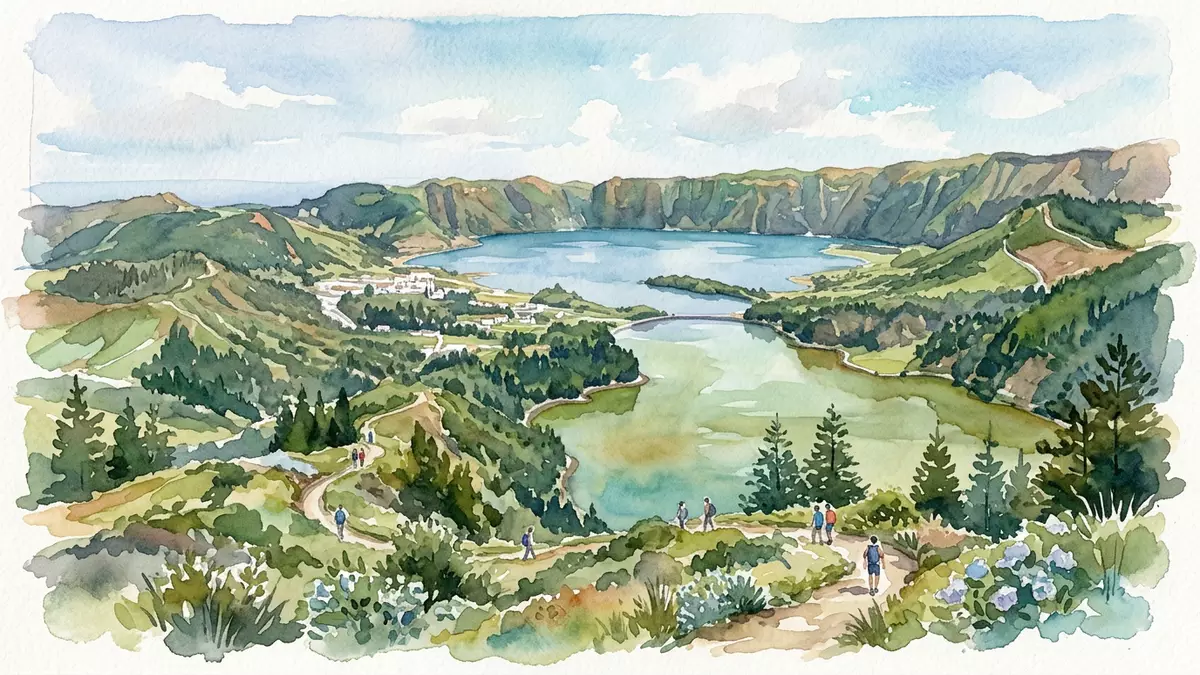
Lagoa das Sete Cidades on São Miguel in Portugal is a twin-coloured crater lake filling much of a broad volcanic basin west of Ponta Delgada. Set within the caldera of the Sete Cidades volcano, it forms the largest natural freshwater lake in the Azores and anchors a landscape where steep crater walls, water and pasture meet in a single amphitheatre.
A twin lake on the floor of a vast caldera
The defining feature of Lagoa das Sete Cidades is its twin character: one continuous freshwater lake that is widely described as two adjoining bodies of water named Lagoa Azul and Lagoa Verde. Both parts occupy the floor of the Sete Cidades caldera, a nearly circular volcanic depression several kilometres across with crater walls rising hundreds of metres above the basin.Sete Cidades caldera At the narrowest point between the blue and green stretches, a low bridge carries the road across the lake, making the division between the two arms particularly legible from the shore and from viewpoints on the rim.twin lake system
In area and depth, Lagoa das Sete Cidades ranks as the largest natural surface freshwater reservoir in the Azores, extending over more than 4 km² and reaching about 33 m at its deepest soundings.largest freshwater lake The lake occupies much of the caldera floor and is surrounded by meadows, patches of forest and the built fabric of the village of Sete Cidades, which lies near the water’s edge on the northern side. Away from the main twin lake, smaller crater lakes such as Lagoa de Santiago and Lagoa Rasa sit in their own enclosed depressions inside the wider volcanic structure, adding further pockets of water to the basin.additional crater lakes
A volcanic landscape shaped over geological time
Lagoa das Sete Cidades owes its setting to the long geological history of the Sete Cidades volcanic complex on the western side of São Miguel. Geologists describe this complex as a central volcano with a collapse caldera that has been building and reshaping itself for more than 200,000 years, through sequences of eruptions that emptied magma chambers and allowed the summit area to subside.central volcano description The caldera itself measures around 5 km in diameter, with walls that rise to heights of several hundred metres, framing the twin lake and surrounding pastures in a broad, sheltered basin.average caldera diameter
Within this depression, later volcanic activity produced smaller craters, domes and maars, which now host secondary lakes and pockets of wetland, making Sete Cidades part of a wider protected area recognised under several environmental designations. The crater system and its main lake form a Ramsar Site under the Convention on Wetlands and belong to the Azores UNESCO Global Geopark, reflecting both the geological value of the caldera and the ecological importance of its water bodies.Ramsar and Geopark status The basin’s slopes, with their mix of pasture, woodland and volcanic outcrops, show how human uses and natural processes are layered within a single volcanic landform.protected landscape area
Views, shorelines and the village of Sete Cidades
For visitors, Lagoa das Sete Cidades presents two distinct scales of experience: wide, panoramic views from the caldera rim and close, shore-level encounters with the lake and the village. On the rim, viewpoints such as Miradouro da Vista do Rei look across the basin, capturing the contrast between the blue and green arms of the lake, the surrounding crater walls and the patchwork of fields on the floor.panoramic viewpoints From these heights, the twin-coloured water and the geometry of the volcanic crater are immediately legible, with the low bridge and strip of land between Lagoa Azul and Lagoa Verde clearly visible.
Down at lake level, roads run close to the shore, passing between water, pasture and the small settlement of Sete Cidades. The village church, modest houses and agricultural buildings sit within sight of the lake, showing how the basin functions not only as a geological site but also as a lived landscape. The shorelines vary between gently sloping banks, narrow strips of grass and areas where vegetation reaches the water’s edge, giving a mix of open and enclosed views along the circuit of the lake.Sete Cidades village setting Away from the twin lake, paths and minor roads reach smaller crater lakes and viewpoints, where the relationship between water, volcanic hollows and surrounding ridges can be read at closer range.
Visiting Lagoa das Sete Cidades: what travellers from Western Europe should know
- Lagoa das Sete Cidades lies on the western side of São Miguel in Portugal, within the municipality of Ponta Delgada; roads signed to Sete Cidades lead from the island’s main coastal routes.
- The terrain around the lake combines steep crater walls and gentler slopes; approaches to rim viewpoints involve driving or walking on winding roads with noticeable gradients.
- Near the shore, tracks and minor roads run close to the water and through the village of Sete Cidades, with short stretches on foot giving access to viewpoints and lakeside areas.
- The official language is Portuguese and the currency is the euro.
Searching for Lagoa das Sete Cidades on social platforms
These links open searches for Lagoa das Sete Cidades on each platform.Frequently asked questions about Lagoa das Sete Cidades
Where is Lagoa das Sete Cidades located?
Lagoa das Sete Cidades lies on the western third of São Miguel island in Portugal, within the municipality of Ponta Delgada in the Azores archipelago.
What should visitors expect when they arrive?
Visitors encounter a large twin-coloured lake set in a broad volcanic basin, with steep crater walls, shore roads, pasture and the village of Sete Cidades around the water.
What makes Lagoa das Sete Cidades distinctive?
The lake is distinctive for its blue and green arms forming a single freshwater body within a 5 km-wide volcanic caldera, recognised as the largest natural lake in the Azores.


