
Lake Nakuru National Park and its flamingo lake landscapes
Published on 09/02/2026 at 15:50 | Editorial responsibility: Rafael Müller, Editor-in-Chief AD HOC NEWS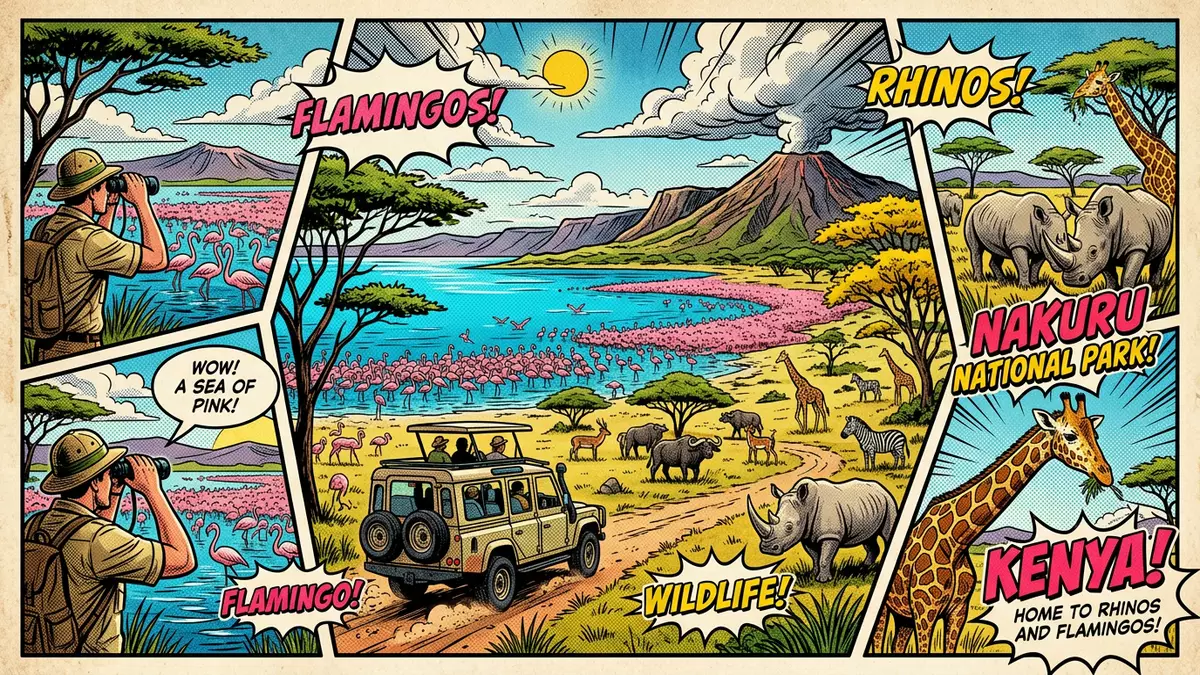
Lake Nakuru National Park in Kenya’s Rift Valley wraps an alkaline lake, wooded escarpments and a fenced wildlife sanctuary into a compact landscape just south of Nakuru town. The park was established in 1961 around Lake Nakuru itself, giving formal protection to a shallow soda lake and the surrounding grasslands and acacia woodland.
An alkaline lake framed by the Great Rift Valley
Lake Nakuru National Park is set within the floor and lower slopes of the Great Rift Valley, where tectonic forces created a chain of lakes and escarpments running through central Kenya.Great Rift Valley location The park encloses Lake Nakuru, a shallow, strongly alkaline water body surrounded by open grassland and patches of woodland.very shallow, strongly alkaline lake The lake’s chemistry supports blue?green algae and invertebrates, creating food for specialised waterbirds.
The protected area covers around 188 square kilometres (73 square miles), making it smaller than many of Kenya’s savannah reserves yet dense with contrasting habitats.188 square kilometres Elevations in the park rise from roughly 1,750 m (5,741 ft) around the lakeshore to higher ground on surrounding ridges, so game drives move between flats near the water and viewpoints on rocky slopes.elevation range
Flamingos, rhinos and rich birdlife
Lake Nakuru has long been associated with vast congregations of lesser and greater flamingos feeding in the shallows, creating a pink band along parts of the shoreline when conditions favour algae growth.flamingo congregations The alkaline water also attracts pelicans, cormorants and a wide range of other waterbirds, contributing to a bird list that runs into several hundred species.over 450 bird species
Grasslands and acacia woodland beyond the lakeshore host large mammals, including buffalo, Rothschild’s giraffes, various antelope and predators such as lion and leopard.mammal communities Lake Nakuru National Park is notable as a fenced sanctuary for both black rhinos and white rhinos, with protective measures in place around the entire park to secure these endangered species.fully fenced rhino sanctuary The combination of rhino sightings, giraffes moving among the trees and birdlife at the water’s edge gives the park a varied wildlife character despite its modest size.
A protected Rift Valley lake system
Officially gazetted as a national park in 1961, Lake Nakuru National Park forms part of a recognised lake system in Kenya’s Rift Valley that has attracted international conservation attention.creation of the park in 1961 The site is identified as a Key Biodiversity Area, reflecting its importance for wetland species and terrestrial wildlife within a relatively small geographic area.Key Biodiversity Area status Lake Nakuru’s alkaline waters, surrounding woodland and grassland together make up a protected mosaic that connects to wider ecological patterns across the Rift Valley.
The park lies just south of Nakuru city, one of Kenya’s major urban centres, and is reached by road from Nairobi along the A104 highway before turning towards gates close to the lakeshore.road access via A104 and park gates Its accessibility from the capital and position within a broader chain of valley landscapes make Lake Nakuru National Park a natural stopping point on journeys through central Kenya.
Visiting Lake Nakuru National Park: what travellers from Western Europe should know
- Lake Nakuru National Park lies south of Nakuru in Kenya’s Rift Valley and is reached by road from Nairobi on the A104 highway, with access through gates such as Lanet and the Main Gate.
- Game viewing routes run on unpaved roads near the lakeshore and up escarpment slopes, so travellers move between relatively flat ground and steeper sections with viewpoints over the lake.
- In wet periods, parts of the park’s dirt road network can be muddy, while dry spells leave surfaces dusty; vehicles share space with wildlife and must negotiate occasional gentle gradients.
- Lake Nakuru National Park sits in Kenya, where the official languages are English and Swahili and the currency is the Kenyan shilling.
- Entry requirements depend on your nationality; UK travellers can check the FCDO travel advice at gov.uk/foreign-travel-advice, Irish travellers the Department of Foreign Affairs at ireland.ie.
Searching for Lake Nakuru National Park on social platforms
These links open searches for Lake Nakuru National Park on each platform.Frequently asked questions about Lake Nakuru National Park
Where is Lake Nakuru National Park located?
Lake Nakuru National Park surrounds Lake Nakuru in Kenya’s Great Rift Valley, lying just south of Nakuru city and reached from Nairobi via the A104 highway.
What should visitors expect on a visit to the park?
Visitors encounter a shallow alkaline lake, lakeside grasslands, acacia woodland and rocky slopes, with wildlife ranging from flamingos and pelicans to rhinos, giraffes, buffalo and predators.
What makes Lake Nakuru National Park distinctive among Kenyan parks?
Lake Nakuru National Park is distinctive for combining an alkaline lake famous for flamingos with a fully fenced sanctuary that protects both black rhinos and white rhinos within a relatively compact area.


