
Lake Nakuru National Park’s pink lake and rhino sanctuary
Published on 08/25/2026 at 19:19 | Editorial responsibility: Rafael Müller, Editor-in-Chief AD HOC NEWS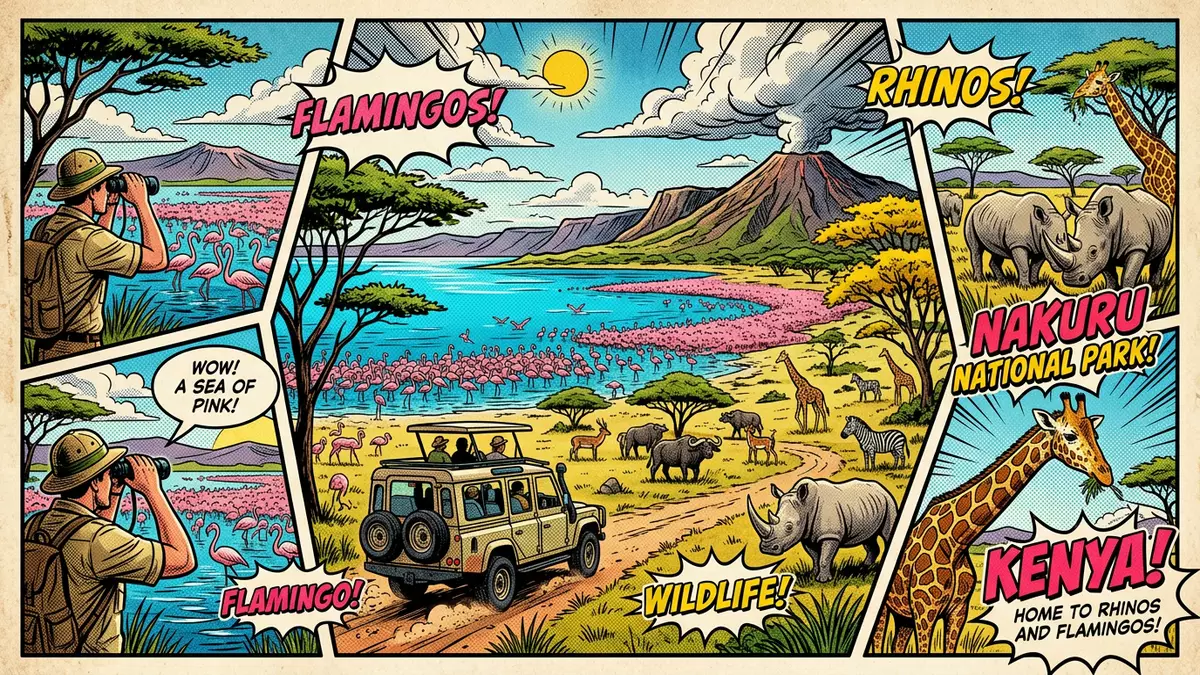
Lake Nakuru National Park in Nakuru brings together an alkaline Rift Valley lake, surrounding wooded hills and a fenced wildlife sanctuary in a compact landscape. Established as a national park in 1961, it later became part of the Kenya Lake System World Heritage Site, alongside lakes Elementaita and Bogoria, recognising its ecological importance and dramatic birdlife.
An alkaline Rift Valley lake framed by escarpments
Lake Nakuru lies within the eastern arm of the East African Rift, filling a shallow basin below steep escarpments and rolling volcanic hills. The lake itself is alkaline, its waters enriched by dissolved minerals that support dense blooms of algae in seasons when levels are stable, creating the conditions that once drew vast concentrations of flamingos to its shoreline.The lake lies in the Rift Valley is one of a chain of basins that stretch across Kenya, and its basin is surrounded by grassland, rocky outcrops and patches of woodland.
The protected area around the lake covers about 188 km² (73 sq mi), rising from the lakeshore to ridges at over 1,700 m (5,600 ft) above sea level, where viewpoints look down over the water, the acacia woodland and the open plains.The national park encompasses about 188 km² is fully enclosed by a fence that separates wildlife from the surrounding farms and the town of Nakuru, so the boundary between park and settlement is clearly marked in the landscape.
A sanctuary for rhinos, giraffes and grazing herds
Lake Nakuru National Park is widely known as a sanctuary for both black and white rhinoceroses, protected within the fenced reserve and monitored closely by Kenya Wildlife Service rangers.The park is managed by Kenya Wildlife Service and has been developed as a stronghold for these heavy browsers and grazers, which move between the open grassland, bushy slopes and the lake’s muddy margins. Rothschild’s giraffes browse among the acacia trees, their pale markings standing out against the dark trunks and the pale grass below.
Out on the plains and along the lakeshore, herds of buffalo, zebras, impalas and waterbucks share the grazing, while predators such as lions, leopards and hyenas patrol the thickets and open ground.The surrounding national park shelters a range of mammals that have adapted to this mosaic of grassland, woodland and wetland. Around the mouth of in-flowing streams and in the deeper channels, hippos spend much of their time in the water, surfacing between stands of reeds and sedges on the lake’s edge.
Flamingos, wetlands and international protection
Lake Nakuru’s alkaline waters have long supported large populations of lesser flamingos, which feed by filtering algae in shallow water near the shore. In seasons when conditions suit them, they gather into dense bands that follow the line of the lake, colouring the shoreline in shades of pink. The lake and its surrounding habitats support hundreds of bird species, from pelicans and cormorants on the open water to fish eagles, herons and waders along the muddy margins and shallows.The site has been recognised as a key wetland for waterbirds across east Africa.
In 1990 Lake Nakuru was designated a Ramsar wetland of international importance, and in 2011 it became part of the Kenya Lake System in the Great Rift Valley World Heritage Site, together with lakes Bogoria and Elementaita.The Ramsar listing covers about 18,800 ha of wetland and associated habitats including sedge swamps, seasonally flooded grasslands and floodplain forests. These overlapping designations underline the lake’s role as habitat for threatened species such as the African black rhinoceros and the common hippopotamus, and as a feeding and resting ground for migratory waterbirds moving along the Rift Valley.
Visiting Lake Nakuru National Park: what travellers from Western Europe should know
- Lake Nakuru National Park lies just south of the town of Nakuru in central Kenya, along the main A104 road between Nairobi and the western highlands. The park is reached by road through designated gates on the edge of the town.
- The park’s terrain combines lakeshore mudflats, open grassland and rocky hills, and some viewpoints are reached by tracks that climb to higher ground above 1,700 m (5,600 ft).
- The official language is English and the currency is the Kenyan shilling.
- Entry requirements depend on your nationality; UK travellers can check the FCDO travel advice at gov.uk/foreign-travel-advice, Irish travellers the Department of Foreign Affairs at ireland.ie.
Searching for Lake Nakuru National Park on social platforms
These links open searches for Lake Nakuru National Park on each platform.
Frequently asked questions about Lake Nakuru National Park
Where is Lake Nakuru National Park?
Lake Nakuru National Park surrounds Lake Nakuru on the floor of the Great Rift Valley, immediately south of Nakuru town in central Kenya.
What can visitors expect on a visit?
Visitors travel through a fenced national park that combines an alkaline lake, open grassland, wooded hills and viewpoints, with chances to see rhinos, giraffes and diverse birdlife.
What makes Lake Nakuru National Park distinctive?
The combination of a soda lake known for flamingos, a rhino sanctuary within a fenced reserve and overlapping Ramsar and World Heritage designations gives Lake Nakuru National Park a particular character among Kenya’s parks.


