
Lalibela and the rock-hewn churches in red volcanic rock
Published on 09/19/2026 at 21:21 | Editorial responsibility: Rafael Müller, Editor-in-Chief AD HOC NEWS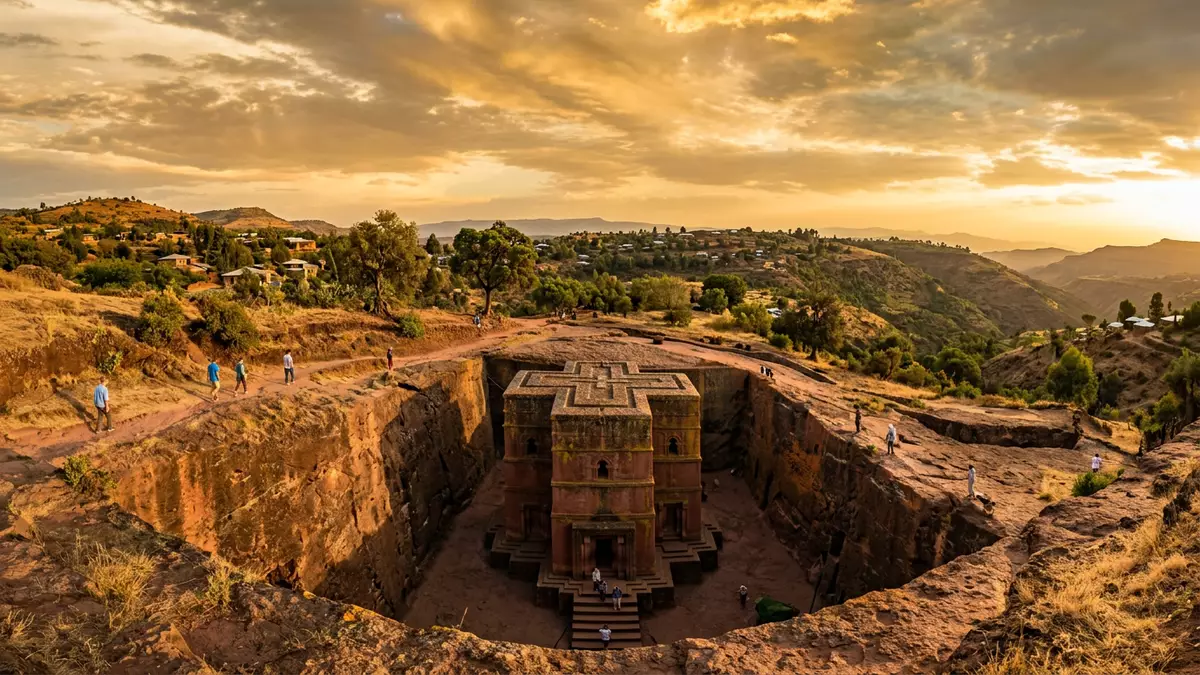
Lalibela in northern Ethiopia is defined by a carved landscape of churches cut directly into red volcanic rock. The best-known ensemble is the Rock-Hewn Churches of Lalibela, a UNESCO World Heritage site inscribed in 1978.
Rock-cut churches beneath ground level
The site contains 11 monolithic churches, hewn from solid rock and arranged in distinct groups. UNESCO inscribed them as a medieval religious landscape rather than as a single monument.
What makes Lalibela immediately legible is its construction from the top down. The churches stand in excavated courtyards, with passages, trenches and cut stairways linking the complex parts.
A town named for King Lalibela
The town took its name from King Lalibela, a ruler of the Zagwe dynasty. Britannica places his reign in the late twelfth and early thirteenth centuries, and describes the churches as the feature for which the place is famous.
The churches are part of a broader Ethiopian Orthodox setting, and Lalibela remains a place of worship as well as heritage. The medieval core is tied to a wider tradition of monolithic church building in Ethiopia, but its scale and arrangement make the town distinctive in visual terms.
Stone, trenches and a divided layout
The churches are not gathered into one uniform block. The Met Museum describes two main clusters separated by a channel known as the River Jordan, with Biete Giyorgis standing apart to the west.
That layout gives the site a clear internal rhythm. Some churches are cut deep into the ground, while others appear as freestanding masses of rock within excavated courts.
Visiting Lalibela: what travellers from Western Europe should know
- Lalibela lies in the Ethiopian highlands, north of Addis Ababa. The churches are reached on foot within the town, and the ground around them is cut by trenches and steps.
- The complex sits in rock rather than on a flat plaza. Approaches involve uneven surfaces, steep drops into the excavated courts and narrow connecting passages.
- The official language is Amharic and the currency is the Ethiopian birr.
- Entry requirements depend on your nationality; UK travellers can check the FCDO travel advice at gov.uk/foreign-travel-advice, Irish travellers the Department of Foreign Affairs at ireland.ie.
Searching for Lalibela on social platforms
These links open searches for Lalibela on each platform.
Frequently asked questions about Lalibela
Where is Lalibela?
Lalibela is a town in the highlands of northern Ethiopia. Its best-known monument is the UNESCO-listed complex of rock-hewn churches.
What does a visit involve?
The churches are spread across excavated courtyards and linked by cut passages, so the terrain is uneven and partly stepped. The place is experienced as a carved religious landscape rather than a single building.
What makes Lalibela distinctive?
The churches are hewn from living rock and arranged as a medieval sacred complex. Their scale, depth and separation into linked groups give the town its strongest visual character.


