
Largo do Senado and Macau’s patterned civic heart
Published on 09/08/2026 at 11:38 | Editorial responsibility: Rafael Müller, Editor-in-Chief AD HOC NEWS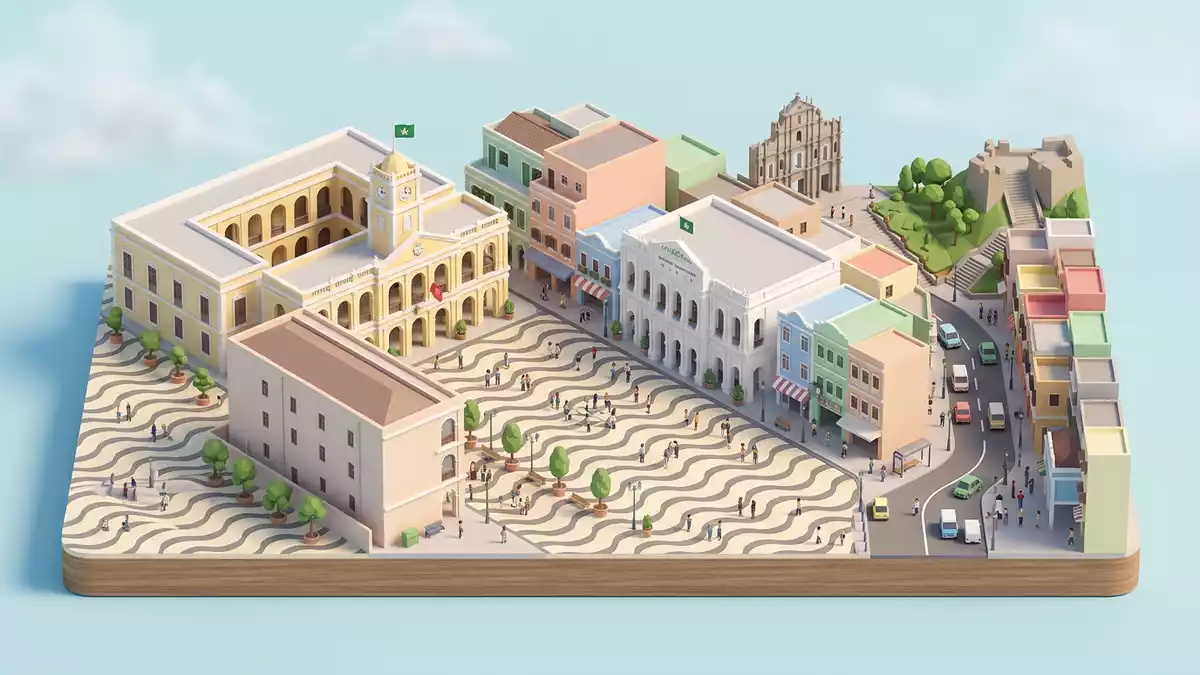
Largo do Senado in Macau is a paved civic square where patterned stone, pastel façades and converging streets form a compact stage for the city’s historic centre. Set on the Macau Peninsula in the Sé parish, the square belongs to the Historic Centre of Macao, which UNESCO inscribed on its World Heritage List in 2005 as a group of streets and plazas reflecting centuries of contact between Portugal and southern China.Historic Centre of Macao
A civic room of stone, façades and converging streets
Largo do Senado is a public square at the centre of the Macau Peninsula, set within the commercial district where several early routes meet. It occupies an elongated triangular site that links Largo do São Domingos at one end with Avenida de Almeida Ribeiro at the other, giving it a distinct perspective across the surrounding streets.central area of Macau Peninsula The square’s ground is laid with Portuguese-style pavement, arranged in undulating bands that create a graphic surface underfoot reminiscent of nineteenth-century Lisbon public spaces.pavement of calçada à portuguesa
The buildings framing Largo do Senado belong largely to the late nineteenth and early twentieth centuries and were finished or remodelled in a coherent architectural language during that period. Their façades show neoclassical influences with arcaded ground floors, regularly spaced windows and simple cornices, painted in soft colours that emphasise the square’s ordered frontage.neoclassical civic buildings Together with the patterned pavement, these façades turn the space into a recognisable civic room, distinct from the denser Chinese streets that feed into it.
From Leal Senado to UNESCO-listed historic centre
The Portuguese name Largo do Senado refers directly to the Leal Senado building, whose history links the square to Macau’s period under Portuguese administration. The Leal Senado was constructed in 1784 as the main seat of the municipal council, which acted as the principal self-governing body of Portuguese Macau.Leal Senado built in 1784 Its presence on one side of the square established the area as a centre of civic power, surrounded by other institutional buildings.
The broader Historic Centre of Macao, of which Largo do Senado forms a part, brings together about twenty buildings and several plazas that record the fusion of European and Chinese urban forms in this port city.Historic Centre of Macau UNESCO listing UNESCO added this ensemble to its World Heritage List in 2005, recognising that the streets and squares around Largo do Senado preserve an extensive group of European-style architecture within Chinese territory.UNESCO inscription in 2005 Within this area, the Leal Senado, the Holy House of Mercy and St Dominic’s Church are notable monuments, each standing close to or directly adjoining the square.
The layered architecture around the square
The façades around Largo do Senado include the Holy House of Mercy, a long-standing charitable institution housed in a building that reflects European civic architecture, and the main post office, which continues the rhythm of arcades and upper-storey windows along the edge of the square.Santa Casa da Misericórdia and post office At the northern end, St Dominic’s Church stands slightly raised above the pavement, drawing the eye along the square’s length towards its entrance.
Many of these surrounding buildings were adapted at the turn of the twentieth century to create a more unified appearance. Their grouped façades show a series of arcades at street level, with upper floors stacked above, forming a continuous frontage along much of the square’s perimeter.arcaded façades around the square The combination of Mediterranean-influenced details and Chinese commercial activity in the adjoining streets makes this area distinctive within Macau’s wider urban pattern.
Visiting Largo do Senado: what travellers from Western Europe should know
- Largo do Senado stands in the Sé parish of Macau, on the Macau Peninsula, reached along Avenida de Almeida Ribeiro and other urban streets that converge on the square.
- The square is laid with patterned stone pavement and surrounded by multi-storey buildings, so visiting involves walking on hard surfaces with changes in level near the church steps and arcaded frontages.
- Within short walking distance of Largo do Senado lie the Leal Senado building, the Holy House of Mercy and St Dominic’s Church, all forming part of the UNESCO-listed Historic Centre of Macao.
- Macau is part of China, and the official languages are Chinese and Portuguese; the currency used locally is the Macanese pataca.
- Entry requirements depend on your nationality; UK travellers can check the FCDO travel advice at gov.uk/foreign-travel-advice, Irish travellers the Department of Foreign Affairs at ireland.ie.
Searching for Largo do Senado on social platforms
These links open searches for Largo do Senado on each platform.
Frequently asked questions about Largo do Senado
Where is Largo do Senado located in Macau?
Largo do Senado is situated in the Sé parish on the Macau Peninsula, within the central commercial area linked to Avenida de Almeida Ribeiro.
What should visitors expect when stepping into the square?
Visitors encounter a paved civic space with wave-patterned Portuguese-style stone, framed by neoclassical façades and leading towards nearby churches and civic buildings.
What makes Largo do Senado distinctive among Macau’s public spaces?
The square’s combination of Portuguese pavement, arcaded pastel façades and its role within the UNESCO-listed Historic Centre of Macao gives it a distinct civic character.


