
Leptis Magna, the Roman city by the Libyan sea
Published on 08/14/2026 at 14:23 | Editorial responsibility: Rafael Müller, Editor-in-Chief AD HOC NEWS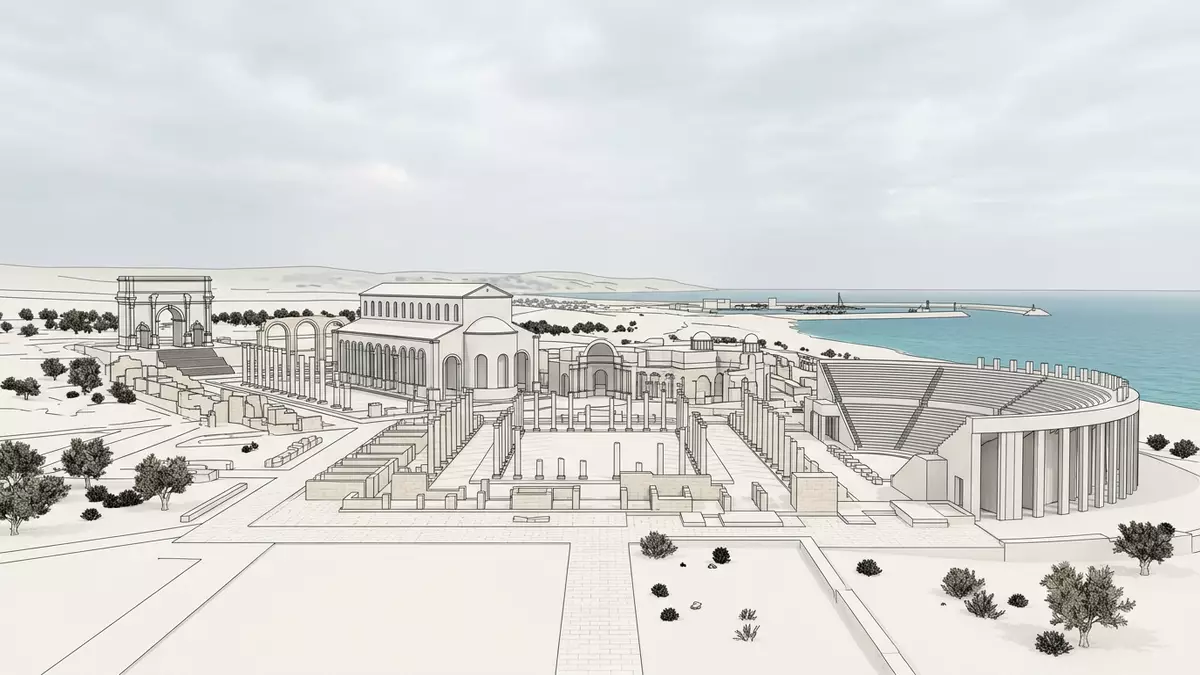
On the Mediterranean coast near Al Khums in Libya, Leptis Magna preserves the stone skeleton of a Roman city laid out on a grand scale in North Africa. Founded as a Phoenician settlement in the seventh century BCE and later absorbed into the Roman world, it became a major centre of Tripolitania and the birthplace of Emperor Septimius Severus in the late second century CE.
A Roman metropolis in Tripolitania
Leptis Magna grew from a Phoenician port into one of the largest cities of the ancient region of Tripolitania along Libya’s central coast.largest city of Tripolitania Its position near the mouth of the Wadi Lebda brought sea access and inland connections, anchoring the settlement between the desert hinterland and the Mediterranean.mouth of the Wadi Lebda
The city originated as a foundation of Tyre in the seventh century BCE, part of a wider Phoenician trading network along the African coast.Phoenician city founded by Tyre Under Carthaginian and then Roman rule, Leptis Magna developed an urban plan with a theatre, forum, markets, baths and harbour installations that reflected its status and wealth.Phoenician port integrated into Rome In 193 CE, Septimius Severus, born in the city, became emperor and reshaped his home with new monuments that still form much of what is visible on site.
Monuments of the Severan city
Many of the most striking remains at Leptis Magna belong to the Severan period, when Septimius Severus enlarged and embellished the city with new public buildings.enlarged and embellished by Septimius Severus The Severan Forum and basilica stand out as a broad ensemble of colonnades and administrative halls, laid out to project Roman civic order towards the sea. At one end of the urban core, the Augustan theatre established earlier in the city’s history anchors a terraced cultural quarter, with the seating cut into the slope above the shore.Augustan theatre and basilica
Close by, the amphitheatre survives as a hollowed-out ellipse in the ground, its tiers once holding crowds for spectacles and contests recorded in Roman North Africa.amphitheatre and racecourse Along the main street, markets and a palaestra lead towards the Hadrianic Baths, a large bath complex whose walls and floors were later clad in marble under Severus.Hadrianic great baths The Arch of Septimius Severus marks a key crossroads, combining carved reliefs with the traffic of what was once a busy Roman city. Together these structures give a continuous streetscape in stone, from entertainment and bathing to trade and administration.
UNESCO recognition and coastal setting
The Archaeological Site of Leptis Magna is inscribed as a cultural World Heritage Site on the UNESCO List, with criteria (i), (ii) and (iii) recognising its value as a masterpiece of urban planning and a testimony to Mediterranean cultural exchange.UNESCO cultural criteria i, ii, iii The inscription dates from 1982 and covers an area of nearly 400 hectares, encompassing the main city grid, harbour works and outlying monuments.World Heritage identification number 183
Leptis Magna lies on the Mediterranean coast east of Tripoli, close to the modern city of Al Khums, with the ruins positioned slightly inland from the shoreline but still within sight of the sea.east of Tripoli on the coast Sand and coastal vegetation frame the streets, and the remains of harbour structures mark where ships once docked. Archaeological work from the early twentieth century onwards, including Italian excavations, has revealed much of the main city plan, bringing to light the theatre, amphitheatre, baths, forum and Severan basilica as a connected ensemble.Italian archaeologists uncovered main buildings
Visiting Leptis Magna: what travellers from Western Europe should know
- Leptis Magna stands near Al Khums on Libya’s central Mediterranean coast, east of Tripoli, reached by road connections from the capital and other cities along the shoreline.
- The archaeological site extends over a broad area with stone-paved streets, uneven ground and substantial ruins; exploring the main monuments involves walking across exposed terrain with steps and ancient surfaces.
- In summer, daytime temperatures on the Libyan coast can be high, and the open nature of the site means limited shade between structures.
- The official language is Arabic and the currency is the Libyan dinar.
- Entry requirements depend on your nationality; UK travellers can check the FCDO travel advice at gov.uk/foreign-travel-advice, Irish travellers the Department of Foreign Affairs at ireland.ie.
Searching for Leptis Magna on social platforms
These links open searches for Leptis Magna on each platform.
Frequently asked questions about Leptis Magna
Where is Leptis Magna located?
Leptis Magna lies on the Mediterranean coast of Libya near Al Khums, east of Tripoli, close to the mouth of the Wadi Lebda.
What can visitors expect at Leptis Magna?
Visitors encounter extensive Roman ruins including a theatre, amphitheatre, Severan Forum and basilica, markets, baths and harbour remains spread across a wide coastal site.
What makes Leptis Magna distinctive among Roman sites?
Leptis Magna preserves a large, coherent Roman city plan in North Africa and holds UNESCO recognition for its architecture and urban layout.


