
Liberty Bell and its cracked bronze presence in Philadelphia
Published on 08/16/2026 at 15:00 | Editorial responsibility: Rafael Müller, Editor-in-Chief AD HOC NEWS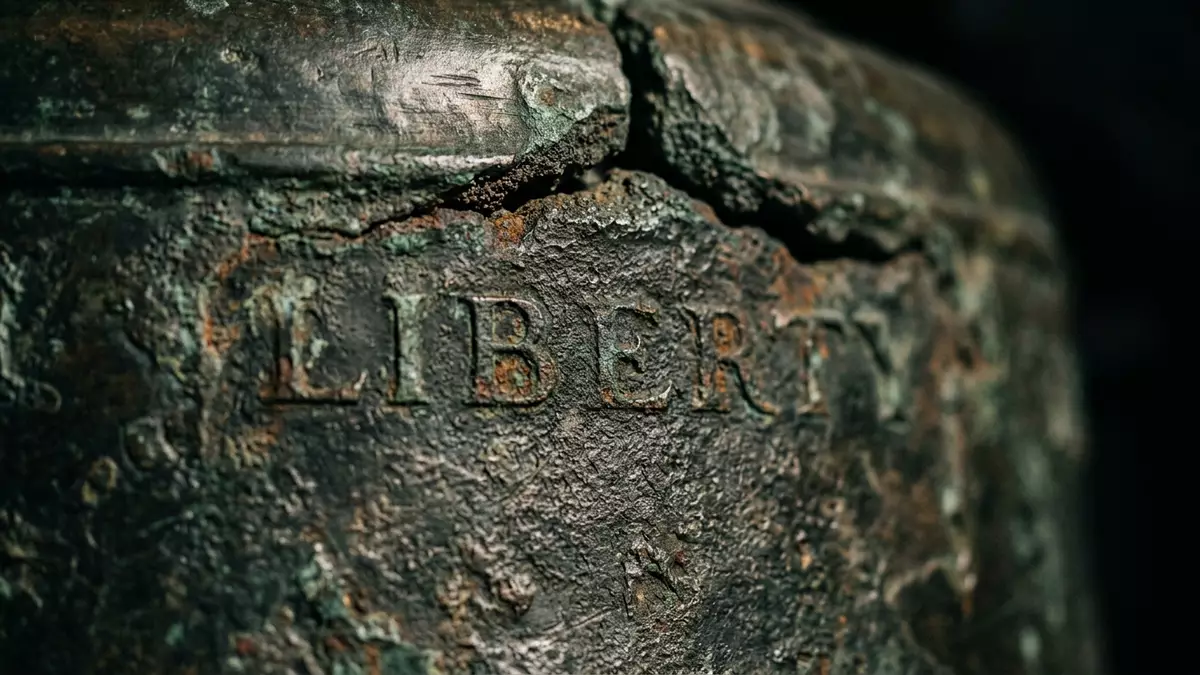
Liberty Bell in Philadelphia is a bronze bell from the eighteenth century whose famous crack and biblical inscription have turned a practical object into a dense piece of American symbolism. It stands opposite Independence Hall in a dedicated glass-fronted pavilion, where visitors file past it as if approaching a monument rather than a piece of city hardware.
A British-cast bell that became Liberty Bell
The story of Liberty Bell begins in the 1750s, when the Pennsylvania Provincial Assembly ordered a bell for the tower of the colony’s State House, the building later renamed Independence Hall.The assembly’s order in 1751 went to the London firm Lester and Pack, an early name of the Whitechapel Bell Foundry, which sent a bell across the Atlantic to Philadelphia.The bell was first cast in London in 1752 as a substantial bronze instrument for the State House tower.
During testing in Philadelphia the imported bell cracked and was recast by local founders John Pass and John Stow, whose names are still visible on its waist alongside the biblical inscription.Pass and Stow melted down the failed bell and recast it in 1753, giving the city a working State House bell. In its early decades it rang from the wooden steeple of the State House to summon legislators and mark events in the colony and, later, the young United States.It served as a signal for meetings and proclamations rather than as a ceremonial mascot.
Inscription, crack and the making of a symbol
The text cast around the shoulder of Liberty Bell comes from the Book of Leviticus: “Proclaim LIBERTY Throughout all the Land unto all the Inhabitants Thereof”.The inscription paraphrases Leviticus 25:10 and gave later generations a ready-made slogan. In the nineteenth century, anti-slavery campaigners took up the bell as an emblem and began calling it Liberty Bell rather than the more functional State House Bell.Abolitionists adopted the bell and its inscription as a symbol in the early 1800s, fixing the name that is used worldwide.
The fracture that defines Liberty Bell visually came later in its life and ended its use as a sounding bell. Accounts describe the crack lengthening during the nineteenth century until the bell was no longer rung for occasions.By the 1840s the bell’s cracked state had become part of its identity, and it moved from being a piece of working equipment to an object of public display. After journeys around the United States in the later nineteenth and early twentieth centuries, it returned permanently to Philadelphia in 1915 and has remained on view there.The bell has been in continuous public display in Philadelphia since 1915, its blemish turning into part of its attraction.
A cracked bell in a modern glass pavilion
Liberty Bell is displayed in the Liberty Bell Center, a long, low modern building with a glass front that frames a clear view of Independence Hall across Chestnut Street.The centre forms part of Independence National Historical Park, a United States National Park Service site that also includes Independence Hall and the surrounding historic blocks.The park protects key buildings from eighteenth-century Philadelphia and sets the bell in a wider historic landscape. Inside the centre, the bell stands at the far end of a linear exhibition that traces its manufacturing, political and social history.
The bell itself is relatively compact by monumental standards, standing around 1 m tall with a flared lip and a sturdy yoke of American timber above it.The casting weighs a little over 900 kg, and visitors can walk close enough to see the texture of the bronze and the finer lettering. The famous crack runs from the lip up through the inscription band, widened with drilling in the nineteenth century to prevent further spreading and giving the bell its jagged, photographic profile. Around it the exhibition space uses light-coloured stone, glass and interpretive panels, but the dark bronze mass of the bell remains the single focus.
Visiting Liberty Bell: what travellers from Western Europe should know
- Liberty Bell stands in the Liberty Bell Center on Chestnut Street in central Philadelphia, directly across from Independence Hall within Independence National Historical Park.
- The bell is viewed indoors in a level, paved pavilion, with a straightforward entrance and a gradual progression through the exhibition to the bell at the far end.
- The surrounding historic area is compact, with brick squares, tree-lined lawns and cobbled sections around Independence Hall that invite exploration on foot between neighbouring landmarks.
- Philadelphia’s main regional rail and subway services converge within walking distance of Independence National Historical Park, and several city streets around the site carry tram and bus routes.
- The official language is English and the currency is the United States dollar. Entry requirements depend on your nationality; UK travellers can check the FCDO travel advice at gov.uk/foreign-travel-advice, Irish travellers the Department of Foreign Affairs at ireland.ie.
Searching for Liberty Bell on social platforms
These links open searches for Liberty Bell on each platform.
Frequently asked questions about Liberty Bell
Where is Liberty Bell located?
Liberty Bell stands in the Liberty Bell Center on Chestnut Street in central Philadelphia, within Independence National Historical Park alongside Independence Hall.
What can visitors expect when seeing Liberty Bell?
Visitors walk through an indoor exhibition about the bell’s history and then approach the cracked bronze bell itself, which stands freely behind a low barrier for close viewing.
What makes Liberty Bell distinctive among historic bells?
The combination of its Leviticus inscription, its long fracture and its association with US independence movements turns a relatively modest bronze casting into a powerful national symbol.


