
Lineas de Nazca and the vast desert drawings of southern Peru
Published on 09/19/2026 at 12:29 | Editorial responsibility: Rafael Müller, Editor-in-Chief AD HOC NEWS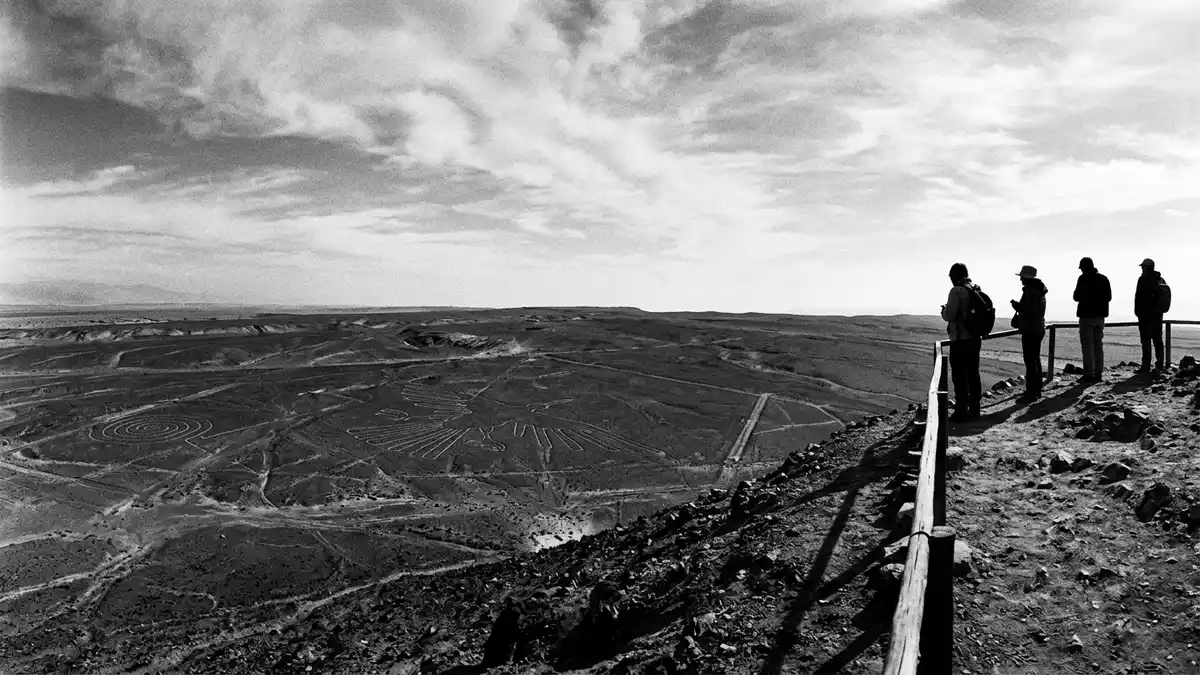
Lineas de Nazca, better known in English as the Nazca Lines, stretch across the desert plateau near Nazca in southern Peru and assemble hundreds of geoglyphs into a single vast landscape of drawings. Etched into the pampas between Nazca and Palpa, they are associated with the Nazca culture of the first millennium AD and form part of a cultural landscape recognised as a UNESCO World Heritage Site in 1994.
A dry plateau turned into a giant drawing
The Nazca Lines occupy an arid coastal plain in the Ica Region, between the Pacific Ocean and the foothills of the Andes, where the ground is a largely bare mix of gravel and sand.Lines and Geoglyphs of Nasca and Palpa The core area sits on the Pampas de Jumana and neighbouring plains, forming a high plateau that runs for many kilometres between the town of Nazca and the smaller centre of Palpa.Nazca Desert plateau between Nazca and Palpa
Across this plateau, straight lines, geometric shapes and figure outlines have been scraped into the surface to reveal the lighter material beneath, creating “negative” images that stand out against the surrounding ground.geoglyphs made by removing rocks and earth The designs range from simple straight lines that run across the plain to more complex shapes, all laid out on a scale that is difficult to grasp from the ground alone.
Figures, geometry and the span of centuries
The Nazca Lines comprise both abstract and figurative geoglyphs, with groups of straight lines, geometric forms and depictions of animals, plants and human-like shapes. Sources describing the site note straight lines running for many kilometres, geometric figures such as trapezoids and spirals, and biomorphs whose lengths can reach hundreds of metres.straight lines and biomorphs on the pampa Seen together, these different types of marking turn the desert surface into a layered graphic field.
Archaeological and heritage documentation places the creation of the geoglyphs between roughly 500 BC and AD 500, linking them to societies that flourished on the Peruvian south coast across many centuries.geoglyphs scratched between 500 B.C. and A.D. 500 The designs are therefore embedded in a wider sequence of pre-Hispanic cultures in the region, including the Nazca culture itself, which is associated in research with the majority of the lines.Nazca culture between 200 BCE and 500 CE
World Heritage recognition and the wider landscape
In 1994 the Nazca Lines and related geoglyphs were inscribed on the UNESCO World Heritage List under the title “Lines and Geoglyphs of Nasca and Palpa”, with criteria recognising their cultural significance and outstanding value.UNESCO World Heritage inscription in 1994 The protected zone extends over tens of thousands of hectares within the Río Grande de Nasca basin, taking in both the open plain and parts of the lower Andean foothills where additional figures have been identified.protected area within the Río Grande de Nasca basin
The wider landscape is a high, dry plateau with low hills and ridges around its edges, offering occasional vantage points from which some of the lines and figures become more legible against the plain.desert plains between the Andes and the Pacific coast The combination of extreme aridity and minimal vegetation has helped preserve the exposed designs, which remain visible across large stretches of the Nazca Desert.
Visiting Lineas de Nazca: what travellers from Western Europe should know
- Lineas de Nazca lie on the desert plains near the town of Nazca in the Ica Region of southern Peru, with further geoglyphs extending towards Palpa along the coastal plain.
- The site sits on a high, arid plateau of gravelly desert, where approaches involve walking over uneven ground and moving between low ridges and open pampas.
- The Nazca Lines are in Peru, where the official language is Spanish and the currency is the Peruvian sol.
- Entry requirements depend on your nationality; UK travellers can check the FCDO travel advice at gov.uk/foreign-travel-advice, Irish travellers the Department of Foreign Affairs at ireland.ie.
Searching for Lineas de Nazca on social platforms
These links open searches for Lineas de Nazca on each platform.Frequently asked questions about Lineas de Nazca
Where are Lineas de Nazca located?
Lineas de Nazca are on the Nazca Desert plateau in the Ica Region of southern Peru, between Nazca and Palpa on the Pampas de Jumana.
What should a visitor expect on a visit?
A visit centres on viewing large geoglyphs scratched into an arid plateau of sand and gravel, with wide open pampas and low ridges forming the surrounding landscape.
What makes Lineas de Nazca distinctive?
Lineas de Nazca are distinctive for their extensive field of straight lines, geometric shapes and giant animal and plant figures spread across a high desert plain.


