
Lineas de Nazca, the vast desert drawings of southern Peru
Published on 09/21/2026 at 06:10 | Editorial responsibility: Rafael Müller, Editor-in-Chief AD HOC NEWS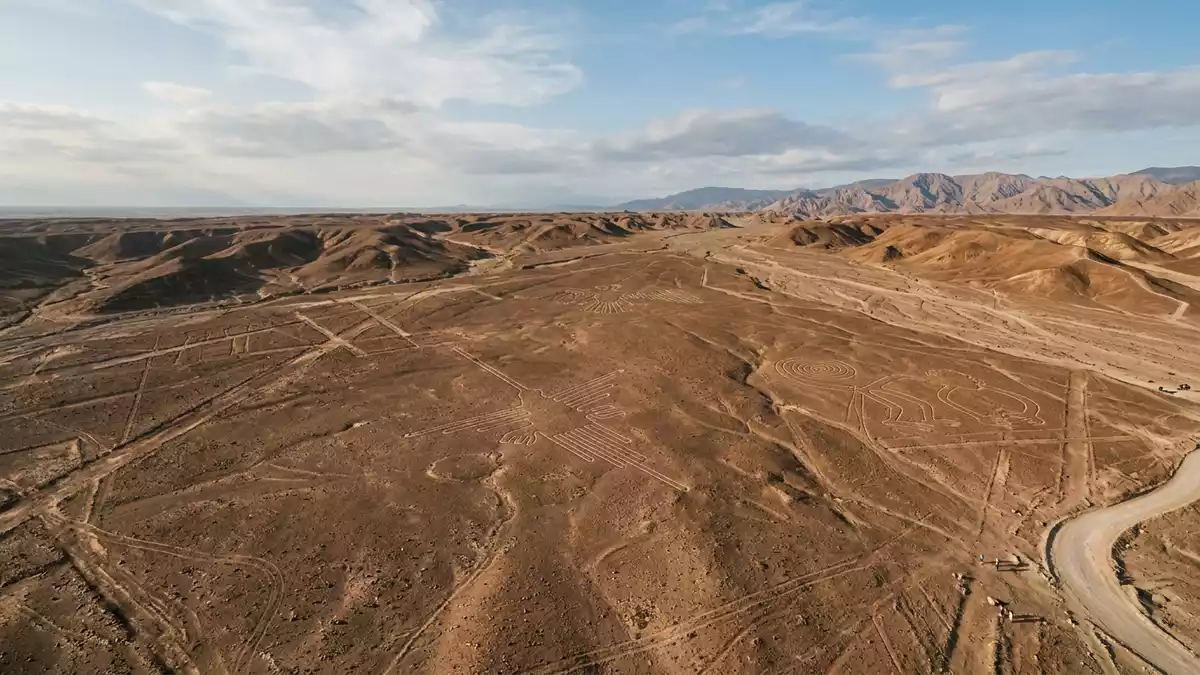
Lineas de Nazca, better known in English as the Nazca Lines, spread across the desert plateau near Nazca in southern Peru as a vast landscape of ancient drawings etched into pale ground. Created by pre-Hispanic societies between roughly the first millennium BC and the first millennium AD, these geoglyphs form one of the most extensive ensembles of line and figure designs anywhere in the Andes.
A desert plain turned into a canvas of lines and figures
The Nazca Lines lie on the coastal plain of southern Peru, in the department of Ica, between the towns of Nazca and Palpa and across pampas such as Jumana and Ingenio. The geoglyph field extends over hundreds of square kilometres of desert plateau and low foothills, forming a continuous zone where lines and figures appear cut into the surface of the ground rather than built above it.coastal plain of southern Peru The plateau’s aridity, sparse vegetation and stable surface help the designs remain clearly visible across large expanses of reddish and grey earth.
The site is inscribed on the UNESCO World Heritage List as Lines and Geoglyphs of Nasca and Palpa, recognising its cultural importance for the region’s pre-Hispanic societies and its exceptional scale.UNESCO World Heritage Site The protected area covers tens of thousands of hectares and includes pampas and gentle slopes where geoglyphs run across both flat ground and low hills, forming a single monumental field of desert drawings.lines and geoglyphs of Nasca and Pampas de Jumana
Ancient geoglyphs carved between earth and sky
The Nazca Lines consist of hundreds of geoglyphs, ranging from straight lines and geometric shapes to stylised figures representing animals, plants and imaginary beings. Many designs run for several kilometres across the desert, linking plateaus and shallow valleys in long trajectories that become coherent only when seen from an elevated vantage point.groups of geoglyphs on the Pampa Colorada Others form compact motifs, with outlines that suggest a hummingbird, a monkey, a spider or a tree, laid out as single figures within the wider mesh of lines.
Archaeological work situates the creation of most Nazca geoglyphs between about 500 BC and AD 500, with some elements attributed to earlier cultures such as Paracas.scratched on the surface between 500 B.C. and A.D. 500 The makers removed dark pebbles from the desert surface to reveal lighter soil beneath, tracing lines that contrast with the surrounding ground without adding new material. This simple technique, combined with the plateau’s dryness, allows lines only a few metres wide to remain legible across long distances and through many centuries.
Reading the Nazca landscape from ground and air
For travellers, Lineas de Nazca present a layered experience of scale. From ground level, individual lines and cleared bands of earth stand out against stony surroundings, and simple shapes can be traced on foot along sections of the desert. From higher viewpoints, the relation between lines and figures becomes clearer, revealing how straight trajectories intersect with curved outlines to form more complex compositions across the pampas.Nazca Lines on the Pampas of Jumana in the Nazca Desert
Seen from the air, the full breadth of the Nazca geoglyphs appears as an immense web of designs spanning open desert and extending towards the Andean foothills. Long linear segments align with each other across different pampas, while individual figures emerge as distinct motifs within the mesh of geometric forms. The contrast between the apparent emptiness of the surrounding landscape and the density of lines across selected plateaus gives the site its particular character as a drawn desert, where the ground itself carries large-scale graphic patterns.
Visiting Lineas de Nazca: what travellers from Western Europe should know
- Lineas de Nazca lie in the Nazca Desert of southern Peru, in the Ica region south of Lima, with the main access point near the town of Nazca.
- The geoglyphs occupy open desert terrain on a plateau and low hills, with approaches involving exposure to sun, dry air and sections of uneven stony ground.
- The official language is Spanish and the currency is the Peruvian sol.
- Entry requirements depend on your nationality; UK travellers can check the FCDO travel advice at gov.uk/foreign-travel-advice, Irish travellers the Department of Foreign Affairs at ireland.ie.
Searching for Lineas de Nazca on social platforms
These links open searches for Lineas de Nazca on each platform.
Frequently asked questions about Lineas de Nazca
Where are Lineas de Nazca located?
Lineas de Nazca lie in the Nazca Desert of southern Peru, in the Ica region, across pampas between the towns of Nazca and Palpa.
What can visitors expect when seeing the Nazca Lines?
Visitors encounter a wide desert plateau marked by long straight lines and large figures in the ground, visible along selected viewpoints and from elevated perspectives.
What makes Lineas de Nazca distinctive as a cultural site?
The Nazca Lines form an extensive field of ancient geoglyphs created between about 500 BC and AD 500 and recognised as a UNESCO World Heritage Site for their scale and complexity.


