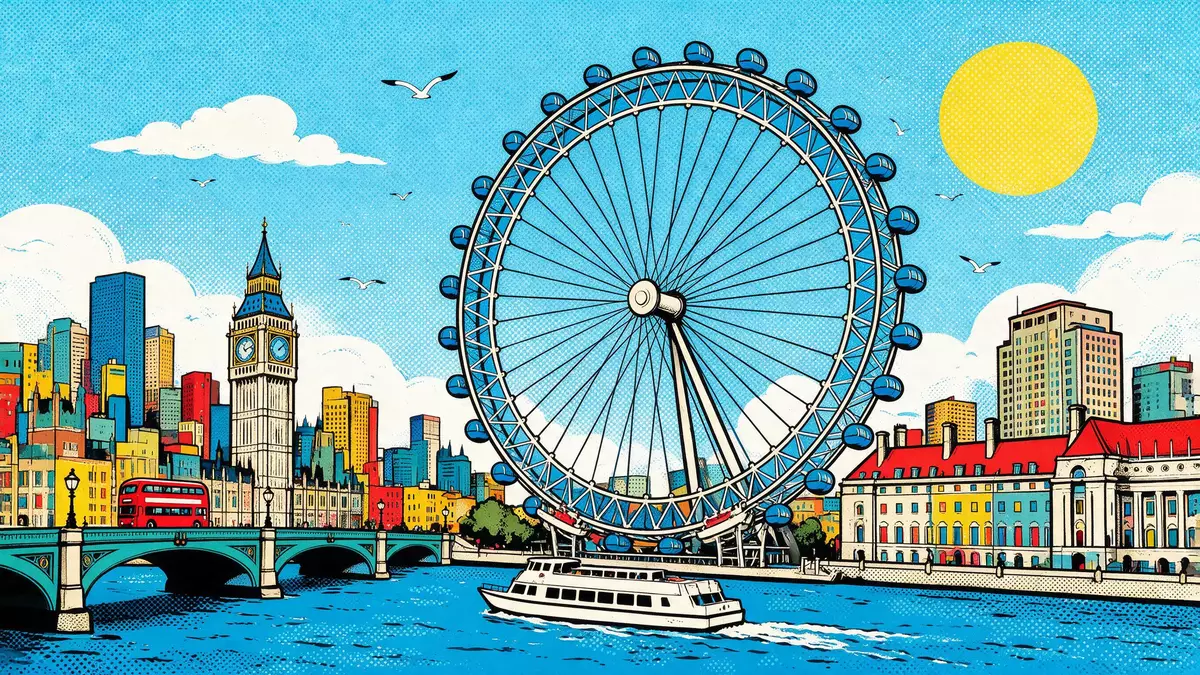
London Eye and its slow rotation above the Thames
Published on 08/06/2026 at 22:21 | Editorial responsibility: Rafael Müller, Editor-in-Chief AD HOC NEWS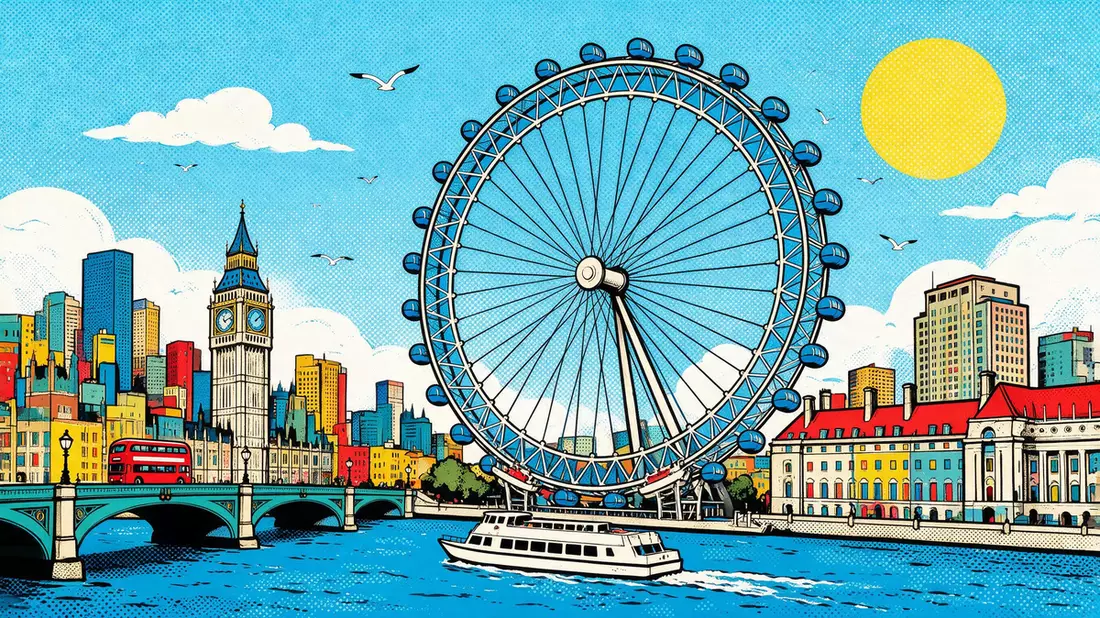
London Eye is the giant observation wheel on the South Bank of the River Thames, facing the historic core of London across the water and turning in a slow, continuous loop above the city. Opened in 2000 and designed by the architectural team of David Marks and Julia Barfield, it has become a modern landmark that sets a ring of steel and glass against older stone structures on the opposite bank.
A riverfront wheel in central London
London Eye stands beside the Thames between Westminster Bridge and the Hungerford railway and pedestrian bridges, in a stretch of riverfront often referred to as the South Bank. The wheel rises above a paved promenade lined with trees, with the river flowing directly in front and the Palace of Westminster, with Big Ben, visible across the water.
The structure takes the form of a large vertical ring supported by an A-frame of pale-coloured steel that leans towards the river, braced by cables that radiate from the hub to the rim. From a distance, the rim and spokes form a delicate pattern against the sky, while closer up the engineering becomes a dense arrangement of steel members and connection points. The supporting legs descend to foundations set behind the promenade, leaving the river edge open for pedestrians.
Design, construction and the capsules
Marks Barfield Architects conceived London Eye in the late 1990s and worked with engineers to realise a wheel that would carry enclosed capsules rather than traditional open carriages. The project involved transporting prefabricated sections along the Thames and assembling the wheel on site before raising it into position, a process that gave the structure its present form as a single, continuous loop of steel.
Around the rim, glass-fibre and steel capsules are mounted externally, projecting from the circle and held by brackets and frames. Each capsule forms an enclosed, climate-controlled space with glass walls and a glass ceiling, allowing passengers to stand and move freely as the wheel turns. Inside, seating is arranged around the centre, leaving the perimeter clear so that visitors can walk to different viewpoints over London. The cabins are numbered and identified on small plates and signs, and one capsule is associated with important ceremonial journeys.
Views over London and the city around the wheel
From the upper part of its rotation, London Eye offers long views over the Thames, Westminster and the broader cityscape. To one side, the Houses of Parliament and Westminster Abbey anchor the historical scene; to another, visitors can see modern office towers in the City of London and beyond. On lower sections of the turn, the view shifts to the river surface, bridges, passing boats and the façades of neighbouring cultural buildings.
A visit to London Eye usually begins at the base building, a low structure housing ticketing, security checks and the entrance to the boarding platform. Passengers step onto the wheel from a gently moving platform as capsules pass through a straight section near the lowest point; the rotation is slow enough to make boarding feel measured, and staff are present to coordinate the process. The immediate surroundings include other attractions, street performers around the promenade and food and drink outlets that serve the wider South Bank area.
Visiting London Eye: what travellers from Western Europe should know
- London Eye stands on the South Bank of the River Thames in central London, reached by urban rail and Underground services to nearby stations and by riverside footpaths.
- Admission arrangements and opening hours are set by the site's operator and change with the season; the official website is the only binding source.
- The wheel operates across the year, and clear daylight or early evening light often makes the views over London easier to appreciate.
- The visit involves walking through the base building and standing inside the capsule for the duration of the rotation, with short ramps and level changes around the boarding area; restrictions may apply on site.
- On the ground, travellers encounter English-language signs, card and cash payment options and urban British customs typical of central London.
- Entry requirements depend on your nationality. UK travellers should check the FCDO travel advice at gov.uk/foreign-travel-advice; Irish travellers the Department of Foreign Affairs at ireland.ie; EU and EEA citizens their own national foreign ministry.
Searching for London Eye on social platforms
These links open searches for London Eye on each platform.
Frequently asked questions about London Eye
Where is London Eye located in London?
London Eye stands on the South Bank of the River Thames, close to Westminster Bridge and opposite the Palace of Westminster in central London.
What can visitors expect during a ride?
Visitors board enclosed glass capsules and spend a full rotation standing or sitting inside, watching London’s riverfront and skyline shift as the wheel turns.
What makes London Eye distinctive among London landmarks?
Its large steel wheel form, riverfront position and panoramic capsules give London Eye a different character from the city’s older towers and historic buildings.