
Longmen Shiku in Luoyang and its carved Buddhist cliffs
Published on 09/19/2026 at 22:32 | Editorial responsibility: Rafael Müller, Editor-in-Chief AD HOC NEWS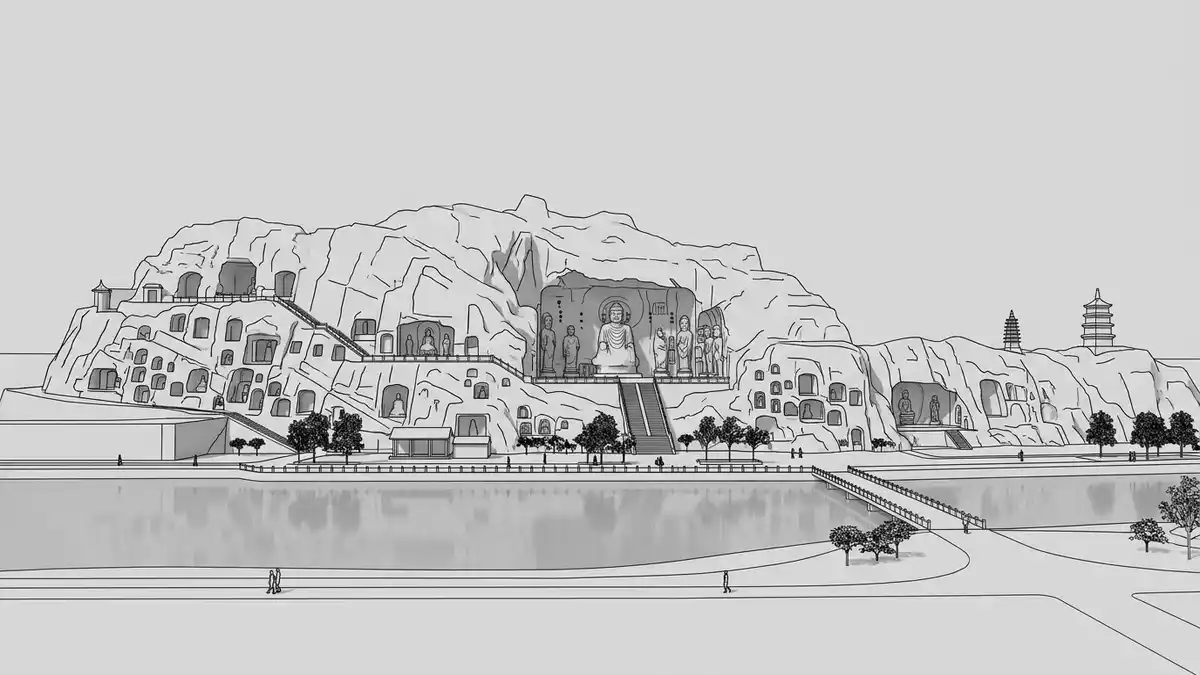
Longmen Shiku, known in English as the Longmen Grottoes, turns a limestone ravine south of Luoyang in Henan Province into a continuous landscape of carved Buddhist cliff faces. Cut into both banks of the Yi River over a stretch of about 1 km (0.6 miles), the grottoes preserve dense stone sculpture from the Northern Wei and Tang dynasties and form a major UNESCO World Heritage cultural site inscribed in 2000.
Limestone cliffs turned into a carved Buddhist world
Longmen Shiku occupies facing limestone hills on either side of the Yi River, with steep cliffs forming natural rock walls that have been hollowed into caves, niches and terraces. The setting lies around 12 km (7.5 miles) south of Luoyang in Luolong District, where Xiangshan and Longmen Mountains frame the river and create the “dragon gate” ravine that gives the site its name.Longmen Grottoes
The carved zone runs for roughly 1 km (0.6 miles) along the cliffs, with grottoes densely distributed on both banks of the Yi River so that the rock face becomes a nearly continuous sequence of openings and sculpture.steep limestone cliffs over a 1km long stretch The limestone has weathered into vertical faces and ledges, and many caves open partway up the slopes, linked by stone stairways and walkways that follow the contours of the hills above the water.
Caves, statues and inscriptions from Northern Wei to Tang
Longmen Shiku is a cave-temple complex of more than 2,300 caves and niches carved into the cliffs, filled with stone figures that chart the development of Chinese Buddhist art.2300 caves and niches filled with Buddhist art The carvings belong largely to the late Northern Wei and Tang dynasties, a span that covers several centuries from the fifth to the eighth century and shows changing styles, proportions and iconography between early and later works.late Northern Wei and Tang Dynasties
Across the cliffs Longmen Shiku holds almost 110,000 Buddhist stone statues, from small relief figures to monumental Buddhas several metres high, together with more than 60 pagoda-like stupas and around 2,800 inscriptions carved on stone steles.almost 110,000 Buddhist stone statues Inscriptions record donors, dates and devotional texts, giving the cliffs a layered surface where sculpture and writing share the same rock. Some major caves, such as Guyang-dong and Binyang-dong, are named and dated to the late fifth and early sixth centuries, marking key phases in the site's formation.Guyang-dong (493)
World Heritage status and the Yi River landscape
Longmen Shiku was inscribed on the UNESCO World Heritage List in 2000 as a cultural property that represents a high point of Chinese stone carving between the Northern Wei and Tang dynasties.inscribed on the UNESCO World Heritage List UNESCO recognises the site as an outstanding repository of Buddhist art whose sculptures offer insight into political, religious and cultural life in ancient China, and the grottoes are protected as state cultural relics.
The Yi River remains central to the character of Longmen Shiku, with the carved cliffs lining both sides of its banks and paths following the water before rising to terraces cut into the hills.steep cliffs on both sides of the Yi River From the river level visitors see the rock face as a wall of niches and figures, while higher vantage points along the paths reveal how the caves are grouped and how the ravine opens between Xiangshan and Longmen Mountains, forming the natural “gate” that frames the grottoes.
Visiting Longmen Shiku: what travellers from Western Europe should know
- Longmen Shiku lies in Luolong District south of Luoyang in Henan Province, with grottoes carved into limestone cliffs on both banks of the Yi River; the area is reached by road links from Luoyang and its railway stations.
- Exploring the grottoes involves walking along riverside paths and climbing stone stairways between terraces, as many caves open partway up the cliff face above the water.
- The terrain includes uneven rock surfaces and steps cut into the hillsides, so moving between major cave groups means crossing bridges and ascending and descending stone routes that follow the contours of Xiangshan and Longmen Mountains.
- The official language is Chinese and the currency is the renminbi (yuan).
Searching for Longmen Shiku on social platforms
These links open searches for Longmen Shiku on each platform.Frequently asked questions about Longmen Shiku
Where is Longmen Shiku located?
Longmen Shiku is located in Luolong District south of Luoyang in Henan Province, with grottoes carved into limestone cliffs on both sides of the Yi River.
What can visitors expect when exploring Longmen Shiku?
Visitors walk along riverside paths and stone stairways that link terraces and cave groups, seeing thousands of carved Buddhist figures, pagoda-like stupas and inscriptions in the cliff faces.
What makes Longmen Shiku distinctive among Buddhist sites?
Longmen Shiku is distinctive for its concentration of more than 2,300 caves and niches and almost 110,000 stone statues carved into a single ravine, representing Buddhist art from the Northern Wei to Tang dynasties and recognised as a UNESCO World Heritage Site.


