
Louvre Abu Dhabi and its floating dome of light
Published on 08/15/2026 at 14:32 | Editorial responsibility: Rafael Müller, Editor-in-Chief AD HOC NEWS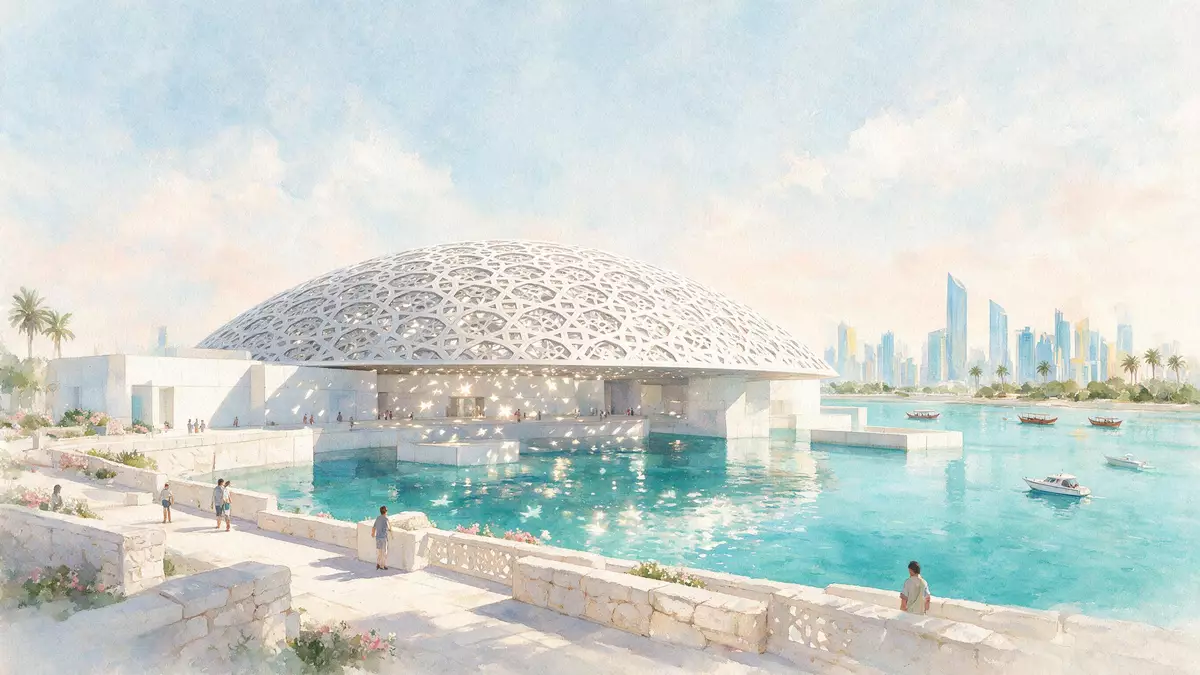
Louvre Abu Dhabi on Saadiyat Island in Abu Dhabi is a museum of art, culture and history defined by a vast silvery dome that appears to float above a low-lying waterside complex. Conceived by French architect Jean Nouvel in the early 2000s and inaugurated in 2017, it presents global artworks and artefacts inside a structure that blends concrete, water and filtered light in a carefully composed museum quarter.
A museum city beneath a vast dome
The central idea behind Louvre Abu Dhabi is a “museum city” set in the sea, a cluster of white, low-rise buildings sheltered beneath a single dome and surrounded by water on an island off Abu Dhabi’s coast.museum city in the sea The complex sits on Saadiyat Island, a man-made cultural district that extends into the Arabian Gulf, with the museum forming one of its anchor institutions.Saadiyat Island location
Jean Nouvel’s plan breaks the museum into dozens of separate volumes linked by outdoor walkways, plazas and basins, creating urban-like routes between the galleries. The buildings are predominantly white and rectilinear, recalling low-lying settlements and medina-style districts found in Arab cities, and their façades use ultra-high-performance fibre-reinforced concrete panels configured in repeating patterns.architecture of low-rise buildings Together, they form a compact ensemble with courtyards and passages opening out to the surrounding sea.
The silvery dome and its rain of light
The most recognisable feature of Louvre Abu Dhabi is its dome, which spans around 180 m (590 ft) in diameter and covers much of the museum city beneath it.180 metre-wide dome Despite the apparent lightness, the dome weighs roughly 7,500 tonnes, comparable to the mass of the Eiffel Tower, and forms an expansive circular canopy whose edge almost touches the water at certain points.7,500-tonne dome weight
The dome’s structure is highly layered: eight separate layers, four outer in stainless steel and four inner in aluminium, are separated by a deep steel framework around five metres high, creating a complex lattice of overlapping star-shaped elements.multi-layered metal dome In total, thousands of stars of varying sizes and orientations form this geometric web, and the pattern produces a characteristic “rain of light” effect as sunlight filters through and casts shifting patches of brightness across the plazas, water surfaces and building façades.
Collections, galleries and environmental ambitions
Louvre Abu Dhabi presents art and artefacts from multiple cultures and periods, organised in sequences that trace human creativity across regions and eras rather than dividing strictly by nation. This universal museum concept, backed by a long-term agreement with French institutions including the Paris Louvre, underpins its programme of permanent displays and temporary exhibitions.French-Emirati museum partnership The gallery buildings beneath the dome house chronologically arranged rooms, thematic displays and spaces for loans from partner museums, alongside dedicated children’s areas and spaces for cultural events.
The museum’s architecture incorporates environmental measures aligned with local sustainability frameworks. Louvre Abu Dhabi has been designed to achieve a Silver rating under the LEED environmental certification system and has received a Three Pearl Estidama Design Rating, reflecting performance in areas such as energy and water use.LEED and Estidama ratings Passive strategies and efficient mechanical systems help moderate the climate within the museum city, while the surrounding basins and reflecting pools emphasise the connection between architecture and sea.
Visiting Louvre Abu Dhabi: what travellers from Western Europe should know
- Louvre Abu Dhabi stands on Saadiyat Island, north-east of Abu Dhabi’s city centre, and is reached by road bridges linking the island with the mainland.
- The museum complex is low-lying and spread across numerous buildings, so a visit involves walking between galleries across outdoor plazas and along waterside paths.
- Abu Dhabi’s climate is hot for much of the year, and many of the circulation routes between buildings are shaded beneath the dome or covered walkways.
- The official language is Arabic and the currency is the United Arab Emirates dirham.
- Entry requirements depend on your nationality; UK travellers can check the FCDO travel advice at gov.uk/foreign-travel-advice, Irish travellers the Department of Foreign Affairs at ireland.ie.
Searching for Louvre Abu Dhabi on social platforms
These links open searches for Louvre Abu Dhabi on each platform.
Frequently asked questions about Louvre Abu Dhabi
Where is Louvre Abu Dhabi located?
Louvre Abu Dhabi is situated on Saadiyat Island in Abu Dhabi in the United Arab Emirates, on a stretch of land extending into the Arabian Gulf.
What should visitors expect during a visit?
A visit involves moving between multiple low-rise gallery buildings and outdoor plazas beneath the large dome, with exhibitions presenting art and artefacts from different cultures.
What makes Louvre Abu Dhabi distinctive among museums?
Its combination of a wide-reaching, cross-cultural collection and Jean Nouvel’s island museum city under a 180 m (590 ft) lattice dome creates a setting rare among art museums.


