
Luang Prabang: a river peninsula of temples and timber houses
Published on 09/17/2026 at 18:25 | Editorial responsibility: Rafael Müller, Editor-in-Chief AD HOC NEWS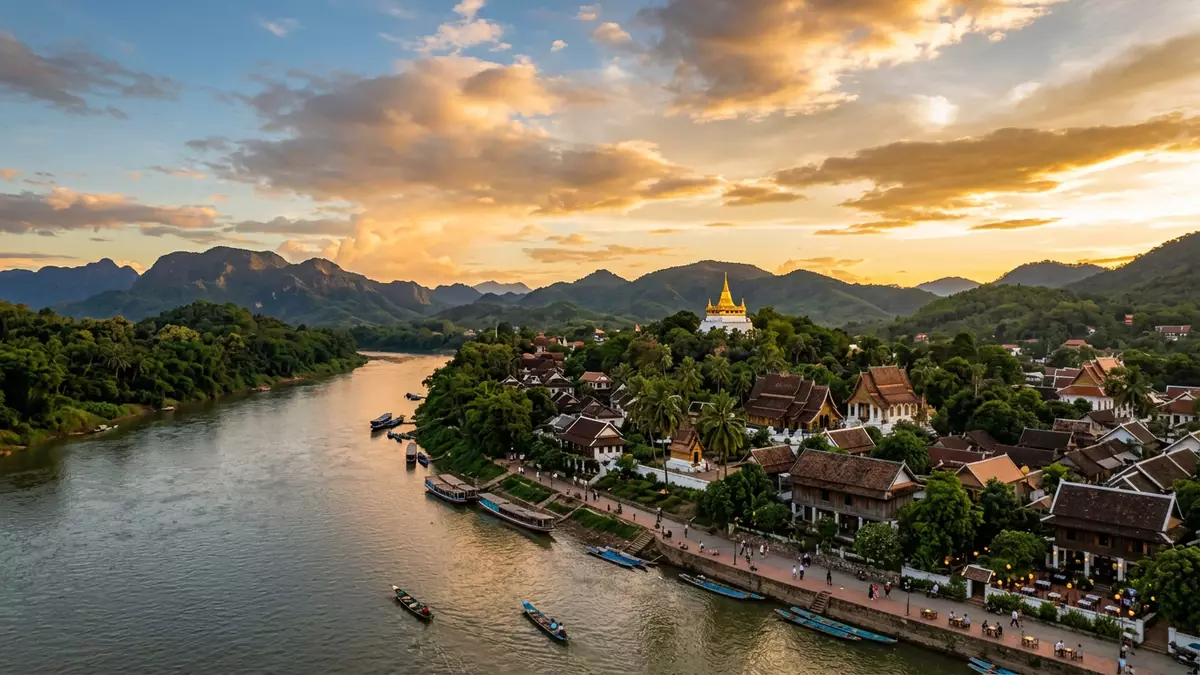
Luang Prabang in northern Laos is a small river town where Buddhist monasteries, timber houses and French colonial villas cluster on a narrow peninsula at the confluence of two rivers. Designated as a UNESCO World Heritage Site in 1995, it preserves a townscape shaped by royal power, Buddhism and colonial administration on a scale that remains intimate and walkable.UNESCO World Heritage Site
A royal town between mountains and rivers
Luang Prabang lies in a mountainous region of northern Laos, set on a tongue of land between the Mekong and the Nam Khan rivers.confluence of the river Mekong and the river Khan The historic centre occupies a peninsula where the ridges of the surrounding hills drop to the water, giving short views from riverbank to temple roof and up to forested slopes. The town was the royal capital and seat of government for one of the historic Lao kingdoms, and it became a royal and religious centre under French protection in the late nineteenth and early twentieth centuries.royal and religious seat of the French protectorate
The protected urban area covers several hundred hectares on and around the peninsula, with a buffer zone extending over the adjacent hills and riverbanks.protected area encompasses villages Within this zone, Buddhist monasteries, royal compounds and ordinary houses stand close together along lanes that follow the river or climb towards the ridge. The compact size means that religious, royal and everyday urban life remain intertwined in the same streets, and monks, market traders and civil servants share the same river crossings and riverfront paths.
Timber houses, brick villas and gilded monasteries
The defining character of Luang Prabang lies in its blend of traditional Lao timber buildings and brick structures from the colonial period.fusion of traditional architecture and Lao urban structures with colonial buildings Traditional Lao houses are typically raised above the ground on timber supports and use wood and bamboo for walls and floors, with an open area beneath once used for animals, carts and weaving.traditional Lao house made from wood and bamboo and raised off the ground Many retain balconies along one side and a linear plan aligned with the river, even where later owners have enclosed the lower level to create additional rooms.
Alongside these timber dwellings stand Buddhist temples and monasteries with richly decorated wooden prayer halls and golden stupas, which gave the town its historic name Xieng Thong and its role as a regional centre of Buddhism.centre of Buddhism in the region Colonial influences appear in brick villas, civic buildings, shop houses and schools whose layouts follow grid patterns introduced by French administrators. In the early twentieth century Chinese merchants and Lao aristocrats commissioned substantial villas on the peninsula, combining French-influenced facades with Lao spatial traditions, and by the 1930s brick shop houses, hospitals and government offices had reshaped parts of the commercial centre.building boom in 1930s with French colonial shop-houses
A living World Heritage town
Luang Prabang was inscribed on the World Heritage List on 9 December 1995 for its cultural values and its harmonious relationship between natural and built environments.inscribed as a World Heritage Site by UNESCO on 9th December 1995 The inscription highlights the close link between rivers, hillsides and townscape as well as the juxtaposition of a Lao urban framework of vernacular wooden architecture with a colonial grid of brick buildings.juxtaposition of a Laotian urban framework and a grid plan typical of colonial urbanism Within the protected area UNESCO catalogued hundreds of civilian and religious structures that contribute to this heritage, ranging from modest houses to royal residences and monasteries.611 civilian and religious buildings
The town remains a functioning provincial capital, and the everyday life of markets, schools and administrative offices continues among heritage buildings. Modern architecture arrived in the mid twentieth century, with concrete shop houses in simple rectangular forms and later suburban houses influenced by American designs, yet these newer structures sit within the wider landscape of timber houses, monasteries and early twentieth-century villas rather than replacing it.modernism came to Luang Prabang in the late 1950s and 1960s From riverbank to ridge, the town reads as a layered record of royal, religious, colonial and later urban forms, framed by the Mekong and Nam Khan and the green hills beyond.
Visiting Luang Prabang: what travellers from Western Europe should know
- Luang Prabang lies in northern Laos in Luang Prabang Province, on a peninsula at the meeting point of the Mekong and Nam Khan rivers, reached by air and by road from other Lao cities.
- The historic centre occupies a compact peninsula with lanes that rise and fall between river level and hill shoulders, and many streets involve short climbs, steps and uneven surfaces.
- On the peninsula traditional houses and monasteries stand close to the riverbanks, so walking between riverfront paths, temple compounds and small squares forms the core experience of exploring the town.
- The official language is Lao and the currency is the Lao kip.
- Entry requirements depend on your nationality; UK travellers can check the FCDO travel advice at gov.uk/foreign-travel-advice, Irish travellers the Department of Foreign Affairs at ireland.ie.
Searching for Luang Prabang on social platforms
These links open searches for Luang Prabang on each platform.Frequently asked questions about Luang Prabang
Where is Luang Prabang and what kind of place is it?
Luang Prabang is a river town in northern Laos, occupying a peninsula at the meeting of the Mekong and Nam Khan rivers and serving as a provincial capital.
What should visitors expect when walking through Luang Prabang?
Visitors encounter timber houses, Buddhist temples and colonial-era brick buildings along short lanes and stairways that rise between riverbanks and low hills within a compact historic area.
What makes Luang Prabang distinctive among Southeast Asian towns?
Luang Prabang stands out for its formal recognition as a UNESCO World Heritage Site and for its documented blend of Lao wooden architecture, royal compounds and French colonial urban forms on a single peninsula.


