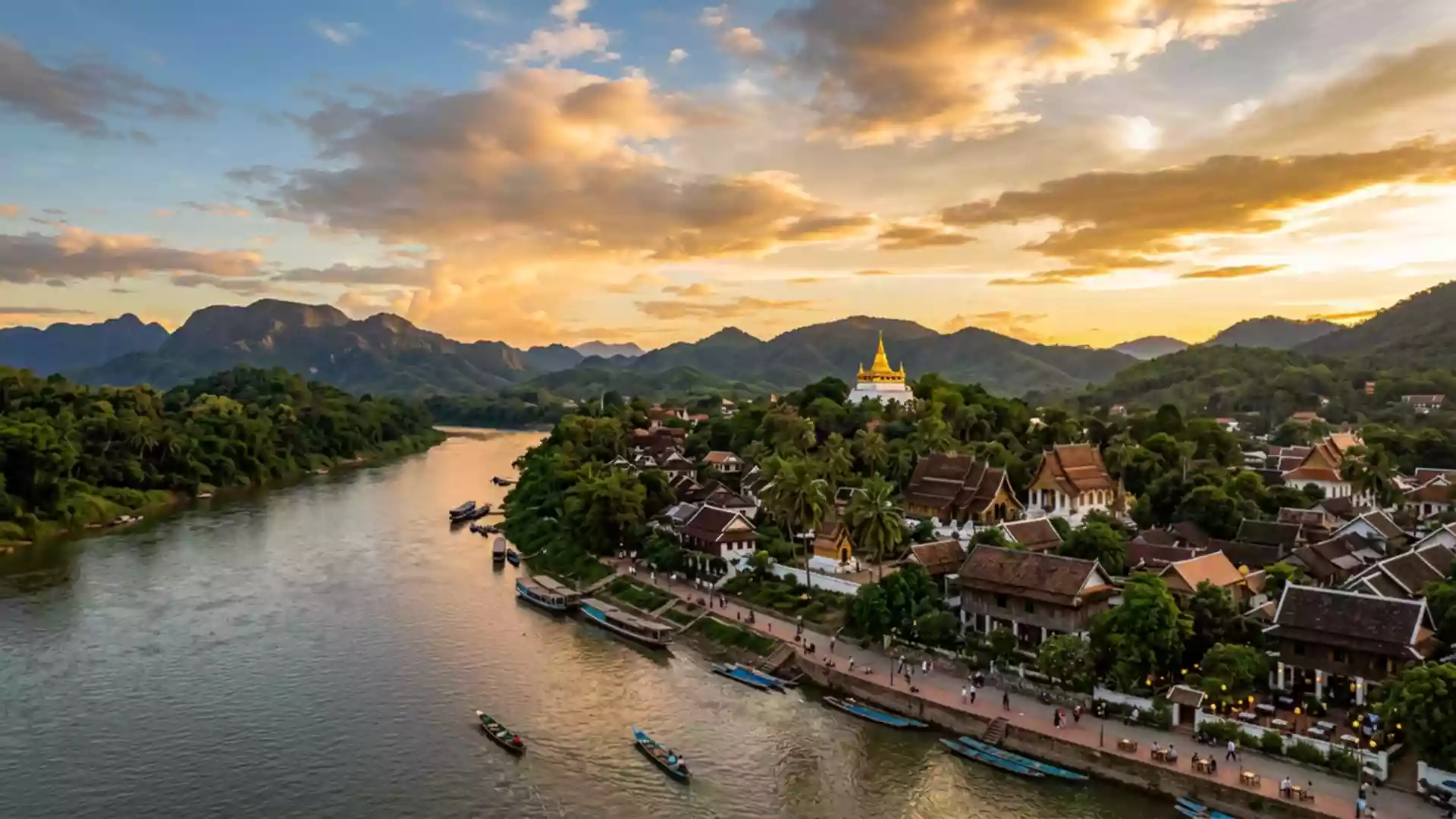
Luang Prabang, where rivers, temples and colonial streets meet
Published on 08/16/2026 at 14:21 | Editorial responsibility: Rafael Müller, Editor-in-Chief AD HOC NEWS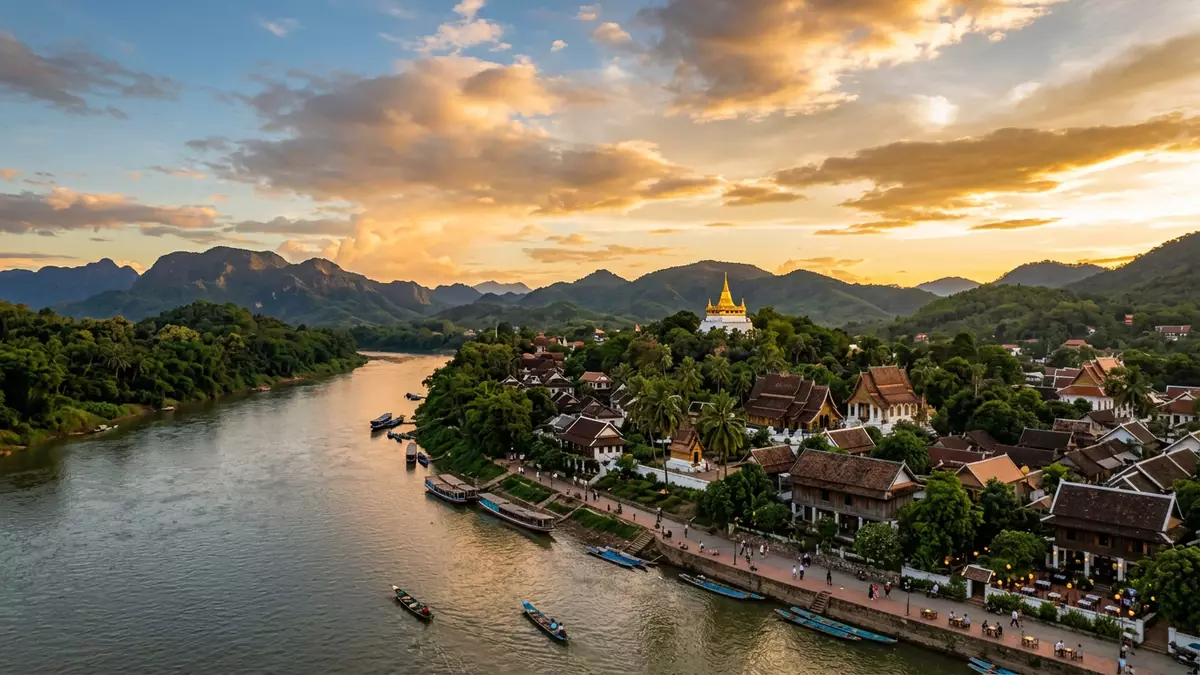
Luang Prabang in northern Laos sits between two rivers and under low green hills, its lanes lined with Buddhist temples, timber houses and pale colonial villas. Designated a UNESCO World Heritage town in 1995, it presents a compact landscape where religion, everyday life and architecture share the same small peninsula in the Mekong valley.
Royal town on a peninsula of rivers
Luang Prabang lies at the meeting of the Mekong and Nam Khan rivers in the mountainous north of Laos, a setting that gives the town a distinct peninsula shape.Located in the mountainous north of Laos the historic centre stretches along the ridge of land between the watercourses, with side streets dropping gently towards the riverbanks.Sits at the confluence of the Mekong and Nam Khan rivers
The town served as a royal capital under the kingdom of Lan Xang from the fourteenth century, with kings based here for several centuries before the political focus shifted downstream to Vientiane.Capital of the Lane Xang kingdom in the fourteenth century In the twentieth century Luang Prabang again held royal status for unified Laos until 1975, giving the small town an unusually long association with monarchy and Buddhist scholarship.Royal capital over several periods
Temples, timber houses and colonial villas
The character of Luang Prabang lies in the way gilded monastery roofs, simple wooden dwellings and masonry villas from the French colonial era stand side by side. UNESCO describes the old town as an outstanding example of the fusion of traditional Lao architecture with buildings introduced by European colonial authorities in the nineteenth and twentieth centuries.Fusion of traditional Lao and colonial urban forms In practice this means low verandas and balconies in timber facing stuccoed facades with shutters, while temple compounds fill entire blocks with ceremonial halls and monastic quarters.
Among the monasteries, Wat Xieng Thong near the tip of the peninsula is closely associated with the royal history of the town and is one of the best-preserved temple complexes from the sixteenth century.Wat Xieng Thong as a key monastery The main sim, or ordination hall, carries sweeping layered roofs and detailed decoration, while smaller chapels and stupas cluster around it. Throughout the protected area dozens of other wats stand along the streets, their drum towers, libraries and monks’ quarters woven into the daily traffic of bicycles and small vehicles.
A World Heritage town between hills and riverbanks
UNESCO inscribed the “Town of Luang Prabang” on the World Heritage List in December 1995, recognising both its architecture and its relationship to the surrounding landscape.World Heritage inscription in 1995 The core protected zone covers hundreds of hectares and includes the peninsula and several adjoining neighbourhoods, where building regulations aim to keep rooflines, materials and street patterns close to their historic forms.Statement of Outstanding Universal Value for Luang Prabang
Just behind the riverside streets, Mount Phousi rises as a steep hill at the centre of the town, crowned by a small stupa and shrines. From its upper terraces the view takes in the curve of the Mekong, the Nam Khan looping around the peninsula and the line of tiled roofs below, giving a sense of how closely the urban fabric is tied to the surrounding hills and water.Urban landscape framed by hills and rivers
Visiting Luang Prabang: what travellers from Western Europe should know
- Luang Prabang lies in northern Laos on the Mekong River, north of Vientiane, and is reached by flights to Luang Prabang International Airport or by overland routes from other Lao cities.
- The historic centre occupies a narrow peninsula between two rivers, so many streets are gently sloping and several stairways climb from the main road down towards the quays.
- The walk up Mount Phousi follows stepped paths with long staircases and landings, which can be demanding in humid weather but rewards travellers with broad views over the town and rivers.
- The official language is Lao and the currency is the Lao kip.
- Entry requirements depend on your nationality; UK travellers can check the FCDO travel advice at gov.uk/foreign-travel-advice, Irish travellers the Department of Foreign Affairs at ireland.ie.
Searching for Luang Prabang on social platforms
These links open searches for Luang Prabang on each platform.Frequently asked questions about Luang Prabang
Where is Luang Prabang?
Luang Prabang is a town in northern Laos, at the confluence of the Mekong and Nam Khan rivers and north of the national capital, Vientiane.
What can visitors expect in Luang Prabang?
Visitors encounter a compact World Heritage town with Buddhist temples, wooden houses, colonial villas, riverfront paths and a central hill with stairways and shrines.
What makes Luang Prabang distinctive?
Luang Prabang stands out for its long royal history and its blend of Lao monastic architecture, vernacular wooden buildings and French-era townhouses in a single small peninsula.