
Ludi Yan in Guilin and the illuminated limestone chambers
Published on 09/18/2026 at 09:42 | Editorial responsibility: Rafael Müller, Editor-in-Chief AD HOC NEWS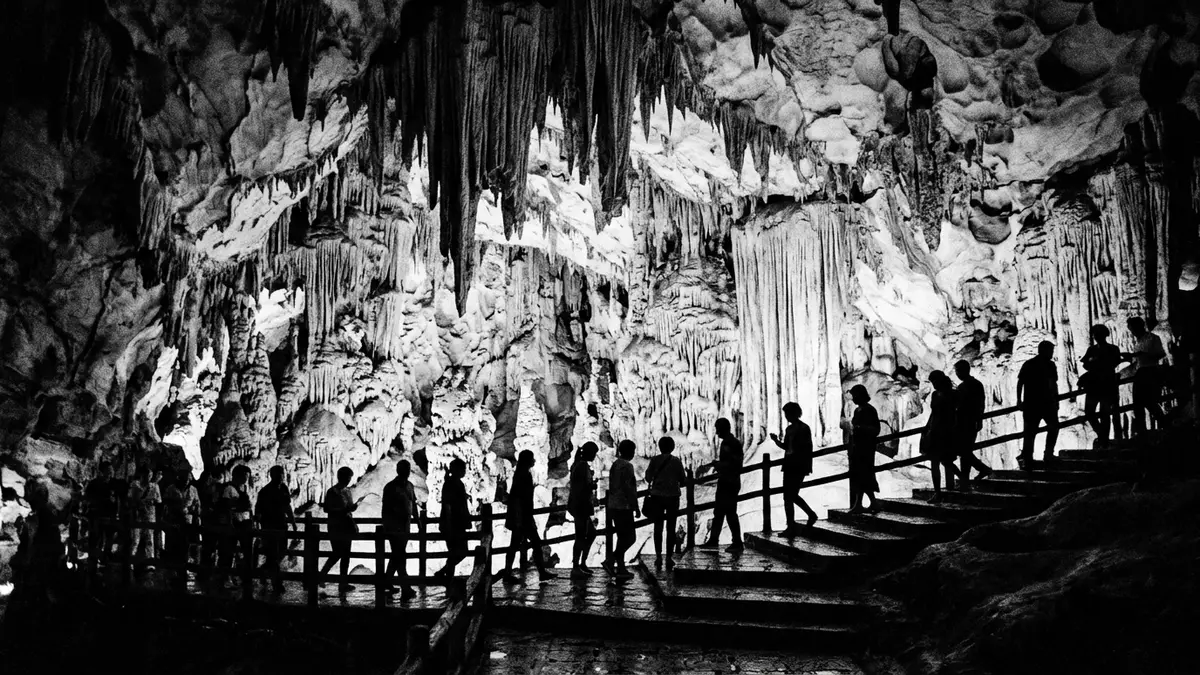
Ludi Yan in Guilin, known in English as Reed Flute Cave, is a limestone cavern cut into Guangming Hill on the north-western side of this city in southern China. Its underground route, formed in the wider Guilin karst landscape, carries visitors through a sequence of chambers where carved rock and coloured lighting frame the same geological space.
An underground passage through Guilin’s karst
Ludi Yan is a natural limestone cave within the Guilin karst, the band of tower-like hills and underground voids that forms part of the broader South China Karst of southern China.water-eroded limestone cave The cave runs for about 240 m (787 ft), following an underground route that has been shaped by water over geological time.about 240 m (787 ft)
The rock belongs to a limestone sequence laid down in the Mesozoic era, so the cave forms part of a system that has existed for well over one hundred million years.limestone cave over 180 million years old Inside, the path passes beneath a roof that rises in places to a maximum height of about 18 m (59 ft), with the passage widening in some halls to around 93 m (305 ft).maximum height and width
Stalactites, inscriptions and coloured light
Ludi Yan is best known for its dense clusters of stalactites and stalagmites, where mineral-rich water has left behind columns, curtains and ridged formations on the cave floor and ceiling.sequence of chambers filled with stalactites The built route follows this natural architecture, stepping from one chamber into the next, with constructed walkways and stairways guiding the line through the cave.
Human marks sit alongside the geological ones. Stone surfaces carry ink inscriptions that date back centuries, recording earlier visits and the long tradition of caves as scenic and cultural destinations in China.ink inscriptions on the rock Light fittings pick out parts of the rock with strong colour, so formations appear against bands of red, blue and green illumination while other areas remain closer to the natural tones of the limestone.karst formations and coloured light
Guangming Hill, reed flutes and Guilin’s landscape
The name Ludi Yan, written ??? in Chinese and rendered in pinyin as Lúdí Yán, refers to reeds that grow outside and can be fashioned into flutes.Chinese name and pinyin The cave lies on Guangming Hill, a karst hill on the north-western edge of Guilin in the Guangxi Zhuang Autonomous Region, and its entrance is reached from Ludi Road at the southern side of the hill.on the southern shoulder of Guangming Hill
Guangming Hill stands among a wider field of limestone peaks and valleys around Guilin, part of the South China Karst that is recognised as a World Heritage landscape.South China Karst listed as a UNESCO World Heritage Site Ludi Yan forms one underground expression of that terrain, pairing a water-carved interior with the steep hillsides and river scenery visible across Guilin’s outskirts.
Visiting Ludi Yan: what travellers from Western Europe should know
- Ludi Yan stands on Guangming Hill on the north-western side of Guilin, with access from Ludi Road in the Xiufeng District once travellers reach the area by city transport.
- The cave is entered through a constructed opening at the base of the hill, and the internal route involves walking along built paths and stairways through several chambers.
- The terrain inside is enclosed and uneven in places, with rock underfoot and steps that can feel steep, so it suits visitors comfortable with an underground environment.
- The cave sits in southern China, where the official language is Chinese and the currency is the Chinese yuan.
- Entry requirements depend on your nationality; UK travellers can check the FCDO travel advice at gov.uk/foreign-travel-advice, Irish travellers the Department of Foreign Affairs at ireland.ie.
Searching for Ludi Yan on social platforms
These links open searches for Ludi Yan on each platform.
Frequently asked questions about Ludi Yan
Where is Ludi Yan?
Ludi Yan is on Guangming Hill on the north-western side of Guilin, in the Xiufeng District of Guangxi in southern China.
What should visitors expect inside the cave?
Visitors follow a constructed path through limestone chambers filled with stalactites, stalagmites and coloured lighting, along walkways and stairways set into the rock.
What makes Ludi Yan distinctive among Guilin’s sights?
Ludi Yan combines a water-carved limestone cave with long-standing inscriptions and a programme of coloured lighting, set within the wider karst landscape around Guilin.


