
Maktabat al-Iskandariya and its vast tilted disc of light
Published on 08/15/2026 at 14:50 | Editorial responsibility: Rafael Müller, Editor-in-Chief AD HOC NEWS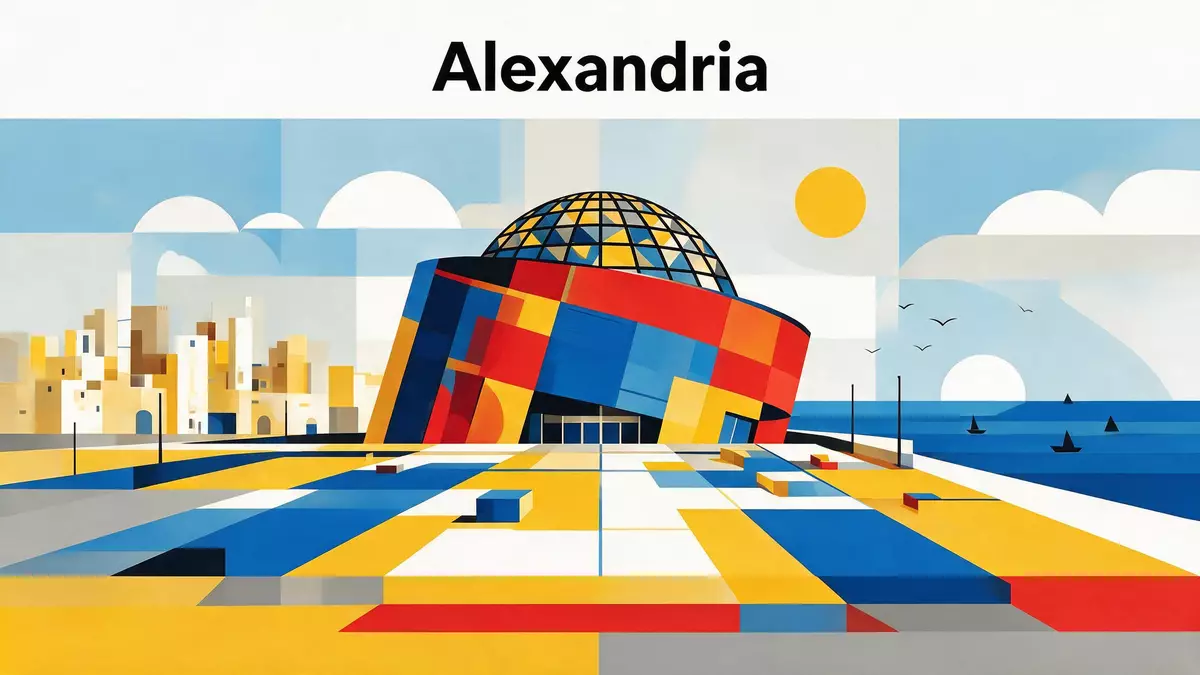
Maktabat al-Iskandariya in Alexandria is a vast circular library and cultural complex on the Mediterranean shore, designed by the Norwegian practice Snøhetta and opened in the early 2000s as a major centre of knowledge in Egypt. Rising from the ground in a single sloping disc beside the sea, it revives the memory of the ancient Library of Alexandria through contemporary architecture and an immense terraced reading room inside.
A tilted disc beside the Mediterranean
Maktabat al-Iskandariya stands on Alexandria’s historic waterfront, close to the city’s ancient harbour and near the modern campus of the University of Alexandria in the Shatby district, with its northern edge facing the Mediterranean Sea.Alexandria’s ancient harbour The main building takes the form of a vast circular structure inclined towards the water, a disc that appears to emerge from the ground at a shallow angle, echoing the image of a rising sun over the Mediterranean.massive cylinder emerging from the ground Much of its volume lies below the surrounding plaza, so that the roof surface becomes a prominent element in the cityscape while the reading halls drop down into the earth.
The disc measures about 160 m (525 ft) across and reaches a height of around 32 m (105 ft) at its tallest point, while descending some 12 m (39 ft) into the ground, giving the complex an unusual sectional profile compared with conventional rectilinear libraries.160 metres in diameter and 32 metres high Around the main building, an open plaza and a reflecting pool create a flat foreground, so that the inclined disc seems to rise out of water and stone rather than out of neighbouring streets.partially surrounded by water A footbridge links this plaza to the nearby university, underlining the connection between the library and academic life.
Architecture, materials and the great reading room
The overall complex was conceived in an international competition launched in 1989, with Snøhetta winning first prize; construction followed in the 1990s and the building was completed around 2001, with a formal inauguration in 2002.competition launched in 1989construction began in 1994 and was completed in 2001 The architectural form is often described as expressionist, with the sloping disc, the embedded main hall and the satellite structures around it contrasting with the more traditional urban fabric of central Alexandria.architecture expressionniste The roof itself is clad in aluminium and glass panels set in a pattern that has been likened to a microchip, creating a technical texture when seen from above.roof pattern of aluminium and glass panels
Inside, the main reading room is one of the defining spaces of Maktabat al-Iskandariya: a vast hall with terraced levels cascading down from the entrance to the lowest point, providing room for thousands of readers and shelving for millions of volumes.immense reading room with seating for 2000 cascading over seven levelsseven cascading levels Several tiers sit below ground level, while others rise above it, so that a visitor can look across a long sweep of desks, book stacks and supporting columns from almost any point along the upper levels. The library was designed to house up to eight million books, and its structure includes provision for compact storage to increase capacity as collections expand.up to 4 million volumes of books, expandable to 8 millionhouse eight million volumes
A cultural complex reviving the Library of Alexandria
Maktabat al-Iskandariya stands near the site associated with the ancient Library of Alexandria, the institution founded in the Hellenistic period under the Ptolemaic dynasty and remembered as one of the great centres of scholarship of antiquity.almost the same site of the ancient library-museum complexrevival of the ancient Library of Alexandria The modern complex brings together several functions around the main library building: there is a planetarium in a separate spherical structure, museums, research centres, and institutes dedicated to information studies and calligraphy, all connected by underground passages and common outdoor spaces.planetarium, conference centre and library building linked around an esplanadesix specialist libraries, three museums, seven research centres
The outer retaining wall of the disc is another distinctive feature: a continuous band of grey granite panels carved with characters from many of the world’s writing systems, forming a vast frieze of scripts that reflects the library’s multilingual holdings.granite panels bearing characters from all the known alphabets On the plaza, a visitor can walk along this wall and see scripts ranging from ancient hieroglyphs to modern alphabets in a single continuous surface. The project has received international recognition, including the Aga Khan Award for Architecture in 2004, which highlights its role as a major cultural institution on Egypt’s Mediterranean coast.recipient of the Aga Khan Award for Architecture in 2004
Visiting Maktabat al-Iskandariya: what travellers from Western Europe should know
- Maktabat al-Iskandariya lies in the Shatby district of central Alexandria, close to the seafront Corniche and alongside the campus of the University of Alexandria Faculty of Arts.
- The main library building stands partly below the surrounding plaza, and reaching the reading rooms involves moving across large interior halls and several levels connected by staircases and lifts.
- The complex includes a separate planetarium and museums around the central disc, so moving between them involves crossing outdoor spaces and internal corridors within the cultural precinct.
- The official language is Arabic and the currency is the Egyptian pound.
- Entry requirements depend on your nationality; UK travellers can check the FCDO travel advice at gov.uk/foreign-travel-advice, Irish travellers the Department of Foreign Affairs at ireland.ie.
Searching for Maktabat al-Iskandariya on social platforms
These links open searches for Maktabat al-Iskandariya on each platform.
Frequently asked questions about Maktabat al-Iskandariya
Where is Maktabat al-Iskandariya located in Alexandria?
Maktabat al-Iskandariya stands on the Corniche in the Shatby district of central Alexandria, close to the Mediterranean shoreline and alongside the University of Alexandria.
What can a visitor expect on a first visit?
A visitor encounters a large sloping disc-shaped building with a broad plaza and reflecting pool outside, and inside a multi-level reading room with terraced desks, book stacks and cultural facilities.
What makes Maktabat al-Iskandariya distinctive among libraries?
Its inclined circular form on the seafront, the extensive terraced reading room built partly below ground, and the granite wall inscribed with multiple writing systems make it a distinctive modern library and cultural complex.


