
Matsumoto-jo, the black flatland castle of Nagano
Published on 08/16/2026 at 14:04 | Editorial responsibility: Rafael Müller, Editor-in-Chief AD HOC NEWS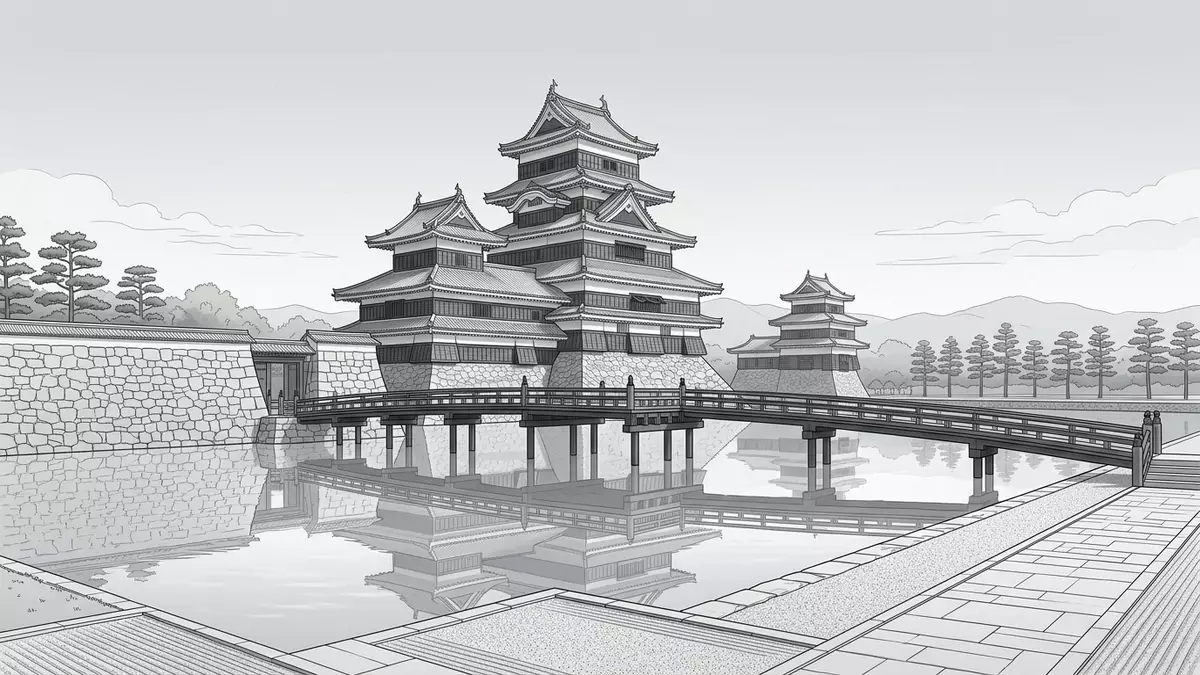
Matsumoto-jo, also known in English as Matsumoto Castle, rises over the plains of Matsumoto in central Honshu with black timber walls and a cluster of linked towers that still keep their original six internal floors from the late sixteenth century.Matsumoto Castle is one of the oldest castles The castle stands as a rare surviving flatland stronghold, surrounded by moats and stone ramparts rather than by cliffs or a mountain slope.Matsumoto Castle is a flatland castle
A black castle from the Warring States period
The story of Matsumoto-jo runs back to Japan’s Sengoku or Warring States period in the late sixteenth century, when regional warlords fortified the Matsumoto plain.Fortification of the site dates back to the Warring States period The present towering keep complex was completed in 1593–1594 under the rule of the Ishikawa clan, retainers of Toyotomi Hideyoshi, with Ishikawa Kazumasa and his son Ishikawa Yasunaga overseeing the work.Toyotomi Hideyoshi's retainers, Ishikawa Kazumasa and Ishikawa Yasunaga, constructed the main keep
The main tower’s dark timber cladding gave Matsumoto-jo its nickname Karasu-jo, the Crow Castle, a name that contrasts with the pale stone base and the white plaster trim under the eaves.also called the Crow Castle In 1936 the keep complex was designated a National Treasure under Japan’s early cultural preservation law, a status that was renewed in 1952 under the modern Cultural Properties Protection Law and underlines the importance of the surviving original timber structure.These castle structures were designated as national treasures on April 20, 1936
Linked keeps, hidden floors and defensive detail
Matsumoto-jo’s striking profile comes from a cluster of structures tied together around the Great Keep, or tenshu, which rises with five visible storeys but contains six internal floors.the oldest surviving example of a castle with five external stories but six internal floors The Inui Keep links to this main tower by a roofed passage, while the Southeast Wing and the Moon-Viewing Tower attach directly, creating a combined plan that shows both linked and compound keep layouts in one ensemble.Matsumoto Castle consists of five structures—the Great Keep, the Inui Keep, the Roofed Passage, the Southeast Wing, and the Moon-Viewing Tower
Inside the keeps, steep wooden staircases climb from floor to floor, threading past low-beamed galleries, storage spaces and defensive positions pierced with openings for matchlocks and arrows. The heavy stone base around the waterline and the encircling moats place the black wooden towers in a defensive landscape characteristic of a hirajiro, or flatland castle, which relied on ramparts, water and walls rather than on altitude.It was built on the plains rather than on a hill or mountain
From domain stronghold to preserved landmark
After the Tokugawa shogunate was established in 1603, Matsumoto-jo became the seat of the Matsumoto domain and passed through the hands of several daimyo families during the Edo period.After the establishment of the Tokugawa shogunate in 1603, Matsumoto-jo became the seat of a domain In the nineteenth century, after the Meiji Restoration, the castle complex faced demolition but was kept standing through the intervention of local residents who organised to buy and preserve it as the surrounding feudal system disappeared.Matsumoto Castle was nearly torn down during the Meiji era and was saved only through the work of local residents
The surviving wooden towers still form the core of a broader site that includes gates, stone walls and moats reflecting centuries of adaptation before twentieth-century restoration. The castle forms one of a small group of original Japanese castles designated as National Treasures, placing Matsumoto-jo alongside Himeji-jo and a few other keeps in the highest category of state protection.Matsumoto Castle is one of the most complete and beautiful among Japan's original castles
Visiting Matsumoto-jo: what travellers from Western Europe should know
- Matsumoto-jo stands in the city of Matsumoto in Nagano Prefecture on the main island of Honshu, inland from the Sea of Japan coast and reached by rail connections that include JR lines into Matsumoto Station.Matsumoto Castle (Matsumotojo) is one of the most complete and beautiful among Japan's original castles
- The castle complex rises on level ground, but the interior routes climb by steep, narrow wooden staircases between the floors of the keep, with low headroom in places and sections where handrails are essential for balance.The towering castle was constructed in 1594
- The site lies within the built-up area of Matsumoto, with views from the upper floors of the towers across the moats towards the surrounding city and the mountains of the Japanese Alps beyond the plain.Matsumoto Castle originally served as a fortress
- The official language is Japanese and the currency is the yen.
- Entry requirements depend on your nationality; UK travellers can check the FCDO travel advice at gov.uk/foreign-travel-advice, Irish travellers the Department of Foreign Affairs at ireland.ie.
Searching for Matsumoto-jo on social platforms
These links open searches for Matsumoto-jo on each platform.
Frequently asked questions about Matsumoto-jo
Where is Matsumoto-jo located?
Matsumoto-jo stands in Matsumoto, a city in Nagano Prefecture on Japan’s main island of Honshu, surrounded by the inland ranges sometimes called the Japanese Alps.
What can visitors expect inside the castle?
Inside the keeps, visitors encounter steep timber staircases, wooden floors, low beams and defensive galleries that preserve the atmosphere of a sixteenth-century mountain-region stronghold.
What makes Matsumoto-jo distinctive among Japanese castles?
Matsumoto-jo combines black-painted timber towers on a flatland site with a rare linked-and-compound keep layout and a main tower that has five exterior storeys and six internal floors.


