
Medina of Tripoli between harbour walls and layered streets
Published on 09/17/2026 at 15:26 | Editorial responsibility: Rafael Müller, Editor-in-Chief AD HOC NEWS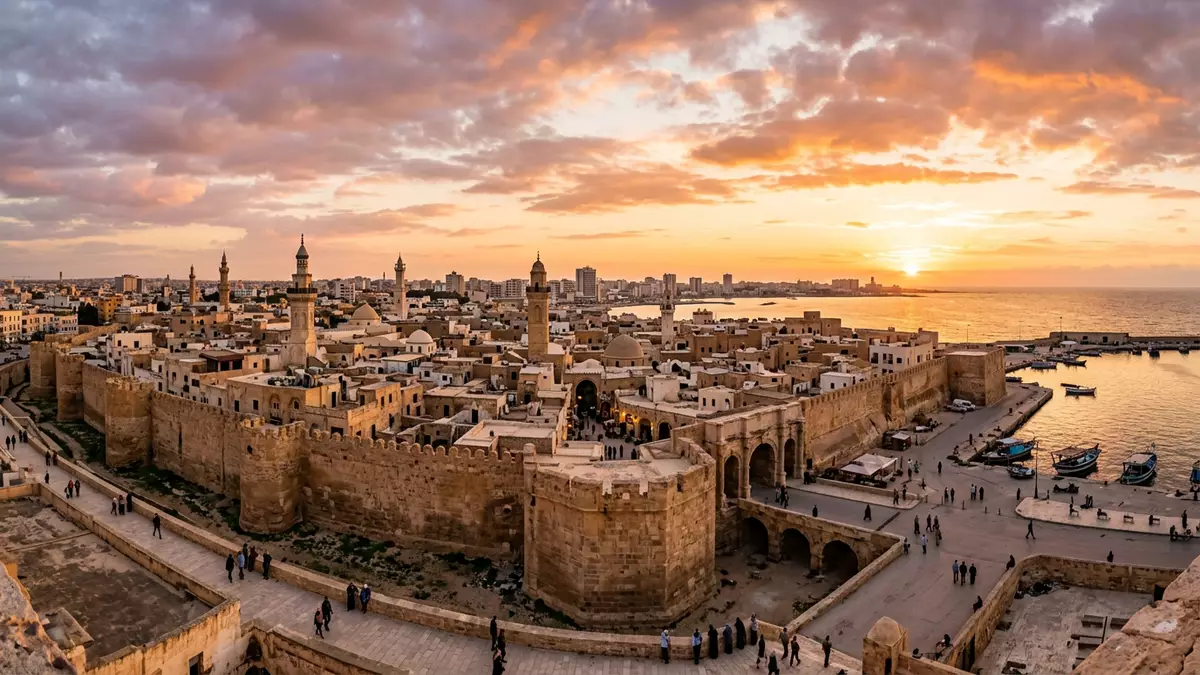
Medina of Tripoli is the historic walled core of Tripolis in Libya, a compact old city pressed between the harbour basin and newer districts on the Mediterranean coast. Its tight street pattern, surviving fortifications and dense mix of mosques and markets give this quarter a distinct character within the wider capital.
Harbour-side walls and the shape of the old city
Medina of Tripoli lies directly beside the harbour on Libya’s Mediterranean shoreline, forming an enclosed urban pocket that can be traced on maps through its lines of walls and bastions. These fortifications, whose final outline dates to Ottoman refortification in the sixteenth century, confine the old quarter into a roughly pentagonal form that contrasts with the more open grid of the surrounding twentieth-century streets.Ottoman refortification in the sixteenth century Within this shell, the Red Castle complex dominates one edge of the medina, reinforcing the impression of a harbour-side stronghold that once guarded approaches from the sea and land.Red Castle complex
The walls historically incorporated gates that marked the transition between newer districts and the old city, and several of these structures remain legible in the urban fabric. Bab Hawwara towards the south-east, Bab Zenata towards the west and Bab al-Bahr facing the sea are among the named gateways through which streets funnel into the medina’s interior.Bab Hawwara, Bab Zenata and Bab al-Bahr From these points, the quarter extends over coastal ground reported as around 48 hectares, its limits set by the fortifications rather than by natural topography.area of 48 hectares
From ancient Oea to an Ottoman-era medina
The history of Medina of Tripoli reaches back to the Phoenician city of Oea, the ancient settlement from which Tripoli developed. Over time, the urban fabric absorbed Roman planning principles, including the reuse of Roman columns within later structures, and then took on its recognisable form during Ottoman control from the sixteenth century onwards.Tripoli began as ancient Oea Under the Karamanli dynasty, which ruled Tripoli in the eighteenth and early nineteenth centuries, houses, mosques and public buildings were added or remodelled, layering local architectural traditions with Ottoman influences.Karamanli rule in Tripoli
Within the medina, this long history appears in visible fragments. Roman elements survive in the arch of Marcus Aurelius, a remnant from the second century that stands close to the old streets, while Ottoman-period mosques and madrasas with domes and minarets rise above surrounding roofs.arch of Marcus Aurelius and historic mosques Residential architecture often clusters around internal courtyards, and some houses, such as the Yusuf Karamanli residence, retain tile-work and decorative features that recall the taste of wealthy families two centuries ago.Yusuf Karamanli house
Narrow streets, markets and religious sites
The interior of Medina of Tripoli is defined by narrow lanes that bend between closely spaced buildings, with arches and overpasses linking structures overhead. Some streets are covered, creating shaded passages that lead deeper into the quarter, while others open onto small squares where cafes, shops and workshops line the edges.maze of narrow streets and arches Souks selling textiles, shoes and everyday goods occupy stretches of these streets, and specialist markets such as the gold souk concentrate jewellery and precious-metal work into compact clusters of stalls.gold market within the medina
Religious sites are woven into this commercial and residential fabric. Mosques including the Gurgi Mosque, built in 1834 beside the Roman arch, form architectural landmarks with their prayer halls and minarets rising above the low surrounding roofs.Gurgi Mosque built in 1834 Caravanserais and former consular buildings add further layers, recalling the medina’s role in trade and diplomacy along the North African coast, while workshops in metal, leather and other crafts continue longstanding urban traditions.caravanserais and consular buildings
Visiting Medina of Tripoli: what travellers from Western Europe should know
- Medina of Tripoli lies in central Tripolis on Libya’s Mediterranean coast, directly beside the harbour and adjacent to major city squares such as the area historically known as Green Square.
- The quarter is compact and largely level but its streets are narrow, with uneven surfaces, occasional steps and passages that pass under arches or through constricted corridors.
- The old city is reached from newer districts by city roads that lead towards the waterfront, with entrances near Martyrs’ Square providing access into the medina’s interior.
- The official language is Arabic and the currency is the Libyan dinar. Entry requirements depend on your nationality; UK travellers can check the FCDO travel advice at gov.uk/foreign-travel-advice, Irish travellers the Department of Foreign Affairs at ireland.ie.
Searching for Medina of Tripoli on social platforms
These links open searches for Medina of Tripoli on each platform.
Frequently asked questions about Medina of Tripoli
Where is Medina of Tripoli located within the city?
Medina of Tripoli forms the historic centre of Tripolis on Libya’s Mediterranean coast, directly beside the harbour and close to central squares and streets.
What can visitors expect when walking through the medina?
Visitors encounter narrow lanes, arches, souks and small squares, with mosques, caravanserais and historic houses set close together in a compact walled quarter.
What makes Medina of Tripoli distinctive among old cities in the region?
The medina combines harbour-side fortifications, a pentagonal walled outline and visible layers from Phoenician, Roman, Ottoman and Karamanli periods within one enclosed urban core.


