
Medina of Tripoli, Libya’s walled harbour old city
Published on 09/21/2026 at 15:57 | Editorial responsibility: Rafael Müller, Editor-in-Chief AD HOC NEWS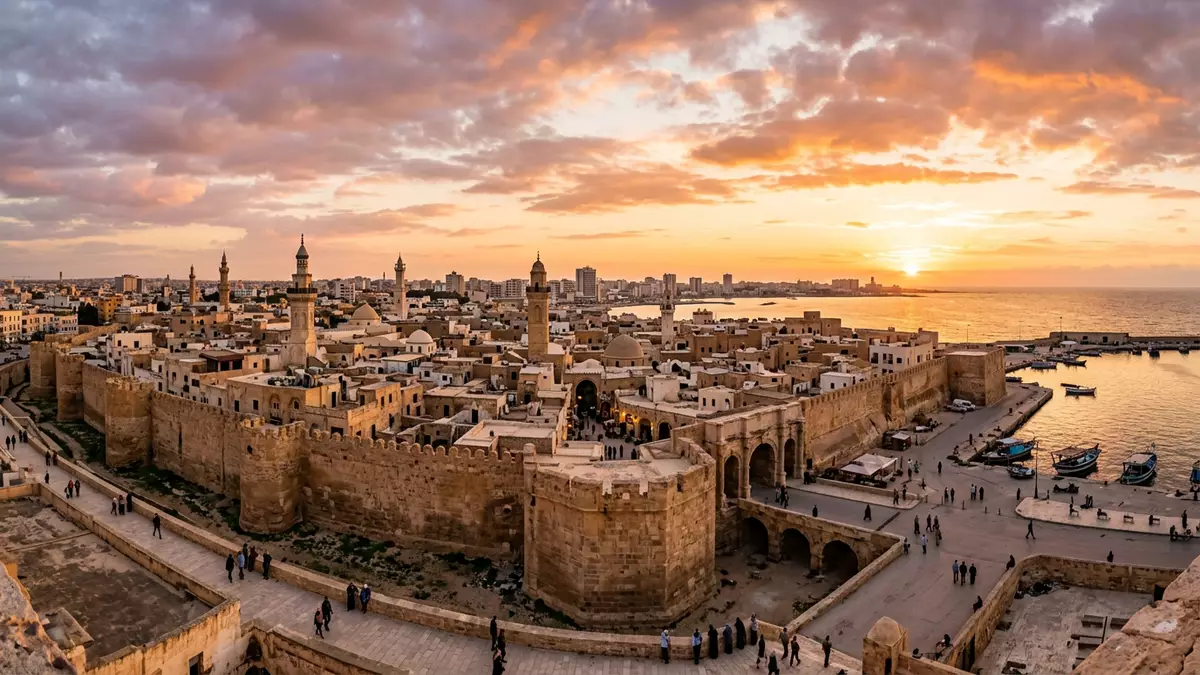
Medina of Tripoli is the historic walled old city of Tripolis in Libya, a compact quarter pressed between the Mediterranean harbour and the newer districts of the capital where dense streets preserve centuries of urban life.
A coastal medina between harbour and castle
Medina of Tripoli forms the enclosed core of Libya’s capital along the Mediterranean Sea, lying beside the harbour on level coastal ground and bounded by stretches of fortification that separate it from the surrounding expansion of Tripolis.ancient walled city Low-rise buildings pack closely behind the waterfront embankment and coastal road, creating a compact mass of roofs and walls between the shoreline and the broader avenues of the newer districts.walled harbour quarter
At the northern edge of the medina, the Red Castle, known locally as Assaraya al-Hamra, rises as a fortified complex that dominates the seafront and anchors the transition between the old city and the open waterfront.Red Castle on the harbour Nearby, the marble arch of Marcus Aurelius, dating from 163 CE, stands as a Roman monument embedded in the urban fabric and marks a point where the ancient past touches the lanes leading into the medina.Marcus Aurelius triumphal arch
Walls, gates and the pentagonal layout
The old city of Tripoli is surrounded by substantial fortification walls whose final outline dates to the sixteenth century, when the town was refortified under Ottoman rule and the overall plan settled into a roughly pentagonal form.Ottoman-period walls and layout These walls enclose an area reported as around 48 hectares, giving the medina a clearly defined edge against the later grid of streets and squares beyond.around 48 hectares of walled streets
Historically, access to the medina passed through named gates in the city walls, including Bab Hawwara towards the south-east, Bab Zenata in the west and Bab al-Bahr facing the sea to the north.historic gates Bab Hawwara, Bab Zenata and Bab al-Bahr Inside, traces of the Roman street grid remain in the form of a main axis that runs between the arch of Marcus Aurelius and areas known as Liberty Gate, with cross streets intersecting it and reinforcing the sense that later Islamic and Ottoman building grew within an older framework.Roman-derived street axes in the medina
Mosques, markets and consular buildings
Within the walled quarter, streets lead to mosques, markets and former consular buildings that show how Medina of Tripoli has served both local religious life and international commerce over time.mosques and consular buildings in the medina The Gurgi Mosque, completed in 1883, and the Karamanli Mosque, dating from the eighteenth century, stand among the notable religious structures, the latter distinguished by its octagonal minaret that rises above the surrounding roofs.Gurgi and Karamanli mosques
Market streets form the commercial core of the medina, where specialised souks occupy lanes and small squares and continue long-established trading patterns in textiles, jewellery and everyday goods.bazaar and traditional wares In places, arches and overpasses link buildings across the lanes, shading stretches of street so that movement through the quarter alternates between open sky and passages under built structures.maze of narrow streets with arches
Visiting Medina of Tripoli: what travellers from Western Europe should know
- Medina of Tripoli lies along the harbour in central Tripolis on Libya’s Mediterranean coast and is reached from the wider city by road and local streets.
- The quarter is compact and largely level, but its lanes are narrow, with uneven surfaces and occasional steps, and some routes pass beneath arches and through constricted passages.
- The old city stands close to central spaces historically known as Green Square, with the Red Castle and the arch of Marcus Aurelius within walking distance of the main market lanes.
- The official language is Arabic and the currency is the Libyan dinar.
- Entry requirements depend on your nationality; UK travellers can check the FCDO travel advice at gov.uk/foreign-travel-advice, Irish travellers the Department of Foreign Affairs at ireland.ie.
Searching for Medina of Tripoli on social platforms
These links open searches for Medina of Tripoli on each platform.
Frequently asked questions about Medina of Tripoli
Where is Medina of Tripoli located within the city?
Medina of Tripoli occupies the historic centre of Tripolis on Libya’s Mediterranean coast, lying beside the harbour and close to central city squares and streets.
What should visitors expect when walking through the medina?
Visitors encounter narrow streets, occasional steps, arches linking buildings overhead, market lanes with traditional goods and views towards mosques, Roman remains and the Red Castle.
What makes Medina of Tripoli distinctive among old cities in the region?
Medina of Tripoli combines a pentagonal Ottoman-era wall layout, Roman monuments such as the arch of Marcus Aurelius and mosques from the medieval and Ottoman periods within one compact coastal quarter.


