
Medina of Tripoli, where harbour walls enclose an old city
Published on 09/18/2026 at 20:13 | Editorial responsibility: Rafael Müller, Editor-in-Chief AD HOC NEWS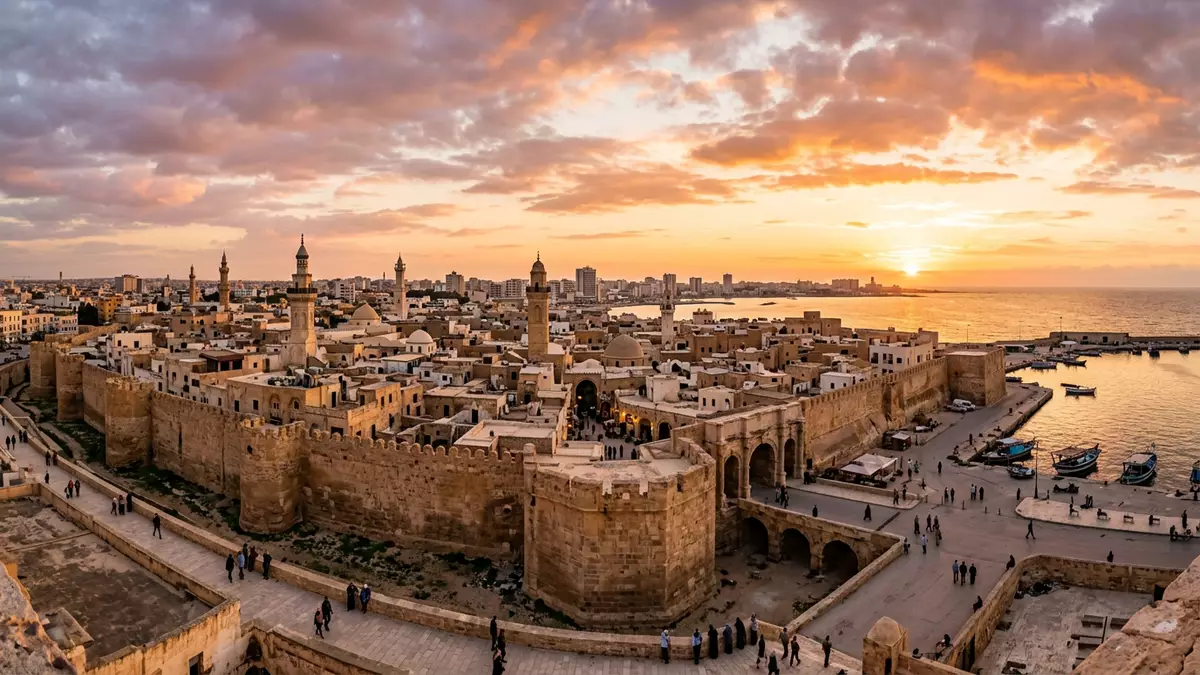
Medina of Tripoli is the historic walled old city of Tripolis in Libya, a compact quarter pressed between the harbour and the newer districts on the Mediterranean coast. Within its dense streets, Islamic, Ottoman and colonial-era buildings sit beside one another, giving the capital a visible core that predates the twentieth-century expansion.
Harbour walls and a compact Mediterranean layout
The Medina of Tripoli forms the enclosed core of Libya’s capital, lying directly along the Mediterranean Sea beside the harbour in central Tripolis. Stretches of fortification surround the quarter, and the overall layout settled into a roughly pentagonal form when the town was refortified under Ottoman rule in the sixteenth century.pentagonal form under Ottoman refortification The old city is distinct from the newer districts around it, with narrow lanes and small squares packed into an area reported as around 48 hectares.around 48 hectares of walled streets
The street pattern inside the walls is fine-grained, with lanes that turn and branch in short segments before meeting slightly wider thoroughfares. Many of these streets carry vaulted coverings or overpasses in the souk area, creating alternation between stretches open to the sky and parts where buildings lean inward above shoppers. Caravanserais, bathhouses and mosques sit within this pattern, their entrances opening directly onto alleys that can feel more like corridors than conventional roads in a modern grid.
Layers from Oea, Ottoman refortification and Karamanli rule
Tripolis traces its origins back to the ancient city of Oea, a Roman-era port on the North African coast whose remains still surface inside the medina. One of the clearest Roman survivals is the arch of Marcus Aurelius, a triumphal structure whose carved reliefs and columns stand within the old city and are partly woven into later buildings.arch of Marcus Aurelius within the medina Across the quarter, spolia from antiquity appear in facades, interior courtyards and religious buildings, with reused columns and carved blocks marking how earlier material was folded into Islamic architecture.
The wider appearance of the Medina largely took shape during the Ottoman period from the sixteenth century onwards, including the time of Karamanli rule, when defensive walls reached their final configuration and administrative and religious buildings multiplied.Ottoman and Karamanli period shaping the old town Architectural vocabulary in the medina draws on Hafsid influences associated with the thirteenth to sixteenth centuries, with mosques and madrassas showing forms inspired by Tunisian examples of that era.Hafsid-style mosques between the thirteenth and sixteenth centuries Later Ottoman interventions, together with Italian colonial construction nearby, added additional layers, leaving consular buildings and an Italian-era palace close to the older fabric.
Souks, specialised markets and religious architecture
Within the Medina of Tripoli, specialised souks concentrate much of the commercial activity and follow a pattern familiar from other Arab medinas. Different trades focus in different streets, with jewellery makers clustering near markets such as Souk al-Turk and leather workers near older tanneries, while spice merchants and food sellers occupy their own souk areas.specialised souks with segregated trades In these quarters, frontages often open in a simple way, with small interiors leading back to storage spaces, workshops and courtyards where much of the work takes place away from the street.
The medina’s religious architecture includes mosques dating from different periods, among them buildings associated with early Islamic history and later Ottoman patrons. Hafsid-style elements appear in arcades and columns, while Mamluk and Ottoman influences show in domes, decorative stonework and internal arrangements of prayer halls.Hafsid and Ottoman influences in mosque design Religious schools and smaller prayer spaces are woven into the residential and commercial fabric, reinforcing how trade, learning and worship share the same tight urban space. Nearby, the Red Castle at the edge of the medina stands as a major landmark connected with the city’s defensive history and later museum use.Red Castle and arch anchoring the historic centre
Visiting Medina of Tripoli: what travellers from Western Europe should know
- Medina of Tripoli lies along the harbour in central Tripolis on Libya’s Mediterranean coast and is reached by city roads from the surrounding districts and main squares.
- Within the medina, streets are narrow and often irregular, and some routes in the souk area pass beneath vaulted coverings and overpasses, so walking involves frequent turns and changes of level.
- The old city stands beside the Mediterranean shoreline and close to central spaces historically known as Green Square, with the Red Castle and the arch of Marcus Aurelius within walking distance of the market lanes.
- The official language is Arabic and the currency is the Libyan dinar. Entry requirements depend on your nationality; UK travellers can check the FCDO travel advice at gov.uk/foreign-travel-advice, Irish travellers the Department of Foreign Affairs at ireland.ie.
Searching for Medina of Tripoli on social platforms
These links open searches for Medina of Tripoli on each platform.
Frequently asked questions about Medina of Tripoli
Where is Medina of Tripoli located?
Medina of Tripoli is the historic walled centre of Tripolis in Libya, lying along the Mediterranean Sea beside the harbour and close to central city squares.
What should visitors expect inside the old city?
Visitors encounter narrow streets, specialised souks, mosques and historic buildings, with Roman, Hafsid, Ottoman and later influences mixed into a compact urban fabric.
What makes Medina of Tripoli distinctive among North African old towns?
Its character comes from the way Roman remains such as the arch of Marcus Aurelius, Hafsid-style mosques and Ottoman-period walls converge beside the harbour in a defined walled quarter.


