
Medina of Tunis, a living Arabo-Muslim city of labyrinthine lanes
Published on 09/18/2026 at 22:26 | Editorial responsibility: Rafael Müller, Editor-in-Chief AD HOC NEWS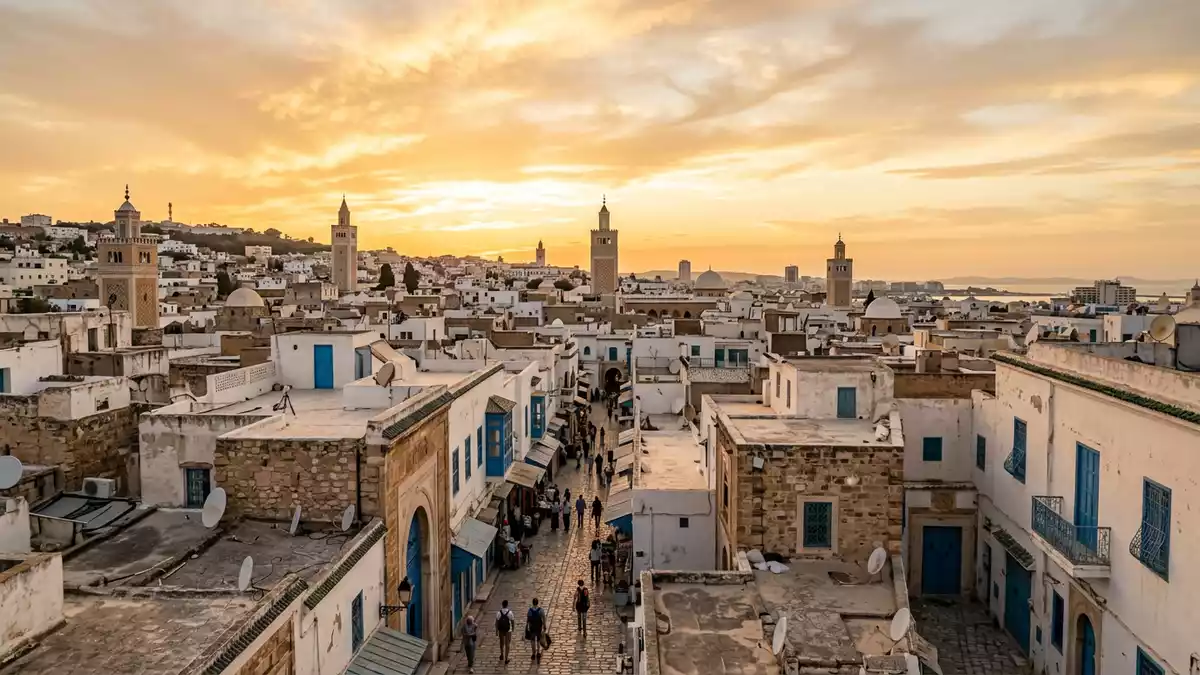
The Medina of Tunis is the historic core of Tunis, a dense Arabo-Muslim city where narrow lanes, courtyards and covered markets still follow an early Islamic street pattern from the eighth century. Founded around the Ez-Zitouna Mosque and later flourishing under dynasties such as the Hafsids, it has been recognised as a UNESCO World Heritage Site since 1979, with hundreds of listed monuments woven into a compact urban fabric.
An early Arabo-Muslim city with a preserved plan
Set in north-eastern Tunisia a short distance inland from the Mediterranean, the Medina of Tunis grew from an early Islamic foundation laid in 698 AD, when an Arabo-Muslim town was established around a congregational mosque.one of the first Arabo-Muslim towns The historic core occupies a few hundred hectares, with the UNESCO World Heritage property described as covering roughly 280 to just under 300 hectares, framing a compact city of houses, religious buildings and trading streets.a complex urban ensemble covering approximately 295 ha
The urban structure rests on a central medina dating from the eighth century, flanked by later suburbs to the north and south that took shape in the thirteenth century.central medina and 13th-century neighbourhoods Within this structure, sources describe some 700 historic monuments, from mosques and mausoleums to madrasas, palaces and fountains, distributed across defined areas. The original street plan, with its irregular mesh of alleys and souqs, has been described as well preserved, giving a visitor an immediate sense of a medieval Arab-Islamic city.
Monuments of faith, power and learning
The Ez-Zitouna Mosque, also written Al-Zaytouna or Zitouna, forms one of the principal landmarks of the Medina of Tunis, occupying a central position and anchoring surrounding markets and streets.im Zentrum der Medina liegt die Ez-Zitouna-Moschee The mosque’s history reaches back to the early centuries of Islam in North Africa, and it stands alongside other significant religious structures, including the Kasbah Mosque and the Youssef Dey Mosque named in UNESCO documentation.Zitouna, Kasbah and Youssef Dey mosques
Beyond the mosques, the medina contains mausoleums such as Tourbet el Bey, palaces and noble houses like Dar el-Bey, Dar Hussein, Dar Ben Abdallah and Dar Lasram, as well as educational institutions including madrasas such as Es-Slimanya and El-Mouradia.palaces, noble houses and madrasas This concentration of monuments reflects periods in which Tunis served as a capital for influential dynasties, among them the Almohads and the Hafsids from the twelfth to the sixteenth century, when it was regarded as one of the greatest and wealthiest cities in the Islamic world.under the Almohads and the Hafsids
Souqs, gates and everyday life in the old city
The Medina of Tunis is not only defined by monuments but also by its souqs and residential quarters, where trading streets and artisan workshops sit alongside homes with internal courtyards and decorated doorways. Historic souqs such as Souq el-Attarine and Souqs ech-Chaouachia are listed among the notable areas, indicating long-established specialisations in perfumery, textiles and other trades.souqs including Souq el-Attarine The spatial relationship between covered markets, religious buildings and civic structures helps explain why the medina is described as an ensemble demonstrating interaction between architecture, urbanism and socio-cultural change.
Access to the old city is marked by gates that punctuate the boundary between the medina and the later city outside its historic core. Bab Bhar, also known as Bab el Bahr or the Porte de France, and Bab Jedid are among the named gates, each facing towards different quarters and later districts.Bab Jedid Gate and Bab Bhar Gate From these entrances, lanes branch into souqs and residential streets, with traffic quickly giving way to pedestrian movement on narrow pavements and stone or packed surfaces, revealing an urban pattern laid down long before motor vehicles.
Visiting Medina of Tunis: what travellers from Western Europe should know
- The Medina of Tunis lies within central Tunis in north-eastern Tunisia, inland but relatively close to the Gulf of Tunis, and is reached from the wider city by urban roads and public transport, including routes that converge near Bab Bhar.
- Within the medina, streets are narrow and often stepped, with frequent changes of level and an irregular layout that can feel like a maze, so walking involves negotiating tight corners, uneven paving and occasional slopes.
- Arabic is the official language and the currency is the Tunisian dinar.
- Entry requirements depend on your nationality; UK travellers can check the FCDO travel advice at gov.uk/foreign-travel-advice, Irish travellers the Department of Foreign Affairs at ireland.ie.
Searching for Medina of Tunis on social platforms
These links open searches for Medina of Tunis on each platform.Frequently asked questions about Medina of Tunis
Where is the Medina of Tunis located?
The Medina of Tunis forms the historic centre of Tunis, in north-eastern Tunisia, a short distance inland from the Gulf of Tunis and the Mediterranean Sea.
What can visitors expect during a visit?
Visitors encounter a dense network of narrow streets, historic souqs, mosques, palaces and traditional houses, with trading areas and residential quarters closely interwoven.
What makes the Medina of Tunis distinctive?
Its combination of an early Arabo-Muslim street plan from the eighth century, hundreds of listed monuments and its inscription as a UNESCO World Heritage Site since 1979 gives the medina a distinctive historic character.


