
Medina of Tunis and its maze of monuments
Published on 09/05/2026 at 13:54 | Editorial responsibility: Rafael Müller, Editor-in-Chief AD HOC NEWS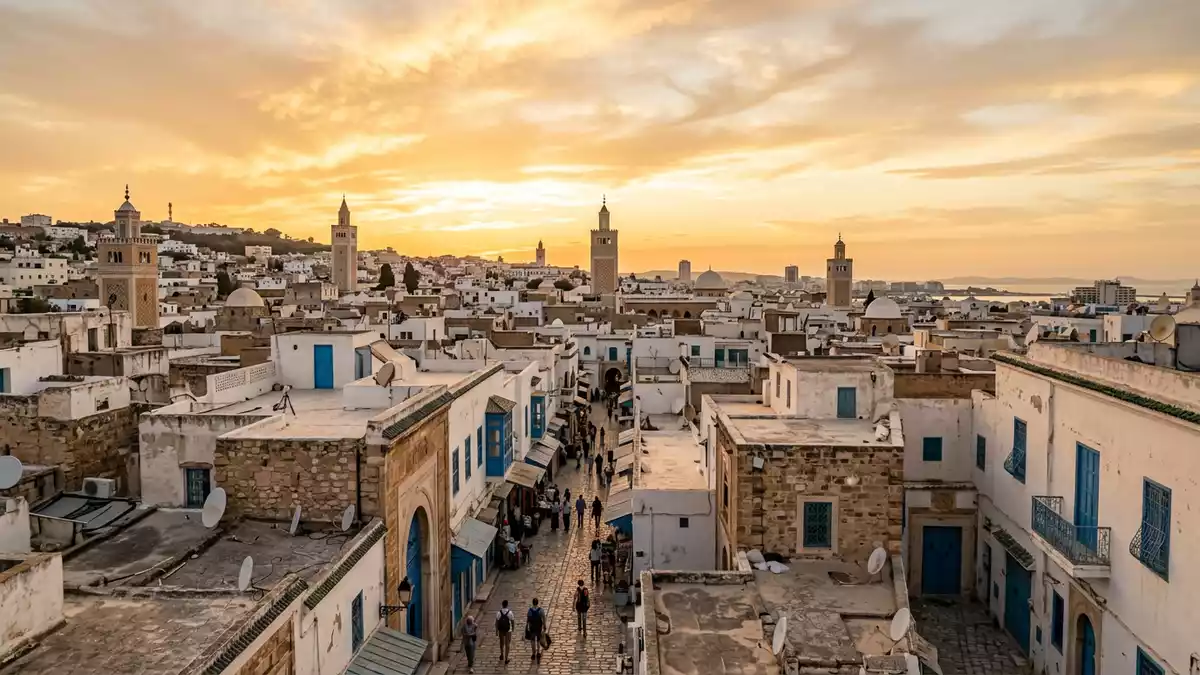
Medina of Tunis is the historic core of Tunis in Tunisia, an Arabo?Muslim city whose fabric took shape from the late seventh and eighth centuries around the Zitouna Mosque and the surrounding souks. It forms an urban ensemble recognised as a UNESCO World Heritage Site, inscribed in 1979 as a cultural property that preserves a dense concentration of religious, civic and commercial architecture within its walls.
An early Arabo?Muslim city shaped around Zitouna Mosque
The Medina of Tunis grew as one of the first Arabo?Muslim towns in the Maghreb, founded in the late seventh century and structured in the eighth century around a central congregational mosque and a tight network of streets.one of the first Arabo-Muslim towns The Aghlabid Ez?Zitouna Mosque, whose origins lie in the early eighth century, anchors the heart of the medina, and its courtyard and arcades form a focal space in the city’s religious and scholarly life.Aghlabid Ez-Zitouna Mosque
Around this core spreads a compact street plan whose main axes lead from gates such as Bab Bhar and Bab Jedid towards the central mosque and markets.Bab Jedid Gate and Bab Bhar Gate The inscribed World Heritage property covers in the order of 280 to just under 300 ha, comprising the original medina and the later suburbs to the north and south that date to the thirteenth century.area and thirteenth-century suburbs Narrow passages open into wider neighbourhood streets, small squares and mosque courtyards, forming a pattern that visitors follow between religious buildings, markets and residential districts.
Dynastic capital and dense concentration of monuments
From the twelfth to the sixteenth century, Medina of Tunis served as the capital of influential dynasties such as the Almohads and Hafsids, who ruled large parts of the Islamic West and North Africa.Almohads and Hafsids Their patronage, alongside that of later rulers, left the medina with some 700 historic monuments in seven areas, including mosques, palaces, mausoleums, madrasas and fountains.some 700 historic monuments Among the most cited are the Kasbah Mosque, the Youssef Dey Mosque, the Tourbet el Bey family cemetery and noble houses such as Dar Hussein and Dar Ben Abdallah, which stand in streets lined by workshops and traders.
The UNESCO inscription in 1979 under cultural criteria (ii), (iii) and (v) formally recognised how Medina of Tunis bears witness to the interaction between architecture, urbanism and socio?cultural and economic changes across centuries.inscribed in 1979 under cultural criteria Within the walls, visitors encounter Ottoman?period minarets, madrasas with courtyards and galleries, and dars arranged around interior patios, each reflecting the periods in which they were built. Religious complexes stand close to souks where guilds of perfumers, metalworkers and cloth sellers have traded in covered streets for generations.
Urban fabric, souks and houses within the walls
The medina’s street pattern, largely dating to the eighth century, has survived major transformations and retains its characteristic hierarchy of main thoroughfares, secondary lanes and cul?de?sacs.original street plan Souq el?Attarine and other markets form linear sequences of shops under continuous roofing, where merchandise spills towards the walkway and arches frame the entries to side passages.Souq el-Attarine and other souqs Behind the commercial frontages lie residential quarters with houses built around interior courtyards, giving access to rooms through porticoes and staircases.
Monuments such as Dar Lasram, Dar Hussein and Dar Ben Abdallah illustrate the domestic architecture of elite families, with stone portals, carved stucco and timber ceilings arranged along reception halls and private rooms.noble houses such as Dar Hussein Military structures and barracks, including the El Attarine barracks, and religious complexes such as the Zaouia of Sidi Mehrez, add further layers to the built landscape, while gates like Bab Bhar still mark transitions between the historic medina and later quarters laid out beyond the former marshes.
Visiting Medina of Tunis: what travellers from Western Europe should know
- Medina of Tunis lies in the governorate of Tunis in northern Tunisia, inland from the Gulf of Tunis and reached by urban roads that lead towards Bab Bhar and other gates at the edge of the historic core.
- The historic quarters consist of narrow, sometimes stepped streets and passageways between closely built houses and markets, with gradients and uneven paving that require steady footing on longer walks.
- Medina of Tunis is surrounded by later districts of Tunis, including areas once known as Ville Nouvelle, so a visit to the medina can be combined with time in the broader city and its coastal surroundings.
- The official language is Arabic and the currency is the Tunisian dinar.
- Entry requirements depend on your nationality; UK travellers can check the FCDO travel advice at gov.uk/foreign-travel-advice, Irish travellers the Department of Foreign Affairs at ireland.ie.
Searching for Medina of Tunis on social platforms
These links open searches for Medina of Tunis on each platform.
Frequently asked questions about Medina of Tunis
Where is Medina of Tunis located?
Medina of Tunis is the historic walled city at the centre of Tunis in northern Tunisia, inland from the Gulf of Tunis and within the governorate of Tunis.
What can visitors expect inside the medina?
Visitors encounter a dense network of narrow streets, mosque courtyards, covered souks and historic houses, along with monuments such as the Zitouna Mosque and Dar Hussein.
What makes Medina of Tunis distinctive among historic cities?
Medina of Tunis combines an early Arabo?Muslim street plan from the eighth century with a large number of monuments from later dynasties, recognised by its UNESCO World Heritage inscription from 1979.


