
Meenakshi Amman Temple and its painted towers of Madurai
Published on 09/05/2026 at 22:31 | Editorial responsibility: Rafael Müller, Editor-in-Chief AD HOC NEWS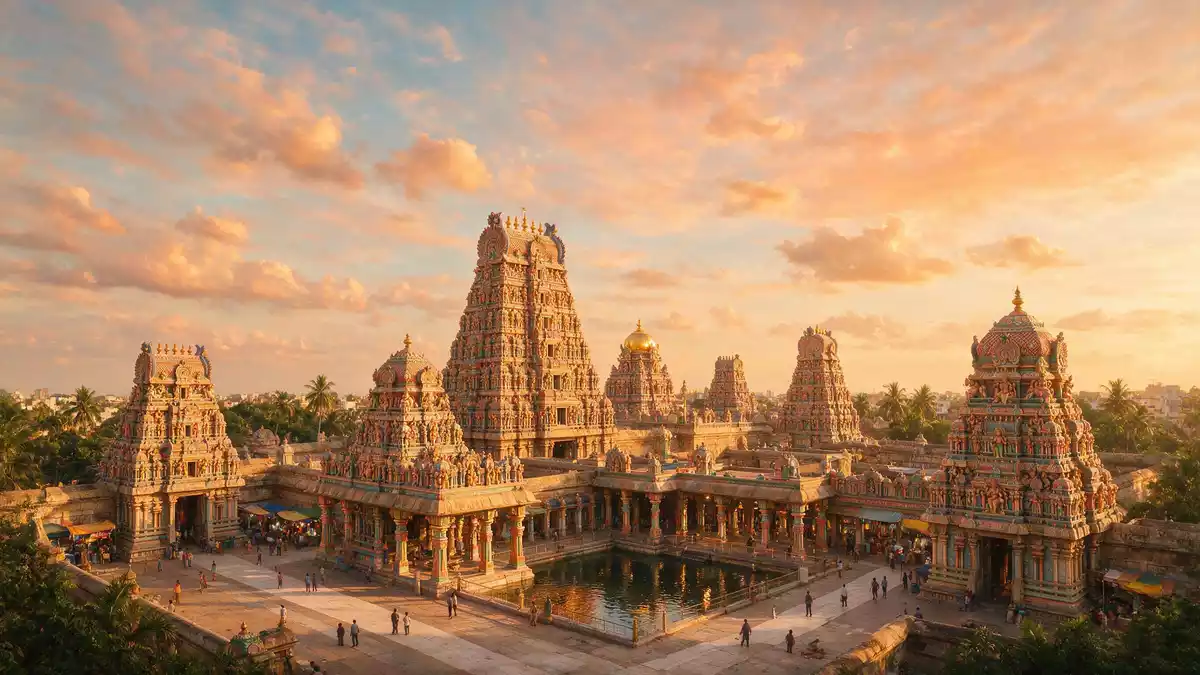
Meenakshi Amman Temple in Madurai is a walled temple-city, where painted gateway towers, pillared halls and shrines form a continuous Dravidian complex shaped above earlier Pandya foundations in the sixteenth and seventeenth centuries.
A temple-city shaped by Pandyas and Nayaks
Meenakshi Amman Temple stands in the centre of Madurai in Tamil Nadu, a city whose history and mythology have been tied to the goddess Meenakshi for many centuries.temple complex in Madurai, Tamil Nadu The site carries layers of construction associated with the Pandya dynasty, whose capital was at Madurai and whose rulers patronised the sanctuary from at least the early centuries of the Common Era.foundations that reach back to the Pandya dynasty
Much of the standing complex, however, belongs to the Madurai Nayak period, when rulers such as Vishwanatha Nayak and Tirumalai Nayak reorganised and expanded the shrine between the sixteenth and seventeenth centuries.expanded during the reigns of Vishwanatha Nayak and Thirumalai Nayak Under the Nayaks the temple grew into a temple-city with concentric enclosures, broad courtyards and long processional routes aligned with the street grid of Madurai, giving pilgrims and visitors successive layers of space around the central shrines.
Dravidian architecture and painted gopurams
The architecture of Meenakshi Amman Temple belongs to the Dravidian tradition of South India, with masonry enclosures, towering gateway superstructures and an ordered sequence of mandapams, or pillared halls.Dravidian temple architecture Over the Nayak period the complex assumed its present form, with gopurams marking major entrances and rising above surrounding districts as landmarks, their dense surfaces carrying stucco figures that are periodically renewed.painted masonry and plaster figures that are periodically renewed
Each gopuram stacks storeys of carved and modelled figures, including deities, guardians, mythical creatures and narrative scenes drawn from Hindu epics, turning the towers into visual encyclopaedias of Tamil religious art.gateway towers crowded with deities and mythological figures Within the enclosures, halls such as the so-called thousand-pillar mandapam belong to the same Dravidian vocabulary, with rows of carved columns and sculpted ceilings that extend the visual density of the gopurams into covered interior space.Hall of 1000 Pillars completed in 1569
Ritual space and everyday movement
Inside Meenakshi Amman Temple, shrines dedicated to the goddess Meenakshi and to Sundareshwarar, a form of Shiva, sit at the heart of a network of courtyards, halls and corridors used for worship and for ritual processions.shrines to Meenakshi and Sundareshwarar The core sanctums are surrounded by subsidiary shrines, sculpted niches and mandapams where ceremonies, recitations and gatherings take place, integrating religious functions with the daily movement of residents and visitors through the precinct.
The temple’s courtyards and halls accommodate ritual processions that follow fixed routes around the complex, passing under gopurams and through mandapams whose pillars and ceilings carry sculpted depictions of the stories celebrated in those same rituals.processional paths laid out by Nayak planners At the same time, the temple-city functions as a dense urban node, with arcades, colonnades and side halls opening into surrounding streets, so that the transition from market lanes into sacral space happens through progressive thresholds rather than a single boundary.
Visiting Meenakshi Amman Temple: what travellers from Western Europe should know
- Meenakshi Amman Temple stands at the centre of Madurai in Tamil Nadu, South India, and is reached from the surrounding streets that radiate out as concentric avenues around the complex.
- Within the temple precinct, access between levels and into many halls is by staircases and stepped thresholds, and movement follows covered corridors and open courts rather than wide, level plazas.
- The Vaigai River flows to the north of central Madurai, and the districts around Meenakshi Amman Temple contain trading streets, markets and older residential quarters that form the city’s historic core.
- The official language in this part of India is Tamil and the currency is the Indian rupee.
- Entry requirements depend on your nationality; UK travellers can check the FCDO travel advice at gov.uk/foreign-travel-advice, Irish travellers the Department of Foreign Affairs at ireland.ie.
Searching for Meenakshi Amman Temple on social platforms
These links open searches for Meenakshi Amman Temple on each platform.
Frequently asked questions about Meenakshi Amman Temple
Where is Meenakshi Amman Temple located?
Meenakshi Amman Temple is located in the city of Madurai in the state of Tamil Nadu in southern India, forming the historic core of the urban layout.
What can visitors expect inside the complex?
Visitors encounter painted gopurams, courtyards, pillared mandapams and inner shrines to Meenakshi and Sundareshwarar, with corridors and halls laid out for ritual movement and worship.
What makes Meenakshi Amman Temple distinctive among South Indian temples?
The combination of ancient Pandya foundations, Nayak-era Dravidian architecture and the dense skyline of sculpted, painted gopurams gives Meenakshi Amman Temple a temple-city character closely woven into Madurai’s street grid.


