
Meiji Jingu and Tokio’s forest shrine
Published on 09/22/2026 at 17:08 | Editorial responsibility: Rafael Müller, Editor-in-Chief AD HOC NEWS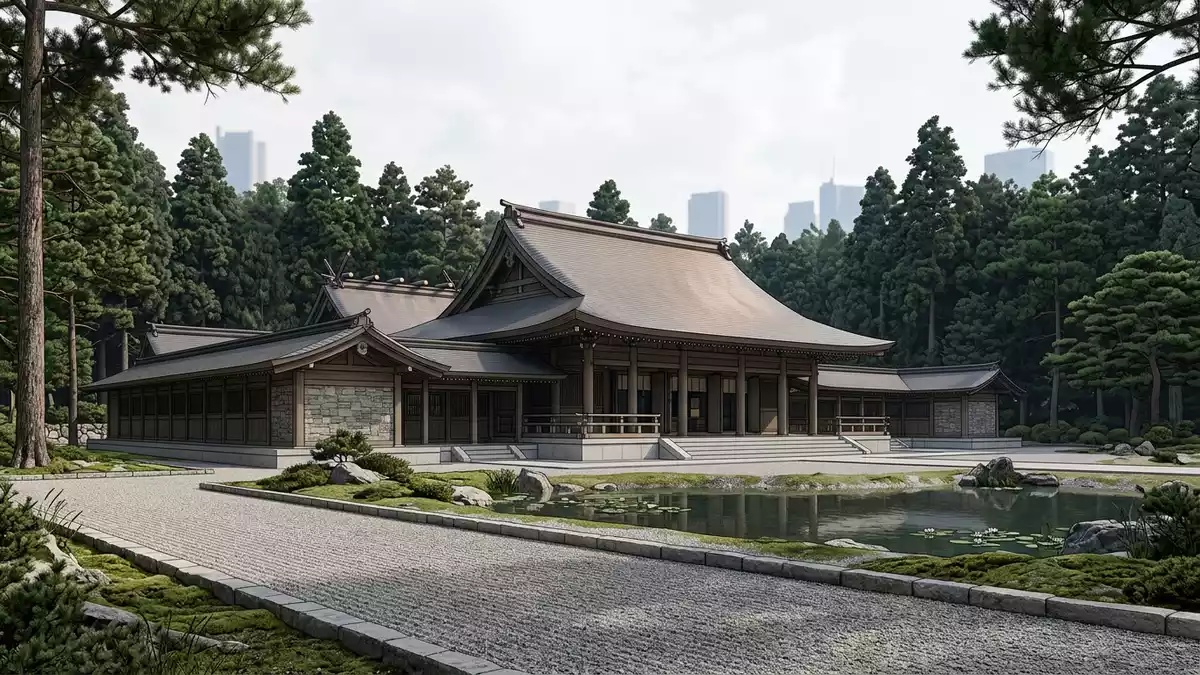
Meiji Jingu is a Shinto shrine in Tokio, set within a broad woodland of planted trees. Its timber buildings and forested approaches create a visible meeting of shrine architecture and an urban landscape.
Meiji Jingu: a shrine within a planted forest
Meiji Jingu was established on 1 November 1920 to commemorate Emperor Meiji and Empress Shoken. The shrine stands in Shibuya, close to Harajuku, with its central buildings surrounded by a forest covering about 70 hectares.
The woodland is man-made rather than an untouched remnant of native forest. More than 100,000 trees came from across Japan, and young volunteers took part in planting the precinct. The result is a dense green setting arranged around broad approaches, gravel paths and shrine buildings.
Timber buildings and nagare-zukuri roofs
The main shrine buildings use Japanese cypress and copper. Their traditional nagare-zukuri form includes extended, asymmetrical gabled roofs, while the surrounding woodland frames the complex with tall trunks and layered foliage.
Construction began in 1915 under the architect It? Ch?ta. The shrine belongs to the early twentieth century, yet its architectural vocabulary draws on established Shinto forms. Wood, copper, gravel and evergreen planting appear together across the precinct.
Emperor Meiji, Empress Shoken and Shinto practice
Meiji Jingu is dedicated to Emperor Meiji, who reigned from 1867 to 1912, and Empress Shoken, who lived from 1850 to 1914. The shrine records their place in Japan’s modern imperial history.
Visitors encounter a sequence of torii gates, wooded paths, purification facilities and worship spaces. The precinct also contains sake barrels donated by breweries, wooden plaques for written prayers and ceremonial areas used for Shinto rites.
Visiting Meiji Jingu: what travellers from Western Europe should know
- Meiji Jingu lies in Shibuya, Tokio, beside Yoyogi Park and close to Harajuku Station. The shrine is reached through the forested precinct from the Harajuku and Meiji-jingumae area.
- The approach follows broad gravel paths beneath the trees. Comfortable footwear is useful because the precinct involves a substantial walk before the central shrine buildings.
- The official language is Japanese and the currency is the Japanese yen.
Searching for Meiji Jingu on social platforms
These links open searches for Meiji Jingu on each platform.
Frequently asked questions about Meiji Jingu
Where is Meiji Jingu?
Meiji Jingu is in Shibuya, Tokio, beside Yoyogi Park and near Harajuku Station. Its shrine buildings occupy a forested precinct in the capital.
What can visitors expect at Meiji Jingu?
Visitors pass through torii gates and wooded approaches before reaching timber shrine buildings. Shinto purification facilities, worship spaces, sake barrels and prayer plaques appear within the precinct.
What makes Meiji Jingu distinctive?
Meiji Jingu combines a shrine established in 1920 with a planted forest covering about 70 hectares. Japanese cypress buildings, copper roofs and dense woodland form its defining landscape.


