
Metzada, the desert fortress above the Dead Sea
Published on 09/14/2026 at 21:35 | Editorial responsibility: Rafael Müller, Editor-in-Chief AD HOC NEWS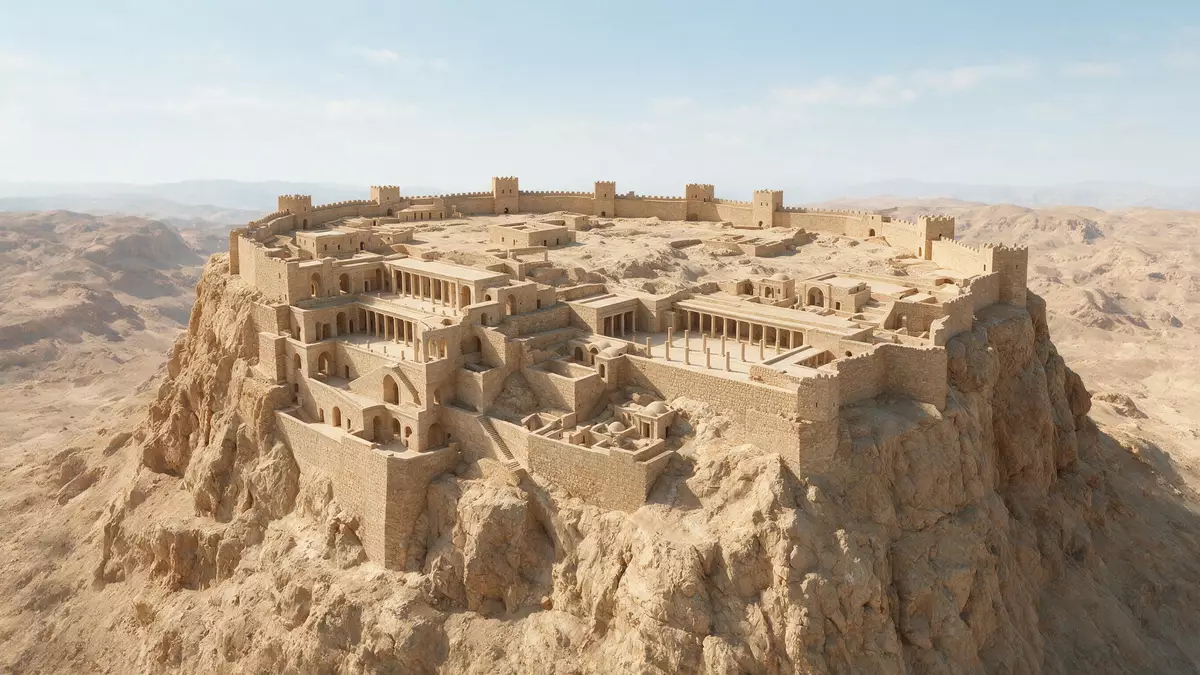
Metzada, known internationally as Masada, is an ancient fortress complex set high on a rocky plateau above the western shore of the Dead Sea in Israel. Its isolated position in the Judaean Desert and its powerful association with the First Jewish–Roman War make it one of the most recognisable archaeological sites in the region.
A palace fortress on a desert plateau
Metzada occupies the top of an isolated mesa in the Judaean Desert in southeastern Israel, overlooking the Dead Sea and the desert plains around it.mountaintop fortress in southeastern Israel The plateau rises several hundred metres above the surrounding terrain, creating steep cliffs on most sides and giving the site a commanding position over the landscape and the shore below.cliffs made up of chalk, dolomite and marl strata
The fortress itself is laid out across the summit of the rock, where natural topography defines a roughly elongated, flat area. Here walls, towers, storehouses and living quarters follow the outline of the plateau, making use of its long edges and narrow ends. The site’s rock is described as chalk, dolomite and marl, and the colour of these layers contrasts with the deeper blue of the Dead Sea below.isolated rock cliff at the western end of the Judean Desert The combination of steep geology and extensive built remains gives Metzada both a strong defensive character and a distinct visual presence.
Herod the Great and the architecture of power
The origins of the fortress go back to the late Hasmonean period, but the most extensive building phase is associated with Herod the Great, King of Judaea, who reigned from 37 BC to 4 AD.Herod the Great, King of Judaea (reigned 37 – 4 B.C.) Between 37 and 31 BC, Herod transformed Metzada into a palace complex in the style of the early Roman Empire, combining residential quarters, reception spaces and defensive works.Herod the Great built the fortress of Masada between 37 and 31 BCE
On the plateau, remains of spacious palaces, luxurious bathhouses, storerooms and barracks testify to the scale of Herod’s construction programme.spacious palaces, luxurious bathhouses, well-stocked storerooms The casemate wall running around the edge of the summit enclosed the complex, and within it stood palatial buildings that combined Roman architectural forms with the needs of a desert stronghold. One of the best known elements is the northern palace, built in terraces descending down the side of the rock, where structural remains suggest multi-level reception rooms and living spaces oriented towards views over the Dead Sea.
Water, storage and the long siege
Metzada’s builders invested heavily in water collection and storage, a crucial feature for a fortress in an arid region away from permanent surface streams. Around the flanks of the rock and on the plateau itself stand multiple large cisterns cut into the rock and lined to hold collected water.sophisticated water collection system that allowed it to sustain a thousand people Channels and aqueducts brought occasional floodwater from the surrounding wadis down towards these reservoirs, feeding the citadel’s supply.
Extensive storerooms across the plateau formed part of the same provisioning strategy, with long halls used to hold food and equipment during times of occupation or siege.storehouses, large cisterns ingeniously filled with rainwater These physical remains have played a central role in archaeological interpretations of the fortress’s capacity and its ability to sustain defenders for extended periods. Combined with the outer fortifications and inner living quarters, they illustrate how Metzada functioned as both royal refuge and later as a stronghold during conflict.
Metzada and the First Jewish–Roman War
During the First Jewish–Roman War in the first century AD, Metzada became the site of a prolonged confrontation between Roman forces and Jewish rebels. After the fall of Jerusalem in 70 AD, the fortress remained as one of the last centres of resistance in Judaea.last remnant of Jewish rule in Palestine The hilltop stronghold was held by members of the Sicarii, a rebel group, along with families who had taken refuge there.fortress was held by members of the Sicarii rebel group
In 72–73 AD, the Roman governor Lucius Flavius Silva led legion X Fretensis and auxiliary units in a siege of Metzada, surrounding the plateau with camps and a circumvallation wall.Roman governor of Judaea, Lucius Flavius Silva One of the most striking features associated with this episode is the great siege ramp built up the western side of the rock from earth and timber, which allowed Roman siege engines to approach the fortress walls.massive assault ramp made of earth and wooden revetments The archaeological traces of these Roman works remain visible around the base of the plateau and form part of the wider landscape visitors encounter.
World Heritage status and modern access
Metzada’s combination of natural setting and historical significance led to its inscription as a UNESCO World Heritage site in 2001.designated a UNESCO World Heritage site in 2001 UNESCO highlights the fortress as a symbol of the ancient kingdom of Israel and of the dramatic events of 73 AD that have entered historical and cultural memory.rugged natural fortress in the Judaean Desert overlooking the Dead Sea The site’s status reflects both its archaeological richness and its role within narratives of resistance and empire in the eastern Mediterranean.
Approaching Metzada involves crossing the arid expanses of the Judaean Desert at the western edge of the Dead Sea. The fortress lies in Israel’s Southern District, with the plateau rising above the desert floor and the shoreline.mountain-top fortress complex in the Judaean Desert Modern access routes bring visitors to the base area, from where paths and mechanical transport ascend to the ruins on the summit. Once on top, the relationship between the built remains, the drop to the Dead Sea and the surrounding desert can be appreciated from multiple vantage points.
Visiting Metzada: what travellers from Western Europe should know
- Metzada stands in the Judaean Desert in southeastern Israel above the western shore of the Dead Sea, reached by road from neighbouring towns and visitor facilities at the base.
- The plateau rises steeply above the desert floor; reaching the summit involves either an ascent on foot across exposed terrain or using mechanical transport from the lower station area.
- The summit area is expansive, with ruins of palaces, bathhouses, storerooms and fortifications spread across uneven ground, so moving between parts of the site involves walking over stone surfaces and climbing steps.
- The official language is Hebrew and the currency is the Israeli new shekel.
- Entry requirements depend on your nationality; UK travellers can check the FCDO travel advice at gov.uk/foreign-travel-advice, Irish travellers the Department of Foreign Affairs at ireland.ie.
Searching for Metzada on social platforms
These links open searches for Metzada on each platform.Frequently asked questions about Metzada
Where is Metzada located?
Metzada is an ancient fortress on a high plateau in the Judaean Desert of southeastern Israel, overlooking the western shore of the Dead Sea.
What can visitors expect on a visit to Metzada?
Visitors encounter extensive ruins of Herodian palaces, bathhouses, storerooms and fortifications spread across the summit, along with cisterns, Roman siege works and wide views over desert and sea.
What makes Metzada distinctive among ancient sites?
Metzada combines a dramatic cliff-top setting, substantial remains of a first-century BC palace fortress built by Herod the Great and clear archaeological traces of the Roman siege of 72–73 AD.


