
Mezquita-Catedral de Cordoba and its forest of arches
Published on 09/18/2026 at 19:31 | Editorial responsibility: Rafael Müller, Editor-in-Chief AD HOC NEWS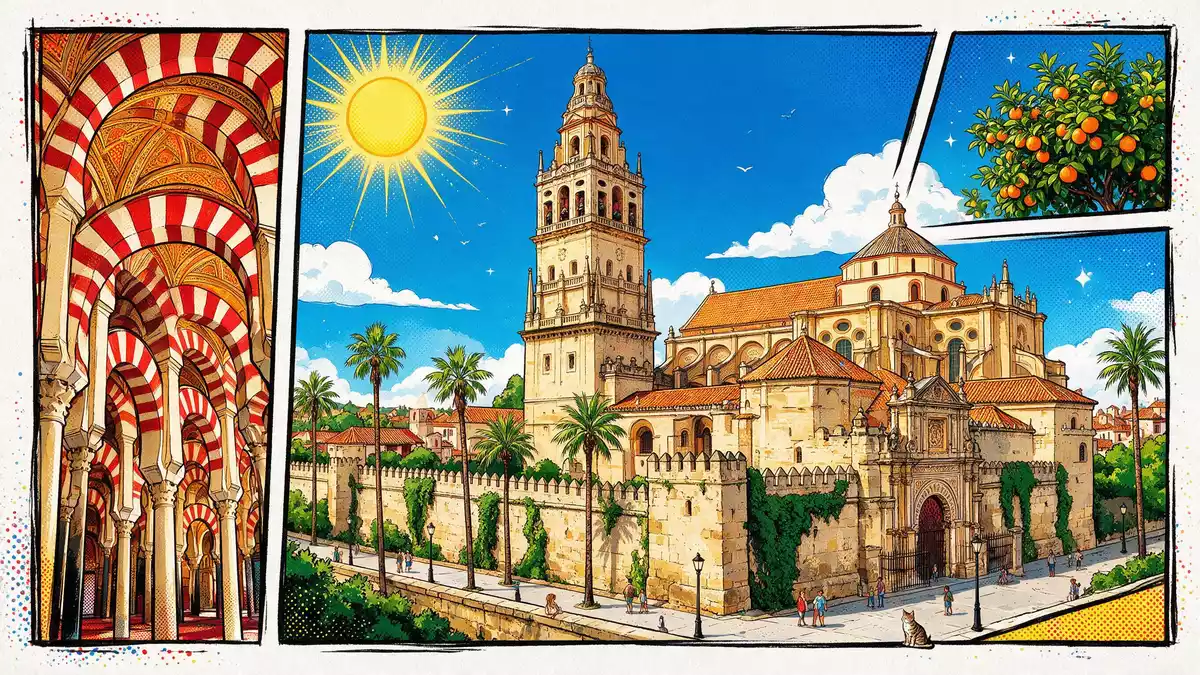
In Cordoba in southern Spain, the Mezquita-Catedral de Cordoba brings more than a millennium of Islamic and Christian building into a single interior, where a mosque begun in 785 under Abd al-Rahman I and a later cathedral share the same walls and arcades.Mosque-Cathedral of Córdoba The building stands within the historic centre of Cordoba, a district recognised as a UNESCO World Heritage Site in the late twentieth century.Historic Centre of Cordoba
A hypostyle hall of stone and red-and-white arches
The core of Mezquita-Catedral de Cordoba is the hypostyle prayer hall of the former Umayyad mosque, a broad interior carried on ranks of columns with superimposed arches that form an ordered forest of stone. Construction of this hall began under Abd al-Rahman I in 784–786, when he established the Islamic Emirate of Cordoba and ordered a congregational mosque on this site.built by Abd al-Rahman I The plan was then extended in several phases between 784 and 988, each pushing the prayer hall further away from the courtyard and enlarging the grid of arcades.extended in four distinct phases
Visitors entering the hall pass under the system of double arches, in which lower horseshoe arches and upper semicircular arches rest on columns of marble and other stone, many reused from earlier buildings in the region.double horseshoe and semicircular arch system The repeating bands of red and pale voussoirs give these arches their characteristic striped effect, emphasising the rhythm of the bays as the hall extends towards the southern wall. Between some of the arches, especially in the area associated with the tenth-century ruler Al-Hakam II, ribbed domes mark more emphatic points in the ceiling and indicate a sequence of more elaborately treated spaces.ribbed domes of Al-Hakam II
The mihrab and the layers of Islamic decoration
At the southern end of the hall, the qibla wall and its mihrab form one of the most intensely decorated areas of Mezquita-Catedral de Cordoba, concentrating a programme of stone carving and mosaic in a relatively small zone. The mihrab niche from the tenth century is lined with Byzantine-style mosaics, including intricate vegetal and geometric motifs, framed by carved stone panels that contrast with the more austere shafts of the main hall.Byzantine-mosaic mihrab Flanking arches and adjoining chambers continue this higher level of ornament, giving the qibla end a distinct character within the otherwise repeating system of columns and arches.
The courtyard on the northern side of the hall, known as the Patio de los Naranjos, preserves the mosque’s relationship with an open-air space planted with trees and served by visible channels for water. The hall and courtyard together embody the principal elements of a major western Islamic mosque, making Mezquita-Catedral de Cordoba a defining example of Umayyad or Andalusian Islamic architecture.defining example of Umayyad architecture This early fabric is the portion that carried the building’s reputation across the Islamic world and later influenced what came to be called Moorish architecture in the western Mediterranean.
Cathedral nave and Christian interventions inside a former mosque
The building changed religious use in 1236, when Ferdinand III of Castile captured Cordoba and consecrated the mosque as a Christian cathedral dedicated to the Virgin Mary.consecrated as a Catholic cathedral on 29 June 1236 From that point, the structure served as the Cathedral of Our Lady of the Assumption, though its Islamic architecture remained largely intact for some centuries.Cathedral of Our Lady of the Assumption The most conspicuous Christian intervention came between 1523 and 1599, when a cruciform nave and choir were inserted into the centre of the hall, rising above the level of the original roof and changing the spatial experience of the middle bays.reconstruction and additions in the Renaissance period
This Renaissance core introduces Gothic, Renaissance and Mannerist details into the mosque interior, including higher vaults, a choir with wood stalls and a main altar that sits within the crossing of the new nave.cathedral nave and transept inserted Around the perimeter, Christian chapels occupy bays along the outer walls, separated from the hypostyle hall by screens and altarpieces that add further carved and painted surfaces to the fabric. The minaret of the original mosque was transformed into a bell tower rising above the complex, giving Mezquita-Catedral de Cordoba a vertical Christian marker beside the more horizontal expanse of the hall.belfry in place of the old minaret
Visiting Mezquita-Catedral de Cordoba: what travellers from Western Europe should know
- Mezquita-Catedral de Cordoba stands in the historic centre of Cordoba in southern Spain, close to the northern bank of the Guadalquivir and reached on foot from the surrounding streets of the old city.
- The interior extends across a large, mostly level hall with stone paving and clusters of columns; reaching the upper levels of the bell tower involves climbing a staircase of many steps.
- The main approach passes through narrow streets of the medieval core, where surfaces of cobblestone and occasional kerbs require attention, particularly for travellers pushing prams or using wheelchairs.
- The official language is Spanish and the currency is the euro.
Searching for Mezquita-Catedral de Cordoba on social platforms
These links open searches for Mezquita-Catedral de Cordoba on each platform.
Frequently asked questions about Mezquita-Catedral de Cordoba
Where is Mezquita-Catedral de Cordoba located?
Mezquita-Catedral de Cordoba stands in the historic centre of Cordoba in Andalusia, Spain, close to the northern bank of the Guadalquivir River.
What should visitors expect inside Mezquita-Catedral de Cordoba?
Visitors encounter an extensive hall of stone columns and striped arches, a richly decorated mihrab at the southern end and a higher Renaissance cathedral nave rising within the older mosque.
What makes Mezquita-Catedral de Cordoba distinctive among European religious buildings?
The building combines a major western Islamic mosque, begun under Abd al-Rahman I in the eighth century, with a later Catholic cathedral nave and bell tower inside the same structure, reflecting centuries of religious and architectural change.


