
Mezquita-Catedral de Cordoba and its forest of arches
Published on 09/23/2026 at 06:33 | Editorial responsibility: Rafael Müller, Editor-in-Chief AD HOC NEWS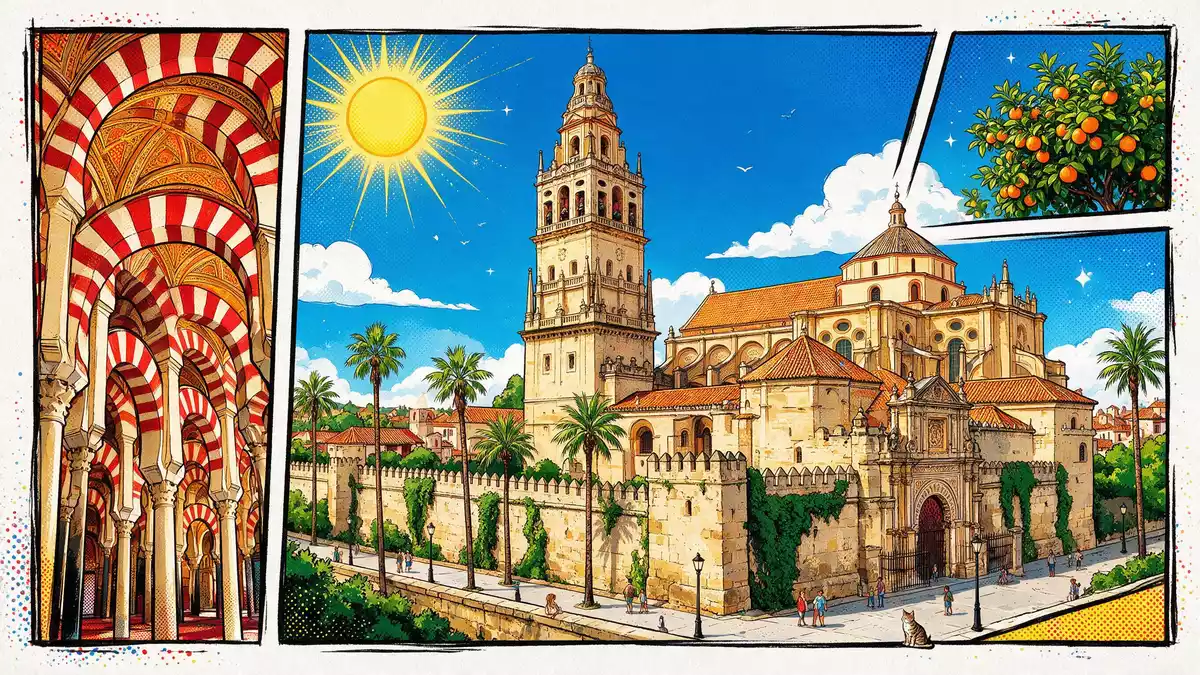
Mezquita-Catedral de Cordoba is a building where a vast field of Islamic arcades surrounds a Christian cathedral. Begun under the Umayyad ruler Abd al-Rahman I in the eighth century, it retains the repeated columns, striped arches and decorated prayer spaces of a great mosque.
Mezquita-Catedral de Cordoba: a hall of repeated arches
The interior is organised around columns of marble, jasper, porphyry and other stone. Above them, horseshoe arches and semicircular arches form stacked lines across the prayer hall.
Red and pale voussoirs mark the arches with alternating bands. The rhythm continues across the aisles, while the Patio de los Naranjos occupies the northern part of the complex. A bell tower rises beside the courtyard, incorporating remains associated with the former minaret.
From Umayyad mosque to Christian cathedral
The original mosque was built between 784 and 786 by Abd al-Rahman I. Umayyad rulers expanded it during the ninth and tenth centuries, including Abd al-Rahman II, Al-Hakam II and Almanzor.
In 1236, Ferdinand III of Castile consecrated the former mosque as a Christian cathedral. Gothic, Renaissance and Baroque features were added within the existing complex, including chapels, a transept, a choir and a high altar.
The mihrab, the maqsurah and the cathedral crossing
The mihrab forms a richly decorated prayer space with Byzantine-style mosaics and gold details. Its surrounding area includes the maqsurah, where interlacing arches and domed compartments create a concentrated architectural setting.
The cathedral crossing introduces a different vertical composition inside the broad mosque hall. Gothic, Renaissance and Mannerist elements appear around the transept, while the choir stalls carved by Pedro Duque Cornejo date from the eighteenth century.
The building has been a National Monument since 1882 and became a UNESCO World Heritage Site in 1984. Its historical layers remain legible in the columns, arcades, chapels, mosaics, timber roofs and bell tower. Umayyad construction began in the eighth century, with later expansions enlarging the mosque. The monument’s historical timeline records its Muslim and Christian phases.
Visiting Mezquita-Catedral de Cordoba: what travellers from Western Europe should know
- The monument stands at Cardenal Herrero, 1, in the historic centre of Cordoba. The surrounding streets connect it with the old quarter and the Roman Bridge.
- The complex combines an enclosed prayer hall with the open Patio de los Naranjos. The interior contains extensive arcades, chapels and the cathedral crossing.
- The official language is Spanish and the currency is the euro.
Searching for Mezquita-Catedral de Cordoba on social platforms
These links open searches for Mezquita-Catedral de Cordoba on each platform.
Frequently asked questions about Mezquita-Catedral de Cordoba
Where is Mezquita-Catedral de Cordoba?
It stands in the historic centre of Cordoba, in southern Spain, close to the Roman Bridge and the Guadalquivir.
What can visitors see inside?
The complex contains a columned prayer hall, striped double arcades, the mihrab, the maqsurah, chapels, a transept, choir stalls and a bell tower.
What makes the building distinctive?
Its Islamic mosque architecture and Christian cathedral interiors share one monumental complex. The contrast is visible in the repeating arcades, mosaics, chapels and cathedral crossing.


