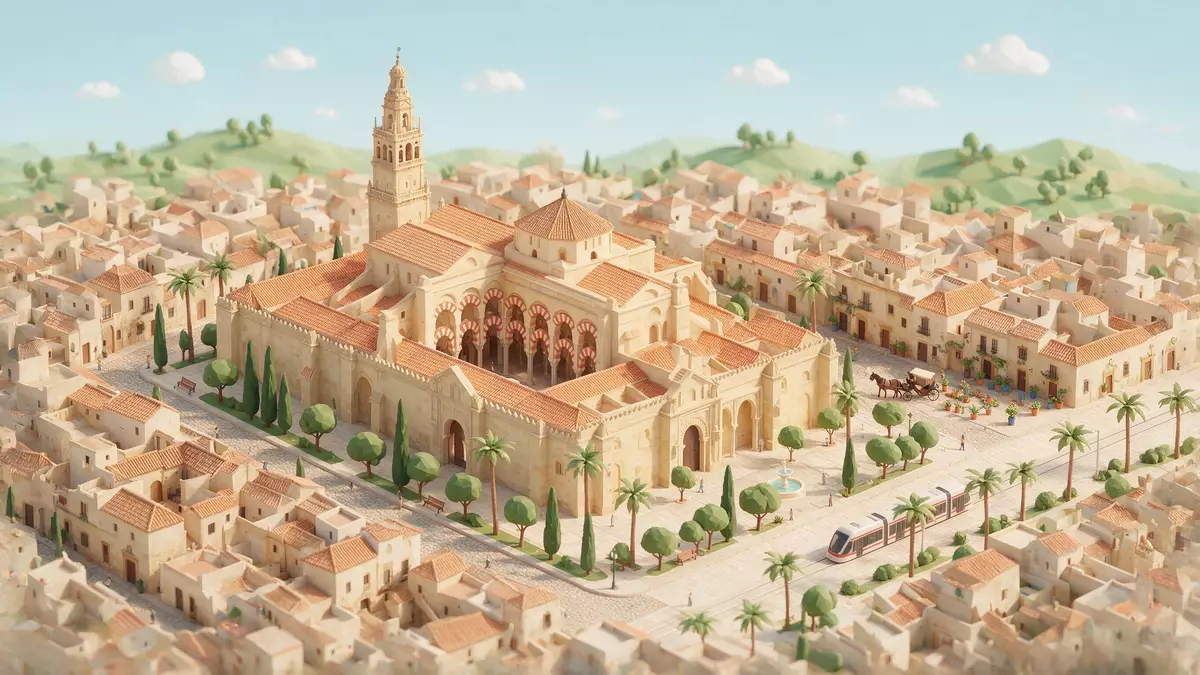
Mezquita-Catedral de Cordoba and its striped arcades
Published on 08/08/2026 at 15:03 | Editorial responsibility: Rafael Müller, Editor-in-Chief AD HOC NEWS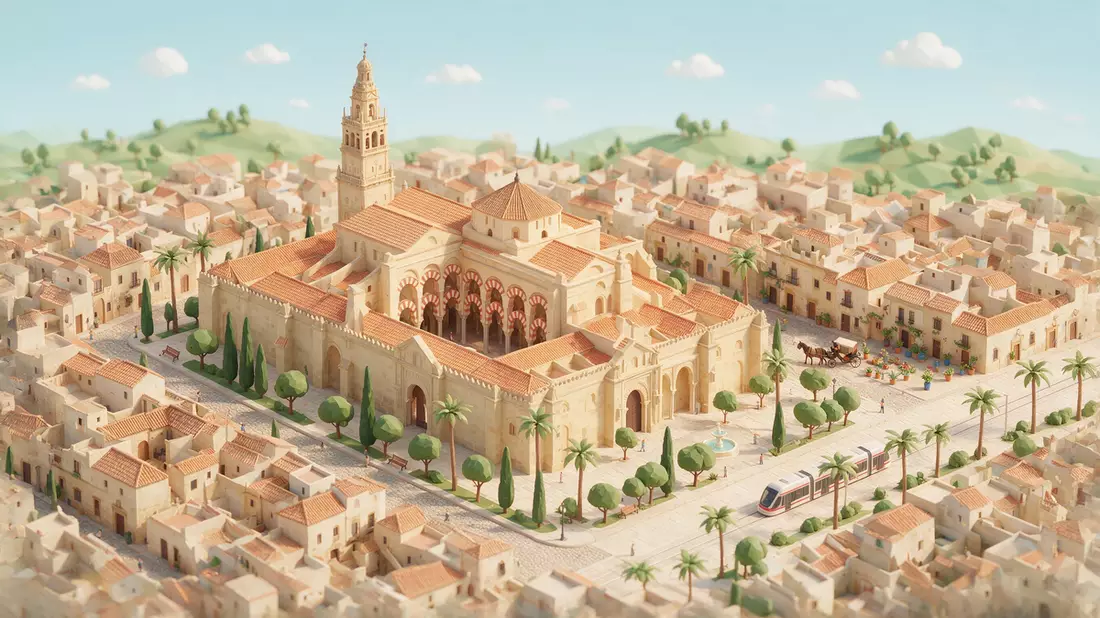
Mezquita-Catedral de Cordoba is one of Cordoba’s defining monuments, and its most striking feature is the forest of striped arches inside the great prayer hall. Built from the eighth century under the Umayyad emir Abd al-Rahman I and enlarged under later rulers, it preserves layers of Islamic and Christian history in one vast stone complex.
Abd al-Rahman I and the great hypostyle hall
The first mosque on the site began under Abd al-Rahman I in 785, when Cordoba was the capital of Islamic al-Andalus. The building took shape as a hypostyle hall, with many columns carrying double arches in alternating colours.
The arcades are the image most travellers carry away. Their red-and-white pattern runs through the interior in long rows, interrupted by later additions and by the cathedral core inserted after the Christian conquest.
Layers of enlargement under the caliphs
Successive expansions under Abd al-Rahman II, al-Hakam II and Almanzor extended the mosque to its present scale. The building’s plan reads as a series of additions, with different zones reflecting different phases of Umayyad rule in Iberia.
Inside, the materials remain restrained: stone, brick and plaster, with carved details concentrated in the more important prayer areas. The famous horseshoe arches recur across the hall, while the later maqsura and mihrab zone carry richer decoration.
The cathedral inserted within the mosque
After the Christian conquest of Cordoba in 1236, the building became a cathedral and later received a Renaissance nave and transept. That intervention places a vaulted Christian core within the earlier Islamic fabric, creating the sharpest contrast in the monument.
The result is a single building that reads in two directions. One part belongs to the ceremonial architecture of the mosque, while another part expresses the liturgical space of a Catholic cathedral, and both remain visible in the same interior.
Visiting Mezquita-Catedral de Cordoba: what travellers from Western Europe should know
- Cordoba is reached from Spain’s rail network and by road from other Andalusian cities.
- Admission and opening hours are set by the site's operator and change with the season; the official website is the only binding source.
- Spring and early autumn suit a visit best, and the interior rewards slow walking and a little time for the upper details.
- The monument is largely level, though the surrounding streets in the old centre can be uneven and crowded.
- Spanish is the language used on site, and cards and cash are both useful for small purchases nearby.
- Entry requirements depend on your nationality. UK travellers should check the FCDO travel advice at gov.uk/foreign-travel-advice; Irish travellers the Department of Foreign Affairs at ireland.ie; EU and EEA citizens their own national foreign ministry.
Searching for Mezquita-Catedral de Cordoba on social platforms
These links open searches for Mezquita-Catedral de Cordoba on each platform.
Frequently asked questions about Mezquita-Catedral de Cordoba
Where is Mezquita-Catedral de Cordoba?
It stands in Cordoba, in southern Spain, close to the old centre and the river. The building forms the city’s best-known historic landmark.
What should visitors expect inside?
Expect a large interior with rows of columns, striped arches and a cathedral nave within the earlier mosque fabric. The contrast between those parts is immediate and constant.
What makes the building distinctive?
Its identity comes from the combination of Umayyad mosque architecture and a later Christian cathedral in one complex. The result is a building that preserves several historical layers in a single interior.