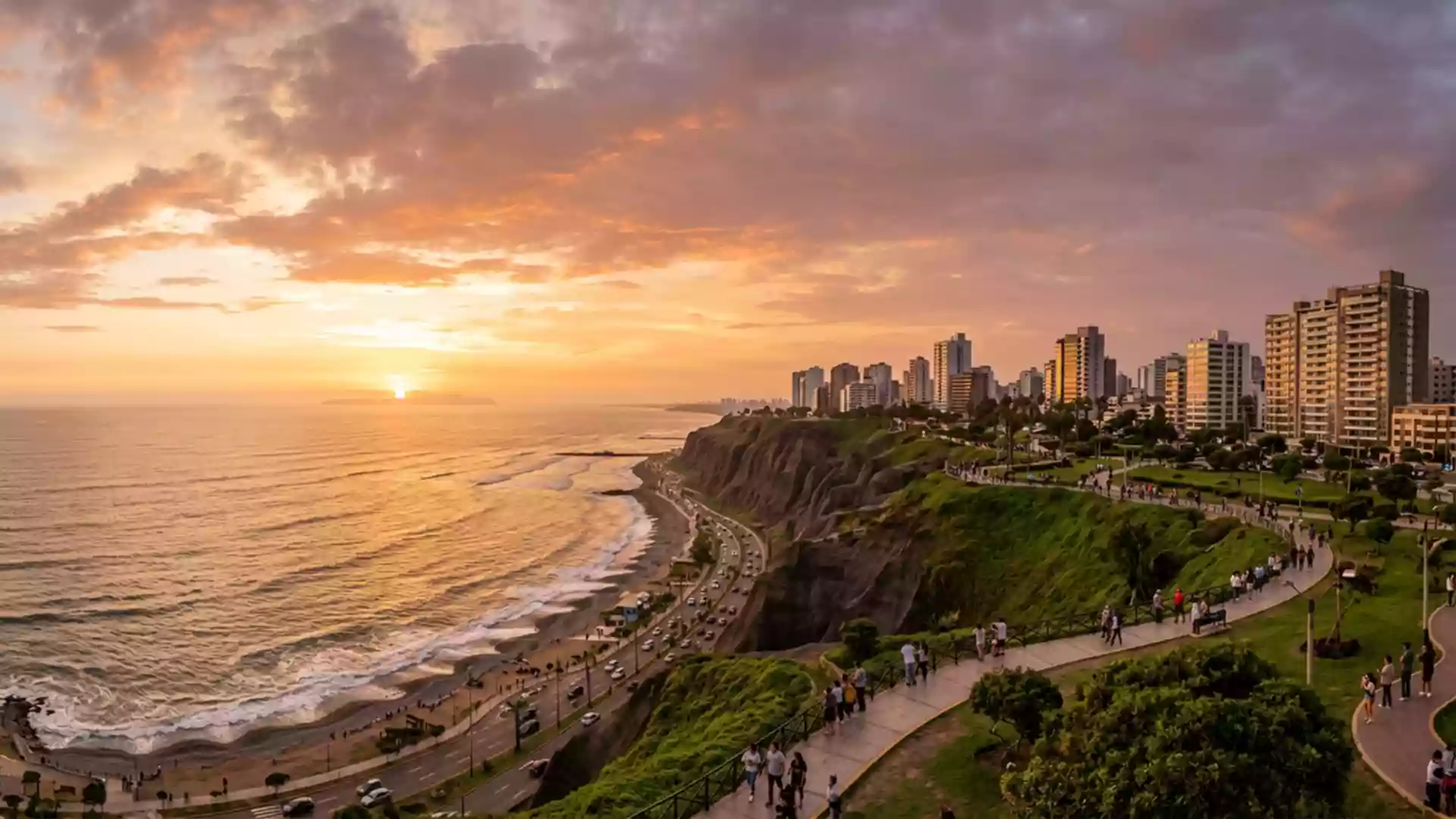
Miraflores in Lima where cliffs meet the Pacific
Published on 08/14/2026 at 14:57 | Editorial responsibility: Rafael Müller, Editor-in-Chief AD HOC NEWS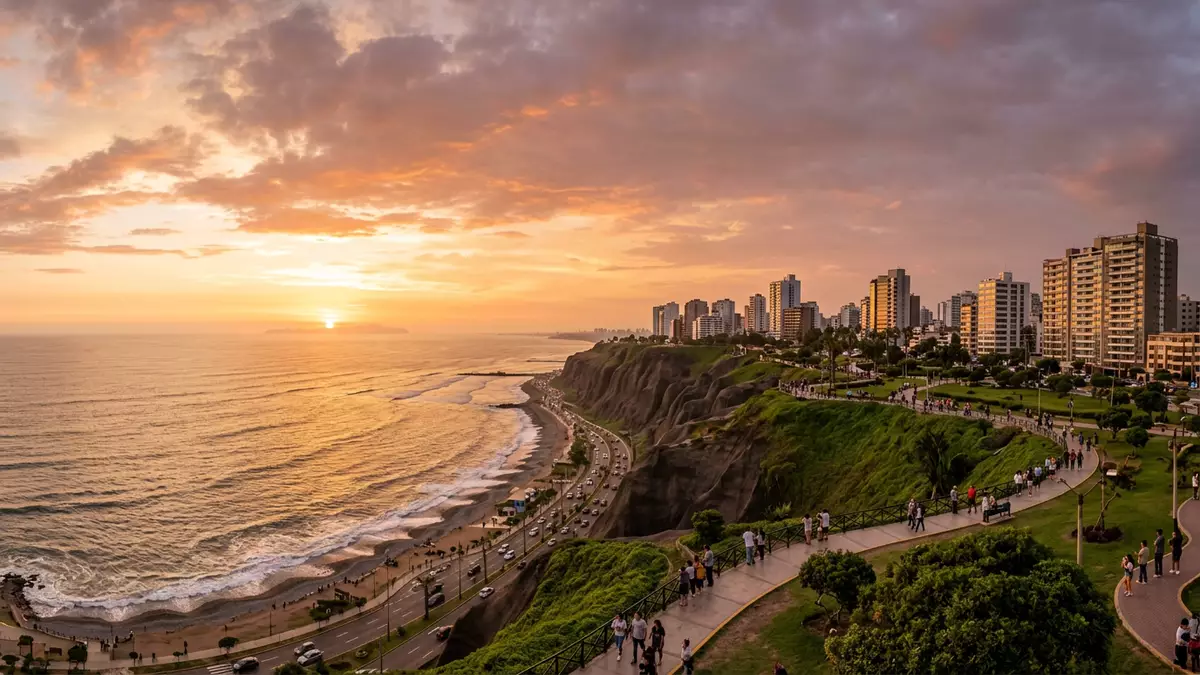
Miraflores in Lima is a coastal district where a line of cliffs, green parks and pre-Columbian ruins meet the Pacific in a single urban landscape. It combines the elevated clifftop promenade known as the Malecón with the Huaca Pucllana pyramid and dense city blocks, so everyday life unfolds beside a long archaeological and maritime edge from different eras.
Clifftop parks and the Malecón above the Pacific
Miraflores occupies a strip of land along the western side of Lima where cliffs rise above the Pacific Ocean and drop to the Costa Verde shoreline below.The district sits at the top of cliffs that reach tens of metres in height, creating a clear separation between the clifftop streets and the beaches and surf breaks at the base of the bluffs. Along the edge of these cliffs, Miraflores has laid out a series of linked parks and viewpoints that form the Malecón de Miraflores, a continuous seafront walkway that runs for several kilometres and offers changing angles on the ocean and coastline.The Malecón consists of clifftop parks and promenades
Individual green spaces along the Malecón include Parque Raimondi and Parque Domodossola, as well as Parque María Reiche and Parque del Amor, which are set into the sequence of lawns, paths and planted borders that follow the cliffline.These parks occupy small terraces along the clifftop and are connected by paved walkways that track the contour of the coast. From this elevated route, views stretch out over the Pacific and down towards the beaches, and the layout also exposes how Miraflores’ streets intersect with the clifftop, with roads such as Avenida Diagonal meeting the Malecón near spaces like Parque del Amor.
Huaca Pucllana and pre-Columbian Miraflores
Set within the built-up neighbourhood of Miraflores stands Huaca Pucllana, a large adobe and clay pyramid that predates Lima’s colonial history and gives the district a visible pre-Columbian core.Huaca Pucllana is described as a great adobe and clay pyramid located in Miraflores and was constructed by the Lima culture, a coastal society active between the third and eighth centuries AD.The monument was built by the Lima culture between the 3rd and 8th centuries AD The archaeological zone occupies part of an urban block at Calle General Borgoño, where the stepped mass of the pyramid rises above adjoining streets and low-rise houses.
Huaca Pucllana’s adobe structures and platforms show how the Lima culture used monumental architecture and organised ceremonial and administrative spaces in what is now a residential district.Official records describe the site as a monumental archaeological zone built between 400 and 700 AD Later cultures, including the Wari and the Ychsma, reused the pyramid for burials and offerings, so the huaca embodies several layers of pre-Hispanic history within its adobe walls.The site museum explains how Wari and Ychsma groups used Pucllana for burials and offerings Visiting Miraflores means encountering this archaeological site as part of the ordinary street grid, with excavation areas, ramps and walls standing directly beside modern restaurants and housing.
An urban district shaped in the nineteenth century
Miraflores is not only a collection of parks and ruins but an administrative district of Lima with its own local history and civic identity. It was formally recognised as a district in the nineteenth century, when President Ramón Castilla established municipalities in 1856 and Miraflores separated from the wider Magdalena area.Miraflores became a district in 1856 during Ramón Castilla’s government The name itself draws on religious references to the Cartuja de Miraflores and was originally connected with the designation San Miguel de Miraflores before being shortened to its present form.Historical accounts link the district’s name to the Cartuja de Miraflores
The district also appears in accounts of national history. During the Peruvian War of Independence, encounters between José de San Martín and Viceroy Joaquín de la Pezuela took place in Miraflores on 24 September 1820, placing the area in the diplomatic and military narrative of the independence period.Miraflores was the site of meetings between José de San Martín and Viceroy Pezuela on 24 September 1820 Later, in the nineteenth century, a battle during the War of the Pacific was fought in the district, remembered as the Battle of Miraflores.Accounts of the War of the Pacific mention the Battle of Miraflores in this district These episodes sit alongside the more everyday image of Miraflores as a residential and commercial area with streets, plazas and local government.
Visiting Miraflores: what travellers from Western Europe should know
- Miraflores lies on the western side of Lima above the Pacific Ocean and is reached from other parts of the city by main avenues that climb to the clifftop streets.
- The Malecón de Miraflores follows the edge of the cliffs with paved walkways and parkland, so walking the clifftop involves gradual gradients and occasional stairways linking different park levels.
- Huaca Pucllana stands within an urban block in central Miraflores, and approaching the site from surrounding streets leads directly from asphalt and pavements into sandy archaeological surfaces and adobe structures.
- Miraflores is part of Peru, so the official language is Spanish and the currency is the Peruvian sol.
- Entry requirements depend on your nationality; UK travellers can check the FCDO travel advice at gov.uk/foreign-travel-advice, Irish travellers the Department of Foreign Affairs at ireland.ie.
Searching for Miraflores on social platforms
These links open searches for Miraflores on each platform.
Frequently asked questions about Miraflores
Where is Miraflores in Lima?
Miraflores is a district on the western edge of Lima, Peru, occupying clifftop land above the Pacific Ocean and forming part of the city’s coastal frontage.
What can visitors expect on a visit to Miraflores?
A visit brings clifftop parks and the Malecón promenade, city streets with shops and restaurants, and the Huaca Pucllana archaeological site set among urban blocks.
What makes Miraflores distinctive among Lima’s districts?
The combination of Pacific cliffs, continuous seafront parkland and a major pre-Columbian adobe pyramid within a dense urban district gives Miraflores a notably layered character.