
Mirski zamok and its blend of Gothic and Renaissance stone
Published on 08/25/2026 at 14:09 | Editorial responsibility: Rafael Müller, Editor-in-Chief AD HOC NEWS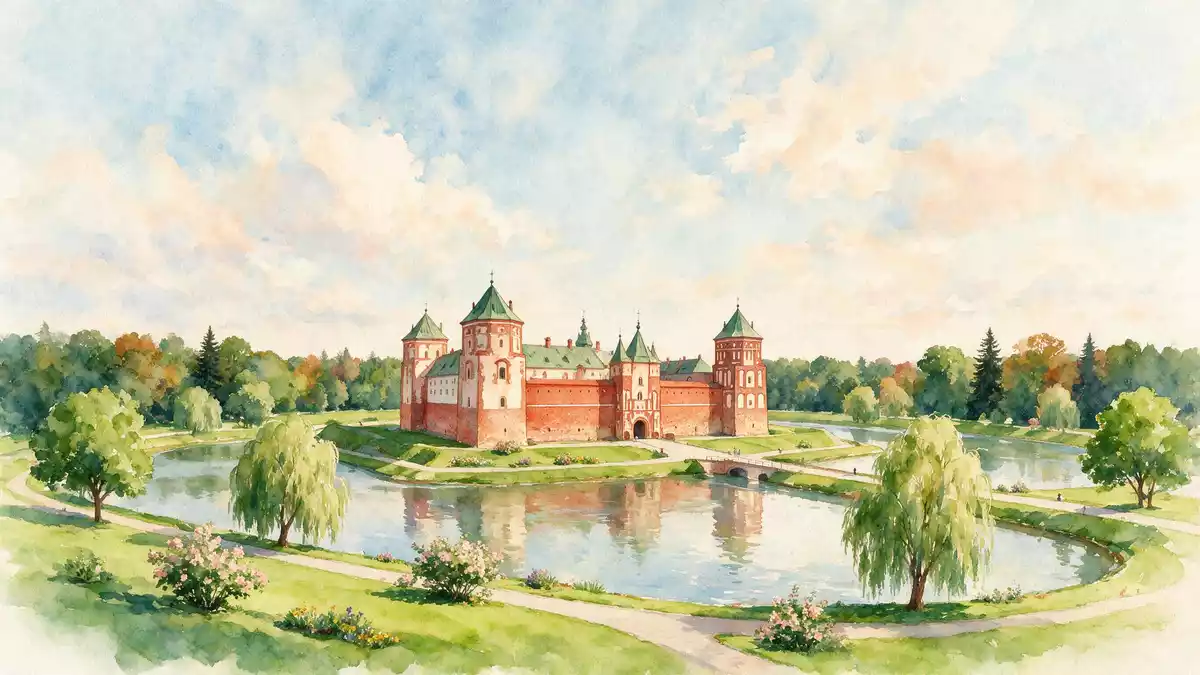
Mirski zamok, known in English as the Mir Castle Complex, rises on the edge of the small town of Mir in western Belarus as a fortified residence shaped by Gothic and later Renaissance and Baroque additions. Built for the Ilyinich family in the early sixteenth century and later transformed by the Radziwi?? princes, it is inscribed as a UNESCO World Heritage Site for the way its brick walls, bastions and palatial wings record successive cultural influences.
A brick fortress on the Belarusian plain
Mirski zamok stands in the Grodno Region of Belarus, in the Karelichy District, where the town of Mir lies on the right bank of the Miranka River.urban village Mir The castle complex occupies a low rise beside a small lake at the confluence of the Miranka and a tributary, with its walls enclosing a roughly square courtyard and towers marking the corners.the Miranka River
The earliest stone phase of Mirski zamok dates to the turn of the fifteenth to sixteenth century and follows the late Brick Gothic tradition of central Europe.central European castle Its curtain walls in red brick, strengthened by projecting towers, form a compact defensive shell that once guarded the approaches to the region and later framed a noble residence.late Brick Gothic style
From Ilyinich fortress to Radziwi?? residence
The first phase of Mirski zamok is associated with the noble Ilyinich family, whose members commissioned the castle as a feudal stronghold in the early sixteenth century.the Ilyinichi family In the later sixteenth century the property passed to the powerful Radziwi?? family, one of the leading magnate houses of the Polish–Lithuanian Commonwealth, who reshaped the fortress into a residence combining defensive and palatial elements.
Over the following centuries the ensemble was extended and altered in Renaissance and then Baroque style, with new residential ranges added inside the walls and a landscape of parks and water laid out around the castle.extended and reconstructed The complex in its present form brings together Gothic masonry in the outer shell with later wings, chapels and service buildings that reflect changing tastes and the fortunes of its owners between the sixteenth and twentieth centuries.complex includes the Mir Castle
A World Heritage castle with park, pond and chapel
Mirski zamok was inscribed on the UNESCO World Heritage List in 2000 under cultural criteria that recognise both its architectural evolution and the history of confrontation and exchange in this borderland region.World Heritage List on the basis The designated property includes the stone castle itself, the surrounding earthen ramparts with bastions, an English landscape park, the pond and associated outbuildings.English landscape park with a pond
Among the most distinctive elements beyond the main walls is the chapel and burial vault of the Svyatopolk-Mirsky family, which stands near the park and pond and underlines the castle’s role as a family seat as well as a military structure.chapel and reliquary The ensemble as a whole forms one of the best-preserved groups of medieval and early modern castle architecture in Belarus, with brick fortifications enclosing later residential and ceremonial spaces that now house museum displays and cultural events.one of 936
Visiting Mirski zamok: what travellers from Western Europe should know
- Mirski zamok stands in the town of Mir in the Grodno Region of Belarus, in the Karelichy District, south-west of Minsk and near the route towards Brest.
- The castle complex rises slightly above the surrounding ground beside a pond and river, and visitors move between cobbled courtyards, earthen ramparts and park paths on foot.
- The official language is Belarusian and the national currency is the Belarusian rouble.
- Entry requirements depend on your nationality; UK travellers can check the FCDO travel advice at gov.uk/foreign-travel-advice, Irish travellers the Department of Foreign Affairs at ireland.ie.
Searching for Mirski zamok on social platforms
These links open searches for Mirski zamok on each platform.
Frequently asked questions about Mirski zamok
Where is Mirski zamok located?
Mirski zamok stands in the town of Mir in the Karelichy District of the Grodno Region of Belarus, on the right bank of the Miranka River.
What can visitors expect to see inside the complex?
Visitors encounter brick fortification walls and towers around a castle courtyard, residential wings with museum rooms, and parkland with a pond and family chapel.
What makes Mirski zamok distinctive among European castles?
Mirski zamok is distinctive for its combination of late Brick Gothic fortifications with later Renaissance and Baroque additions, recognised through its inscription on the UNESCO World Heritage List.


