
Mogao Ku and the cave temples of Dunhuang
Published on 09/07/2026 at 10:54 | Editorial responsibility: Rafael Müller, Editor-in-Chief AD HOC NEWS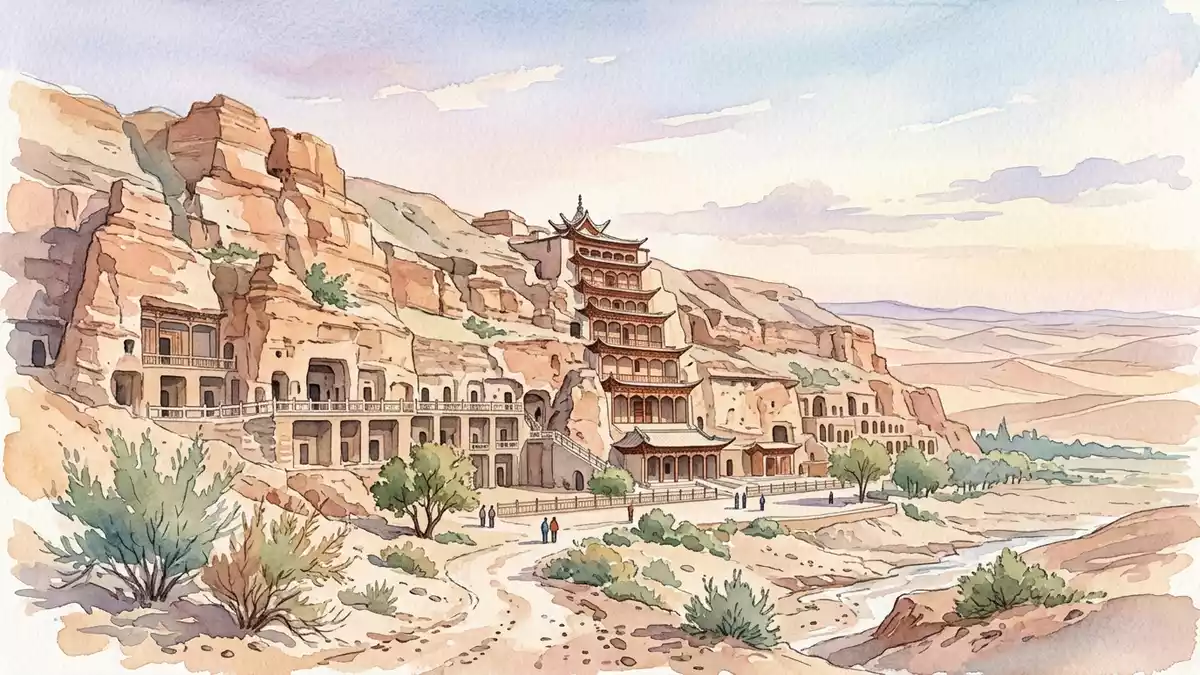
Mogao Ku in Dunhuang is a cliff-cut Buddhist cave complex that combines carved chambers, mural painting and painted sculpture. The site was first constructed in 366 AD and inscribed on the World Heritage List in 1987. first constructed in 366 AD
The cliff face at Mogao Ku
The caves open in a long band of openings in the cliff above the Dachuan River, south-east of the Dunhuang oasis in Gansu Province. The setting gives Mogao Ku its most immediate character: rock, voids and painted surfaces arranged along a desert escarpment. cliff above the Dachuan River
The site is associated with Buddhist art from the fourth to the fourteenth century, and the surviving caves preserve a long sequence of decoration. That span, rather than a single monument, is what makes the place legible to the eye: a carved landscape of repeated chambers and layered painting. fourth to the fourteenth century
Painted chambers and surviving sculpture
Mogao Ku is known for murals, sculpted figures and cave interiors cut into the rock. Hundreds of caves survive, and the decorated walls turn the place into an architectural archive as well as a religious site. Hundreds of caves survive
Among the best-known features are the painted surfaces themselves, which extend through the chambers and passageways rather than appearing in a single hall. The result is not a freestanding temple in the usual sense, but a complex made of cave space, image and rock. painted surfaces
World Heritage status and long use
The Mogao Caves were inscribed as a UNESCO World Heritage Site in 1987. That designation reflects both the age of the complex and the scale of its preserved Buddhist art. UNESCO World Heritage Site
The site remains tied to Dunhuang’s place on the Silk Road, where religious exchange and artistic patronage shaped the region for centuries. The caves therefore read as a historical sequence in stone, with each decorated chamber adding another layer to the whole. Silk Road
Visiting Mogao Ku: what travellers from Western Europe should know
- The caves lie south-east of Dunhuang, in Gansu Province. Reaching the site from the town involves road transport to the cave area.
- The terrain is rocky cliff country above the river valley. The setting is an exposed desert edge, with the cave fronts cut into the escarpment.
- English-language articles and maps often call the place the Mogao Caves or the Mogao Grottoes. Mogao Ku is the Chinese name used here.
- The official language is Chinese and the currency is the Chinese yuan.
- Entry requirements depend on your nationality; UK travellers can check the FCDO travel advice at gov.uk/foreign-travel-advice, Irish travellers the Department of Foreign Affairs at ireland.ie.
Searching for Mogao Ku on social platforms
These links open searches for Mogao Ku on each platform.
Frequently asked questions about Mogao Ku
Where is Mogao Ku?
It lies south-east of Dunhuang in Gansu Province, China, on a cliff above the Dachuan River. The site sits at the edge of the desert landscape associated with the Silk Road.
What does a visit involve?
The place presents cave fronts, rock-cut chambers and painted interiors rather than a single building. The experience is shaped by the sequence of caves and the amount of surviving decoration.
What makes Mogao Ku distinctive?
The combination of a long historical span, Buddhist mural art and cliff-cut architecture gives the site its character. The 1987 World Heritage inscription reflects that layered cultural value.


