
Mole National Park’s broad savannah and elephants near Larabanga
Published on 09/21/2026 at 11:27 | Editorial responsibility: Rafael Müller, Editor-in-Chief AD HOC NEWS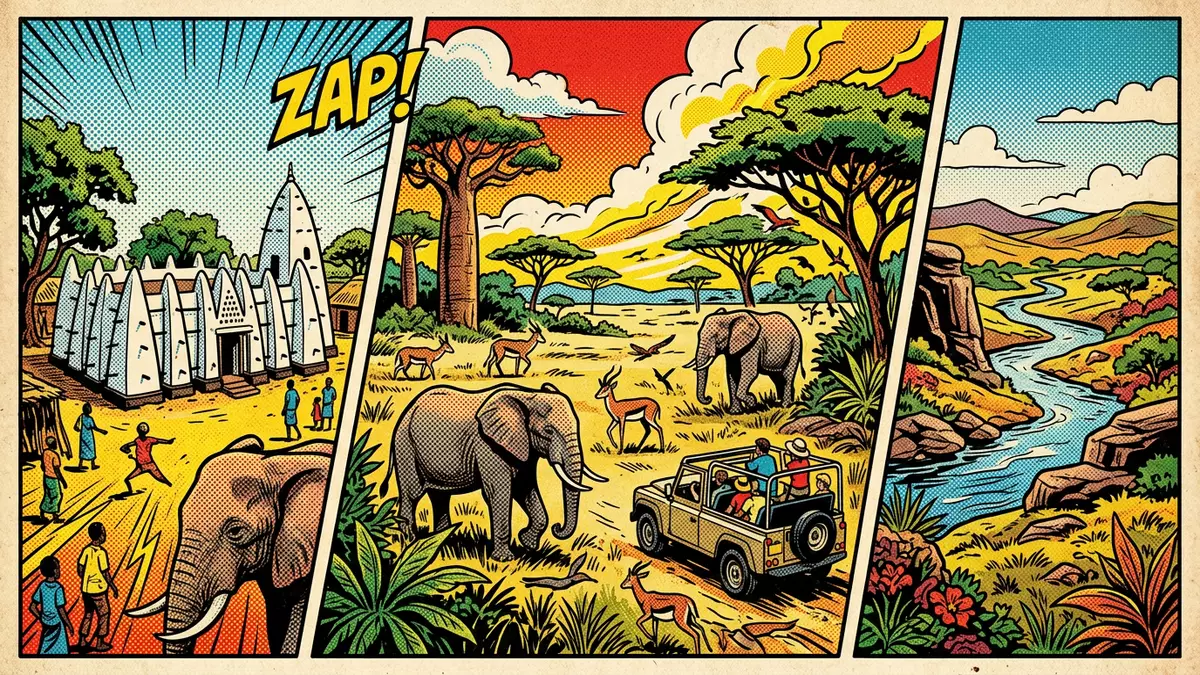
Mole National Park near Larabanga in northern Ghana is a broad Guinea savannah landscape where African elephants roam beneath low hills and escarpments above seasonal waterholes. The reserve was designated as a wildlife refuge in 1958 and later gazetted as a national park in 1971, giving Ghana a large protected savannah area in the country’s north.
Guinea savannah, escarpments and waterholes
Mole National Park lies in Ghana’s Savannah Region, reached by road through Larabanga and set in a landscape of Guinea savannah woodland, open grassland and river valleys. The protected area covers about 4,577 km² (1,767 sq mi) according to Ghana Wildlife Division and conservation reports, forming Ghana’s largest wildlife refuge and one of West Africa’s substantial inland savannah reserves.covers about 4,577 km² The southern boundary of the park follows a marked escarpment, with visitor facilities perched on higher ground looking across woodland and waterholes below.grassland savannah and escarpment
The vegetation belongs to the Guinea savannah zone, combining scattered trees, shrubs and tall grasses with riparian forest along streams and seasonal pools.Guinea savannah vegetation In the central part of the park, an escarpment overlooks waterholes that attract wildlife from the surrounding low hills and plains. Travellers see a contrast between the open country below and the rocky high ground, with views that take in woodland, pools and the distant savannah around Larabanga.
Wildlife: elephants, antelope and primates
Mole National Park is associated above all with African savanna elephants, which move across the woodland and grassland and visit waterholes near the main escarpment viewpoint.free-ranging African elephants Surveys compiled for Ghana’s Forestry Commission and park authorities list over 90 mammal species within the reserve, along with more than 300 recorded bird species.about 93 species of mammals Large mammals include elephants, buffalo, several antelope species such as kob, roan antelope and waterbuck, warthogs and a range of primates.
Birdlife is varied, with savannah and woodland species taking advantage of the mixture of open country, riverine forest and seasonal wetlands inside the park’s boundary.savanna woodland, rivers and pools Reptiles and smaller mammals contribute to the park’s biodiversity, supported by records that list hundreds of plant species as well as extensive fauna. The wide area of protected Guinea savannah makes Mole an important refuge for northern Ghana’s remaining savannah wildlife.
From game reserve to national park
The beginnings of Mole National Park lie in the mid-twentieth century, when British colonial authorities designated a game clearance area in the northern interior of Ghana as part of tsetse fly control measures.game clearance area in the 1930s Wildlife protection on the ground dates to 1958, when the Mole Game Reserve was created and large parts of the present park were set aside as a refuge. In 1971 the reserve was formally gazetted as a national park under Ghana’s Wildlife Reserves Regulations, with an enlarged area that later reached its current size after boundary adjustments in 1992.designated as a National Park in 1971
The park lies near Larabanga in Ghana’s Savannah Region and forms part of the West Gonja District, connecting with surrounding communities through roads that link Damongo, Larabanga and the entrance gate.near the village of Larabanga Over the decades the protected area has grown into Ghana’s largest national park, anchoring a wider tourism circuit in northern Ghana while retaining its core character as a savannah wildlife reserve focussed on elephants, antelope and broad landscapes.
Visiting Mole National Park: what travellers from Western Europe should know
- Mole National Park lies in northern Ghana’s Savannah Region and is reached by road through Larabanga, with routes connecting from towns such as Damongo and Tamale.
- The main visitor area stands on an escarpment above waterholes and woodland, so moving around involves slopes, steps and walking on uneven ground within the savannah setting.
- The official language is English and the currency is the Ghanaian cedi.
- Entry requirements depend on your nationality; UK travellers can check the FCDO travel advice at gov.uk/foreign-travel-advice, Irish travellers the Department of Foreign Affairs at ireland.ie.
Searching for Mole National Park on social platforms
These links open searches for Mole National Park on each platform.
Frequently asked questions about Mole National Park
Where is Mole National Park?
Mole National Park is in northern Ghana’s Savannah Region near the town of Larabanga, with access by road from centres such as Damongo and Tamale.
What should travellers expect on a visit?
Travellers encounter a broad Guinea savannah reserve with escarpments, waterholes and guided wildlife viewing focussed on elephants, antelope, primates and varied birdlife.
What makes Mole National Park distinctive?
Mole combines Ghana’s largest protected savannah area with free-ranging African elephants, extensive mammal and bird diversity and viewpoints on an escarpment above woodland and waterholes.


