
Mole National Park’s savannah and elephants near Larabanga
Published on 09/19/2026 at 06:48 | Editorial responsibility: Rafael Müller, Editor-in-Chief AD HOC NEWS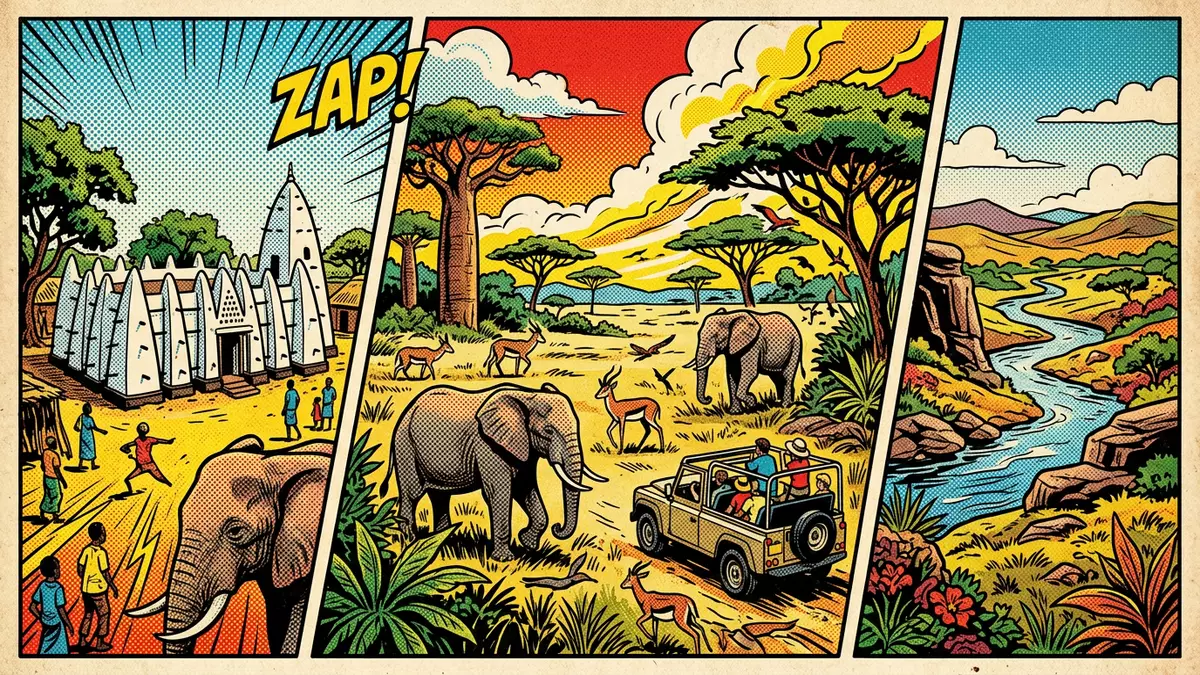
Mole National Park in northern Ghana is a broad sweep of Guinea savannah where elephants, antelopes and birds move across undulating terrain above a marked escarpment near Larabanga. The protected area was established as a wildlife refuge in 1958 and re-designated as a national park in 1971, giving Mole a documented role in Ghana’s conservation history. From the park headquarters on the plateau, travellers look out across woodland and grassland that stretch towards the horizon, a landscape where waterholes and riparian corridors break the dry-season browns with patches of green.
Guinea savannah, escarpment edge and waterholes
Mole National Park lies in the Savannah Region of northern Ghana, in a belt of Guinea savannah that mixes open grassland with scattered trees and patches of denser woodland. A sharp escarpment forms the southern boundary of the park, creating a distinct topographical edge where the plateau drops to lower country and giving some viewpoints a sense of standing on a balcony above the landscapesharp escarpment forming the southern boundary. Within this setting, seasonal streams, pools and riparian corridors draw wildlife, turning waterholes into focal points for game drives and guided walks.
The protected area covers several thousand square kilometres of relatively undisturbed savannah, with figures around 4,577 km² and 4,840 km² appearing in official and scientific descriptionscovers an area of 4,577 km2 of fairly undisturbed Guinea savannahcovers an area of 4,840 km2 of undulating terrain. The elevation around 150 m supports a mosaic of grassland, thicket and gallery forest, with undulating ground and steep scarps shaping long views from the plateau. Around the main visitor area, tracks lead down towards water bodies where elephants and other mammals are frequently seen during the dry months, and the contrast between open savannah and wooded valley bottoms is one of the park’s defining visual experiences.
From tsetse control to Ghana’s oldest national park
Mole’s history as a protected landscape stretches back to mid-twentieth-century efforts to control tsetse flies in northern Ghana, when parts of the area were set aside for wildlife refuge before being formally recognised as a park. Mole National Park was established in 1958 and later gazetted under Ghana’s Wildlife Reserves Regulation (L.I. 710) in 1971 with an enlarged area, making it the country’s oldest and largest wildlife preserveestablished in 1958 and re-designated as a National Park in 1971gazetted as a National Park under Wildlife Reserves Regulation (L.I. 710). That transition from a refuge to a national park fixed its status within Ghana’s network of protected areas and placed Mole at the centre of wildlife tourism in the country.
The nearest town is Larabanga, whose historic mosque is itself a recognised attraction, and the park entrance lies a short distance off the Damongo–Sawla roadone main Park entrance, located 3 km from Larabanga, off the Damongo-Sawla road. Headquarters and visitor facilities are on the plateau above the escarpment near Mole Motel, from where guided vehicle safaris and walking excursions set out into the surrounding savannah. For Ghana, Mole’s combination of size, long-standing legal protection and concentration of large mammals makes it a reference point in discussions of conservation policy and eco-tourism across the Savannah Region.
Elephants, antelopes and birds on foot-level safaris
Mole National Park is known above all for its large mammals, with elephants a central presence around the main waterholes and savannah clearings. Surveys and park descriptions record over 90 mammal species, including African elephants, kob, roan antelope, hartebeest, waterbuck, buffalo and several primates such as baboons and vervet and patas monkeysover 90 mammal species notably elephants, buffalo, roan, kob, hartebeest, waterbuck and 4 primate speciesMole National Park is Ghana's largest protected area and covers about 4,577 km². Lions, leopards and hyenas occur but are rarely seen, underlining the park’s role as habitat for a full range of savannah fauna even where apex predators are elusive.
Birdlife adds another layer to Mole’s appeal, with around 300 species recorded and Important Bird Area recognition reflecting its value for both resident savannah birds and migrants. Raptors such as palm-nut and white-headed vultures, Bateleur and martial eagle share the airspace with hornbills, turacos and a variety of herons and storks near water, turning even short walks around the escarpment edge and pools into extended birdwatching sessionsaround 300 species of birds are found here. Reptiles, including crocodiles around ponds, and amphibians add to the biodiversity, and scientific work has used Mole’s large herbivore populations, particularly elephants and kob, to study savannah ecology and wildlife dynamicsMole National Park (MNP) is Ghana’s oldest and largest wildlife preserve.
Visiting Mole National Park: what travellers from Western Europe should know
- Mole National Park lies in the Savannah Region of northern Ghana, with its main entrance reached from the town of Larabanga off the Damongo–Sawla road; park headquarters and visitor facilities stand on the plateau above the escarpment.
- The park landscape combines undulating savannah with steep scarps and tracks that descend towards waterholes, so visiting the main viewing areas involves walking on uneven ground and, in some places, climbing short slopes or stairs between the lodge level and pools.
- Mole National Park sits in northern Ghana, where English is an official language and the currency is the Ghanaian cedi.
- Entry requirements depend on your nationality; UK travellers can check the FCDO travel advice at gov.uk/foreign-travel-advice, Irish travellers the Department of Foreign Affairs at ireland.ie.
Searching for Mole National Park on social platforms
These links open searches for Mole National Park on each platform.
Frequently asked questions about Mole National Park
Where is Mole National Park and how is it reached?
Mole National Park is in the Savannah Region of northern Ghana, with its entrance near Larabanga on the Damongo–Sawla road and park headquarters on the plateau above the escarpment.
What should visitors expect during a visit?
Visitors encounter wide Guinea savannah with undulating terrain, guided game drives and walks around waterholes where elephants, antelopes, primates and a broad range of birds can be seen.
What makes Mole National Park distinctive among West African parks?
Mole is Ghana’s oldest and largest national park, combining a sizeable area of relatively undisturbed savannah with documented elephant and antelope populations and Important Bird Area status.


