
Monasterio de Piedra, where cloisters overlook a carved river park
Published on 09/18/2026 at 21:37 | Editorial responsibility: Rafael Müller, Editor-in-Chief AD HOC NEWS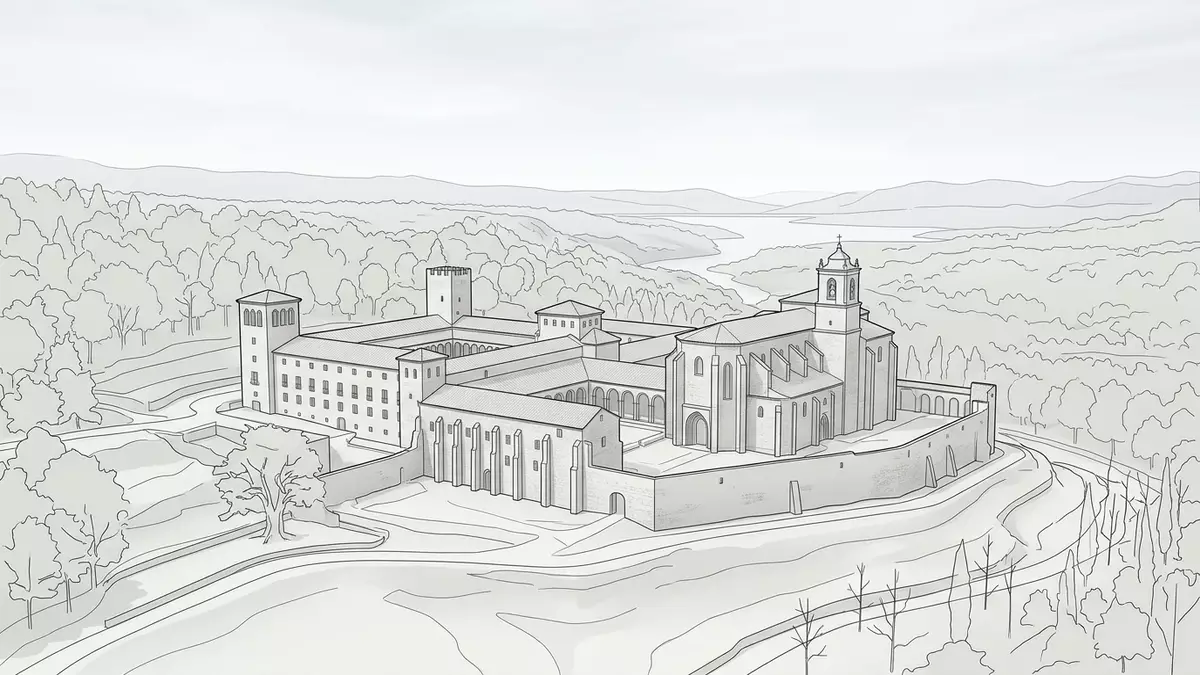
Monasterio de Piedra in Nuevalos in north-east Spain is a former Cistercian monastery where solid stone cloisters stand beside a river gorge turned into a park of waterfalls and pools. Founded in 1194 under Alfonso II of Aragon beside the Piedra River, the complex brings together medieval buildings and later landscaped paths in a single enclosed valley that feels distinctly separate from the surrounding dry uplands.
From Cistercian foundation to national monument
The medieval monastery at Monasterio de Piedra grew from a donation by Alfonso II of Aragon, who granted an old castle and its surrounding land beside the Piedra River to a group of Cistercian monks in 1194.founded in 1194 Thirteen monks travelled from Poblet Monastery in Catalonia to establish the new community, dedicating it to St Mary the White and adapting the fortified structure into a religious house.castle and surrounding land
The complex developed as a Cistercian abbey over the following centuries, with church, cloister and domestic ranges built in stone along the valley floor beside the river. After nineteenth-century confiscations the monastery passed into private hands and the religious community ceased, but the buildings remained standing and the site eventually took on a new role that combined hospitality with heritage. In 1983 the ensemble of monastery and park was formally declared a national monument, recognising both its medieval fabric and the surrounding landscape as part of Spain’s protected cultural heritage.declared a national monument
Cloisters, church and stone interiors
The monastery buildings at Monasterio de Piedra form a compact group of stone structures arranged around a central cloister, with arcaded walks leading to the refectory, chapter house and church. Much of the visible fabric belongs to the Gothic period, with pointed arches and ribbed vaulting giving a measured rhythm to the interiors, although the complex also carries traces of later alterations as its use shifted and parts were adapted for secular functions.antiguo monasterio cisterciense
Within the cloister, stone columns and moulded capitals frame views into the courtyard, where the enclosed space underlines the monastic character even though the community has long gone. The church rises beside it with a nave defined by tall walls and slender supports, and the surviving rooms around the cloister include spaces such as the refectory where the monks once gathered for meals. In the modern era parts of the complex have been converted into a hotel and visitor facilities, but substantial areas of the original monastery remain recognisable, allowing visitors to read the Cistercian layout in the stonework while also seeing how a historic abbey has been adapted to contemporary use.Cistercian Monastery of Piedra
Waterfalls and paths in a carved river valley
Alongside the cloistered buildings, the river valley at Monasterio de Piedra has been reshaped into a park where the Piedra River descends through a gorge, forming cascades, pools and quiet stretches of water. The monastery sits within the Iberian System mountain ranges, in a part of Aragon that is generally known for arid uplands, so the presence of dense planting and running water in this protected hollow gives the site a distinct character.located in one of the most deserted areas of Aragon
Paths lead down from the monastery into the park, crossing bridges and passing viewpoints onto the falls and the Piedra River canyon. One of the named features is Lago del Espejo, or Mirror Lake, a still section of water where cliffs and vegetation are reflected in the surface, contrasting with the nearby falls where water drops in multiple stages.Lago del Espejo The garden landscape has been formally recognised as a scenic area in Spain, underlining that the combination of river, rock and planting is part of the protected identity of the site as much as the monastic architecture.
Visiting Monasterio de Piedra: what travellers from Western Europe should know
- Monasterio de Piedra lies near the village of Nuevalos in the province of Zaragoza in Aragon, in inland Spain; it stands beside the Piedra River within the Iberian System mountain ranges and is reached by road from surrounding towns.
- The terrain around the park follows the descending river valley, with footpaths that include staircases, bridges and sections passing through narrow rock formations, so visiting the landscaped area involves walking on uneven ground.
- The monastery and park sit in a relatively dry region of Aragon, but the enclosed valley around the Piedra River carries dense planting and running water, creating local contrasts in shade and exposure along the paths.
- The official language is Spanish and the currency is the euro.
Searching for Monasterio de Piedra on social platforms
These links open searches for Monasterio de Piedra on each platform.Frequently asked questions about Monasterio de Piedra
Where is Monasterio de Piedra?
Monasterio de Piedra is in Nuevalos in the province of Zaragoza in Aragon, inland Spain, beside the Piedra River within the Iberian System mountain ranges.
What can visitors expect on a visit?
Visitors encounter historic Cistercian monastery buildings with cloisters and a church, together with a river valley park of waterfalls, pools and footpaths through rock formations and dense planting.
What makes Monasterio de Piedra distinctive among Spanish monasteries?
The site is distinctive for the way its medieval stone monastery complex stands immediately beside a carved river gorge relandscaped as a scenic park, combining architectural heritage and dramatic water features in one enclosed setting.


