
Monasterio de Piedra where medieval stone meets falling water
Published on 09/22/2026 at 10:56 | Editorial responsibility: Rafael Müller, Editor-in-Chief AD HOC NEWS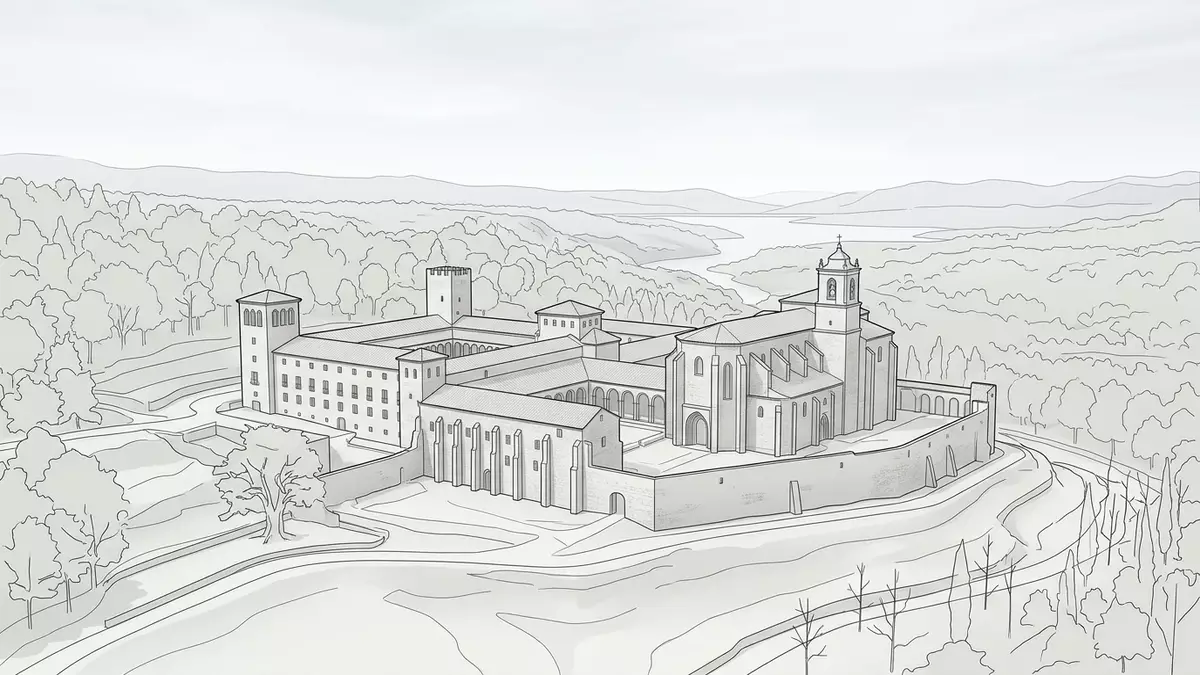
Monasterio de Piedra brings medieval stonework and falling water together in a single site near Nuevalos, in Aragón, Spain. The complex includes a former Cistercian monastery and a landscaped river park shaped around the Piedra River, with caves, pools and waterfalls.
Monasterio de Piedra and its Cistercian beginnings
Alfonso II of Aragon and his wife, Sancha of Castile, donated the Castle of Piedra to monks from Poblet in 1186. A Cistercian monastery was founded at the site in 1194, beside the Piedra River.
The surviving buildings belong to a long architectural sequence. Medieval masonry, pointed arches and cloister spaces record the monastery’s religious past, while later work altered parts of the complex. The site is dedicated to Santa María la Blanca and reflects the transition from Romanesque forms towards Gothic architecture.
Cistercian monks remained connected with Monasterio de Piedra until the nineteenth century. Religious life ended after Spain’s disentailment policies suppressed male religious orders and transferred their properties into private ownership. The monastery is therefore both a medieval religious foundation and a place marked by nineteenth-century political change.
Stone rooms beside the Piedra River
The contrast between masonry and water defines the visit. The monastery presents enclosed courtyards, thick walls and carved stone, while the adjacent park follows a river valley filled with vegetation, rock formations and cascades.
Water appears throughout the park as a sequence of visible features rather than a single viewpoint. The Piedra River passes through narrow rock sections, drops over waterfalls and reaches pools beneath caves. Cola de Caballo is the best-known fall, with water descending beside the Iris Cave.
The park’s paths connect wooded sections, bridges, viewpoints and grottoes. Limestone and tufa appear around the river, where mineral-rich water has deposited pale rock. The result is a landscape in which natural formations and planted garden areas sit beside the monastery’s stone architecture.
Monasterio de Piedra became privately owned in 1840, when Pablo Muntadas Campeny acquired the former monastery. His son, Juan Federico Muntadas, developed the surrounding park with paths, plantings and access through the river landscape. The garden received national scenic recognition in 1940.
A historic park shaped by water and cultivation
The nineteenth-century park has a history that extends beyond scenery. In 1860, the Iris Cave was opened to visitors after its discovery. In 1867, a fish-farming centre was established at the site, linking the river grounds with the study and propagation of aquatic species.
The park combines planted vegetation with the Piedra River’s existing rock formations. Ferns, trees and other moisture-loving plants occupy the valley around waterfalls and caves. Stone steps, paths and bridges pass between these elements, creating a continuous route through the grounds.
The monastery buildings and the garden belong to different chapters of the site’s history. The Cistercian foundation belongs to the Middle Ages, while the landscaped park took its recognisable form after private ownership began in the nineteenth century. Their proximity gives Monasterio de Piedra its defining visual contrast.
The complex was declared a national monument on 16 February 1983. Its cultural identity rests on the connection between the monastery, the river and the park, not on a single building viewed in isolation.
Visiting Monasterio de Piedra: what travellers from Western Europe should know
- Monasterio de Piedra lies near Nuevalos in Zaragoza province, Aragón. The approach is by road through the inland landscape around the Piedra River.
- The park route includes stone paths, steps, bridges, caves and viewpoints beside waterfalls. Footwear suited to uneven ground belongs with the terrain.
- The monastery and park are distinct parts of the same complex. The route combines enclosed medieval buildings with open river scenery.
- The official language is Spanish and the currency is the euro.
Searching for Monasterio de Piedra on social platforms
These links open searches for Monasterio de Piedra on each platform.
Frequently asked questions about Monasterio de Piedra
Where is Monasterio de Piedra?
Monasterio de Piedra is near Nuevalos, in Zaragoza province, Aragón, Spain. The complex stands beside the Piedra River.
What can visitors see there?
The site contains a Cistercian monastery, cloisters, a landscaped park, waterfalls, caves, pools, bridges and river paths.
What makes the complex distinctive?
Its defining feature is the close relationship between medieval stone architecture and a river landscape filled with falling water and caves.


