
Monestir de Montserrat and the mountain sanctuary
Published on 09/24/2026 at 04:53 | Editorial responsibility: Rafael Müller, Editor-in-Chief AD HOC NEWS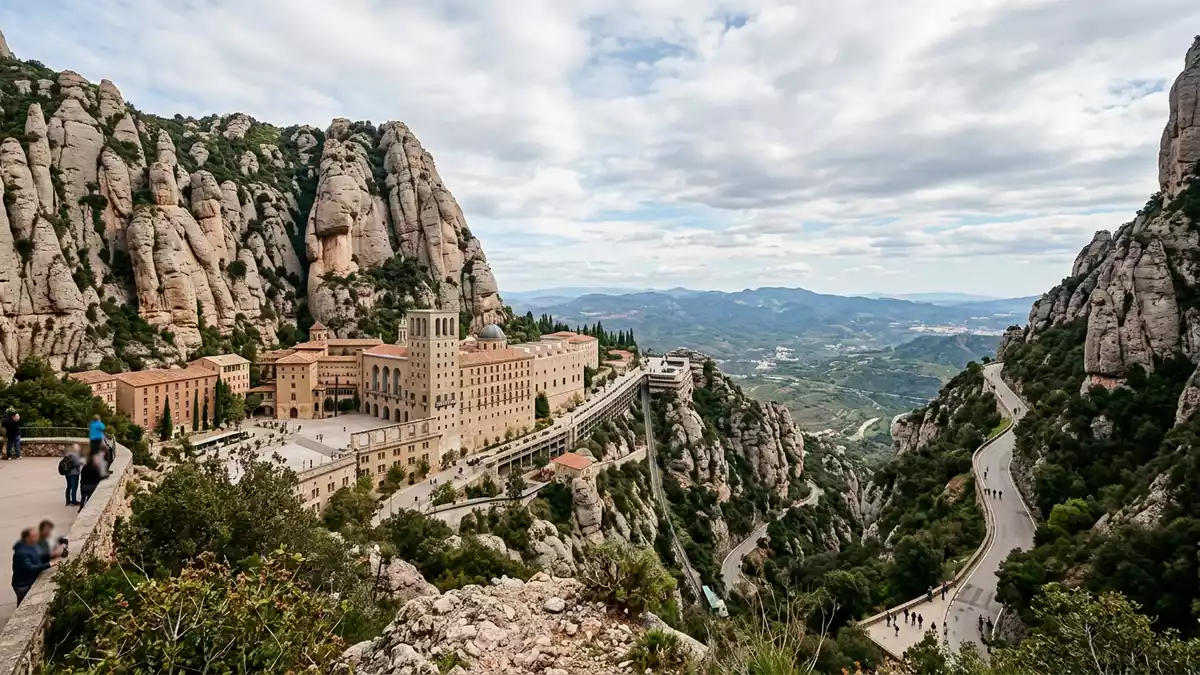
Monestir de Montserrat occupies a high shelf among the serrated rock formations of Montserrat in Catalonia. The Benedictine abbey, its basilica and the dark wooden figure known as La Moreneta form a single cultural and religious complex.
Monestir de Montserrat beneath serrated rock
The monastery stands at about 720 m above sea level, within a mountain landscape shaped by pale conglomerate rock and abrupt, rounded pinnacles. Terraces, cliffs and narrow ridges surround the buildings, placing the abbey in direct visual relationship with the massif.
The name Montserrat refers to the mountain’s jagged profile. Monestir de Montserrat is not an isolated church in a flat settlement, but a sanctuary built into a steep landscape, with religious buildings, paths, chapels and viewpoints arranged along the mountainside.
Abbot Oliba and the foundation in 1025
The monastery was founded in 1025 by Oliba, Abbot of Ripoll and Bishop of Vic. Its history belongs to the medieval Benedictine tradition of Catalonia, and the foundation gave the mountain a permanent monastic institution.
Medieval expansion established Monestir de Montserrat as a centre of worship and learning. The complex developed through successive periods, leaving a mixture of Romanesque, Gothic, Renaissance and later architectural features. The Abbey of Montserrat remains closely connected with Catalan cultural heritage.
La Moreneta inside the basilica
The basilica contains the wooden image of the Virgin of Montserrat and the infant Christ, known in Catalan as La Moreneta. The Romanesque carving is traditionally dated to the end of the twelfth century and is associated with the dark appearance that gives the figure its familiar name.
In 1881, Pope Leo XIII granted the image a canonical coronation, and Our Lady of Montserrat became the patron saint of Catalonia. The figure’s presence gives the basilica a distinct focus within the larger monastery, while the surrounding rooms and public spaces contain further religious and artistic details.
The complex also has a long cultural history. Montserrat developed a music tradition, a library and museum collections connected with Catalan art. The history of art and culture is present alongside the monastic setting, linking devotional practice with painting, sculpture and music.
Visiting Monestir de Montserrat: what travellers from Western Europe should know
- Monestir de Montserrat lies in Catalonia, north-west of Barcelona. The R5 railway from Barcelona reaches Monistrol de Montserrat, where the Cremallera de Montserrat railway climbs towards the monastery.
- The monastery sits high on a steep mountain shelf. Access around the complex includes gradients, stairs and uneven stone surfaces.
- The mountain has exposed cliffs, narrow ridges and abrupt rock formations. The sanctuary and its surrounding paths occupy different levels above the valley.
- The official language is Catalan and Spanish, and the currency is the euro.
Searching for Monestir de Montserrat on social platforms
These links open searches for Monestir de Montserrat on each platform.
Frequently asked questions about Monestir de Montserrat
Where is Monestir de Montserrat?
Monestir de Montserrat is in Catalonia, Spain, on the Montserrat massif above the municipality of Monistrol de Montserrat. Barcelona is the nearest major city.
What can visitors see there?
The complex includes a Benedictine monastery, the basilica, La Moreneta, mountain terraces and cultural collections connected with Catalan art and music.
What makes Monestir de Montserrat distinctive?
Its buildings occupy a steep mountain setting among serrated conglomerate cliffs. The medieval foundation, the basilica and the Romanesque image of La Moreneta combine religious history with a singular landscape.


