
Mont-Saint-Michel and its abbey above the tides
Published on 09/18/2026 at 22:17 | Editorial responsibility: Rafael Müller, Editor-in-Chief AD HOC NEWS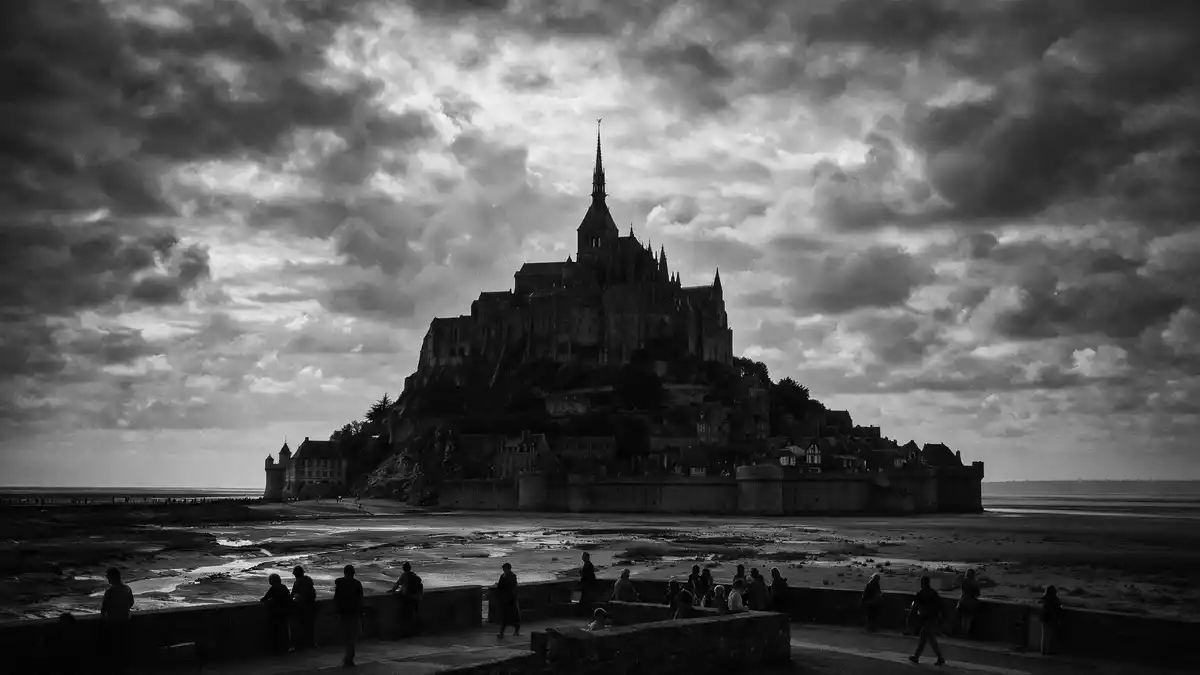
Mont-Saint-Michel is a rocky tidal island off the coast of Normandy, near Le Mont-Saint-Michel in France, crowned by a Benedictine abbey that dominates the surrounding bay in every direction. Its sanctuary dedicated to Saint Michael the Archangel is traditionally dated to the early eighth century, giving the place a deep historical reach that still frames every visit.
An abbey stacked above the sea
The story of Mont-Saint-Michel begins with Bishop Aubert of Avranches, who founded a first sanctuary on the summit of what was then called Mont Tombe in 708 in honour of Saint Michael. Over time this sanctuary evolved into a monastery, and in 966 Duke Richard I of Normandy installed Benedictine monks on the island, linking it to a wider movement of monastic reform in the region.history of the monument The abbey church familiar to visitors today is thought to date from the eleventh and twelfth centuries, when large Romanesque works were begun on the rock and extended upwards in a sequence of halls and crypts.
Later Gothic additions produced one of the most striking ensembles of medieval architecture in France, a complex that rises in tiers from the village streets to the cloister just below the church. Between the eleventh and sixteenth centuries builders created a series of stone buildings on the limited summit, including the structure known as La Merveille, with its great halls stacked above one another on the northern side of the mount.construction from the eleventh to sixteenth centuries Seen from the bay, the abbey’s spire and buttressed walls rise sharply from the rock, emphasising how little flat ground was available.
Pilgrimage, prison and preservation
For centuries Mont-Saint-Michel functioned as a place of pilgrimage in the Christian West, attracting travellers from across Europe to venerate Saint Michael and to visit the monastic community. Under the Benedictines the abbey became known as a centre of medieval culture, producing and preserving manuscripts that gave it an intellectual reach well beyond the surrounding coastline.Gothic-style Benedictine abbey Kings of France and England visited, and the island’s fortified position gave it strategic value during conflicts such as the Hundred Years’ War, when its defences helped it withstand sieges.
The French Revolution brought a harsh change of function. The abbey buildings were converted into a prison, a role they retained into the nineteenth century, which left marks on the interiors and on the perception of the mount itself.transformed into a detention centre In 1864 Mont-Saint-Michel was classified as a historic monument, and later conservation efforts focused on the abbey and the surrounding village streets climbing up the slopes. In 1979 the mount and its bay were inscribed on the UNESCO World Heritage List, recognising the site as an outstanding example of medieval Christian civilisation and a technical achievement in a demanding natural setting.UNESCO inscription in 1979
A tidal island shaped by land and sea
Mont-Saint-Michel stands in a wide bay where the sea retreats far from the shore at low tide and returns with speed at high tide, surrounding the mount with water and wet sand. The rock itself forms a compact island close to the Norman coast, linked to the mainland by access infrastructure that has changed over the centuries but continues to emphasise the mount’s insular character.rocky tidal island Approaching from the land, travellers first see the outer walls and village houses clustered around the base, with the abbey church rising above them.
Within the abbey, terraces, cloisters and halls open to views across the bay, revealing how closely the architecture responds to the contours of the rock. The mount’s setting in the estuarine landscape of Normandy, with mudflats exposed at low tide and water reaching the foot of the ramparts at high tide, remains central to its identity. The formal dedication to Saint Michael connects Mont-Saint-Michel to other hilltop and coastal sanctuaries honouring the archangel, including sites in Italy that provided early models for its first church.legend of Saint Michael and Aubert
Visiting Mont-Saint-Michel: what travellers from Western Europe should know
- Mont-Saint-Michel lies off the Normandy coast in north-west France, near the village of Le Mont-Saint-Michel, and is reached by road links from the mainland.
- The climb from the entrance gate to the abbey runs up steep, narrow streets and stairways, and the interior of the complex includes further flights of steps.
- The surrounding bay is a tidal landscape of sand and water, and the views from the ramparts and terraces extend across the coastline towards Brittany.
- The official language is French and the currency is the euro.
Searching for Mont-Saint-Michel on social platforms
These links open searches for Mont-Saint-Michel on each platform.
Frequently asked questions about Mont-Saint-Michel
Where is Mont-Saint-Michel?
Mont-Saint-Michel is a tidal island off the Normandy coast in north-west France, close to the village of Le Mont-Saint-Michel and the border with Brittany.
What should visitors expect on a visit?
Visitors encounter steep village streets, stone ramparts and extensive stairways leading up to the medieval abbey, along with wide views across the tidal bay.
What makes Mont-Saint-Michel distinctive?
Mont-Saint-Michel combines a layered medieval abbey complex with a compact village on a small rock surrounded by one of Europe’s most dynamic tidal landscapes.


