
Monte Alban, a Zapotec mountain city above Oaxaca
Published on 08/15/2026 at 14:33 | Editorial responsibility: Rafael Müller, Editor-in-Chief AD HOC NEWS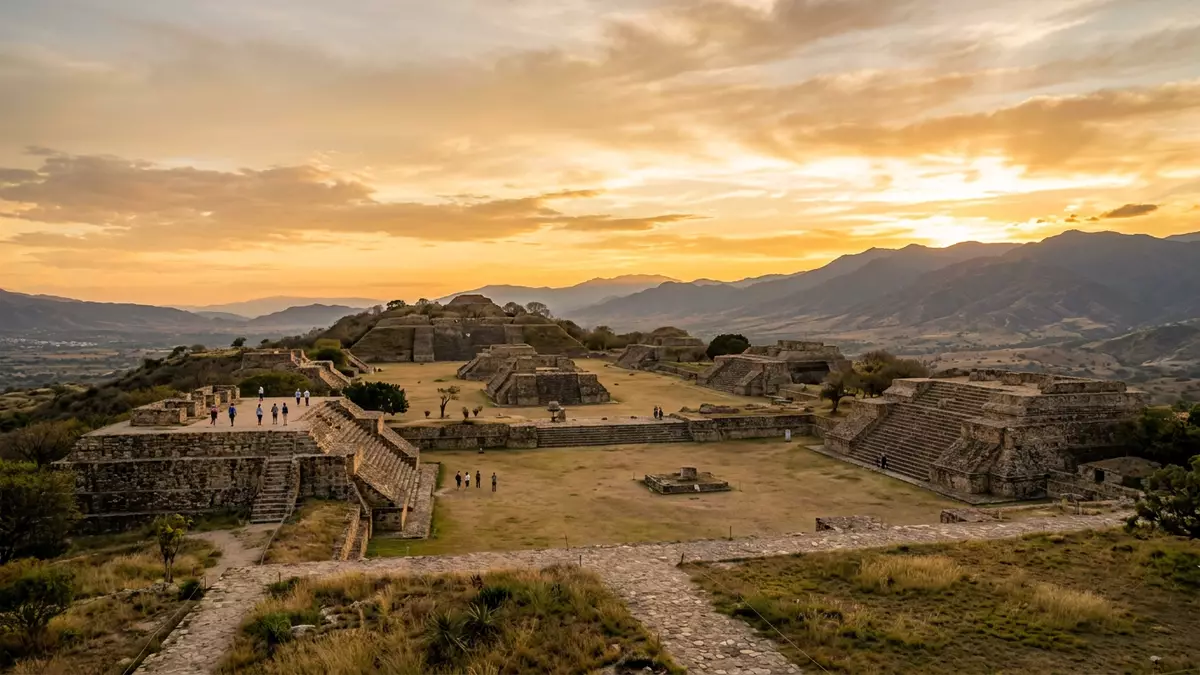
Monte Alban rises on a flattened ridge above the central valleys of Oaxaca, transforming a mountain spine into an organised pre?Hispanic city of plazas and pyramids. Founded around 500 BCE as the capital of the Zapotec civilisation, it remained a major urban and ceremonial centre for more than a millennium before later occupation by Mixtec peoples.
A hilltop capital carved from the mountain
The site occupies a low mountainous range overlooking the meeting point of the Etla, Tlacolula, Zimatlán and Ocotlán branches of the Oaxaca Valley, a position that gives broad views along the three arms of the basin. The ridge was levelled to create terraces and platforms, turning irregular hilltops into large artificial surfaces that could carry civic and ceremonial structures.central valleys of Oaxaca The resulting urban landscape stretches over several square miles, with monumental architecture concentrated around a single Great Plaza on the main summit.
Monte Alban served as the grand capital of the Zapotecs from about 500 BCE to 800 CE, one of the earliest large urban centres in the Americas and a counterpart in scale to Teotihuacán in central Mexico.Zapotec metropolis founded in the sixth century BCE After the decline of Zapotec political power, areas of the city were occupied by Mixtec communities, who reused elite residences and tombs and left their own burials and offerings among the older structures.Olmec, Zapotec and Mixtec presence
The Great Plaza, platforms and ball court
At the heart of Monte Alban lies the Great Plaza, a broad open square framed by platform mounds, pyramids and temple bases that once supported administrative and ritual buildings.monumental Grand Plaza On the north and south edges, massive platform complexes rise above the square, reached by stairways and carrying further terraces and structures on their upper levels. Between them, a cluster of smaller buildings occupies the centre of the plaza, including the distinctive Building J with its angled plan and carved panels.
Monte Alban contains a formal ball court designed for the Mesoamerican ballgame known as tlachtli, recognisable by its I?shaped arrangement of sloping walls and end zones.court for playing tlachtli Around the plaza and along the surrounding terraces stand numerous temples and palatial structures, while carved stone monuments such as the so?called Danzantes panels record figures and hieroglyphic texts. Archaeological work has also documented an extensive network of tombs beneath and beside these buildings, with around 170 burial chambers identified to date, many richly furnished with ceramics and ornaments.about 170 tombs
Writing, sacred topography and World Heritage status
The architecture and sculpture at Monte Alban show early examples of writing and calendrical notation in Mesoamerica, carved onto stelae, building facades and tomb entrances.early writing systems and carved monuments Terraces, dams, canals, pyramids and artificial mounds were cut into the bedrock of the mountain, creating what has been described as a sacred topography in which the natural ridge and constructed city form a single composition. This integration of landscape and urban planning, together with the long sequence of occupation, allows the basic chronology and artistic styles of the region to be read in the ruins.
Monte Alban forms part of the joint UNESCO World Heritage inscription “Historic Centre of Oaxaca and Archaeological Site of Monte Alban”, a designation granted in 1987 that recognises its outstanding value in the history of the Americas.World Heritage property since 1987 For visitors, the hilltop location above Oaxaca and the broad open plaza create a stone city in the sky, with views across cultivated valleys and surrounding mountain ranges that situate the ruins within the wider landscape of southern Mexico.
Visiting Monte Alban: what travellers from Western Europe should know
- Monte Alban stands on a ridge west of Oaxaca de Juárez in southern Mexico, reached by road from the city via Carretera a Monte Alban and other signed approaches.
- The archaeological zone occupies a flattened mountaintop with wide open plazas and terraces; reaching the principal structures involves walking on uneven stone surfaces and climbing stairways without shade.
- The official language is Spanish and the currency is the Mexican peso.
- Entry requirements depend on your nationality; UK travellers can check the FCDO travel advice at gov.uk/foreign-travel-advice, Irish travellers the Department of Foreign Affairs at ireland.ie.
Searching for Monte Alban on social platforms
These links open searches for Monte Alban on each platform.
Frequently asked questions about Monte Alban
Where is Monte Alban located?
Monte Alban is in the state of Oaxaca in southern Mexico, on a low mountainous range above the central valleys just west of Oaxaca de Juárez.
What can visitors expect during a visit to Monte Alban?
Visitors encounter wide plazas, pyramids, platform mounds, a ball court and numerous terraces and stairways on a flattened mountaintop, together with broad views over the surrounding valleys.
What makes Monte Alban distinctive among Mesoamerican sites?
Monte Alban is distinguished by its role as a long?lived Zapotec capital, its integration of urban planning with a mountain ridge and its inscription as a joint UNESCO World Heritage site with Oaxaca’s historic centre.


