
Monte Alban and the stone geometry of Oaxaca
Published on 09/23/2026 at 05:32 | Editorial responsibility: Rafael Müller, Editor-in-Chief AD HOC NEWS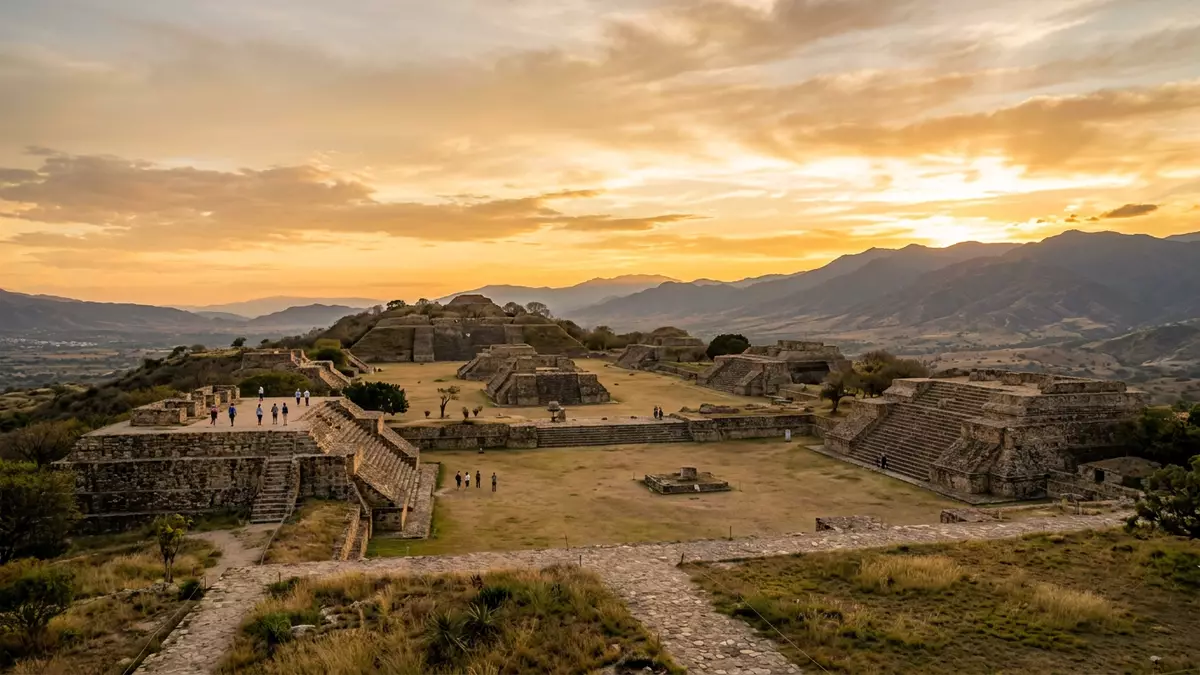
Monte Alban is a hilltop archaeological city above Oaxaca, where broad plazas and monumental terraces extend across a flattened mountain summit. Founded by the Zapotec civilisation around 500 BC, it became a ceremonial and political centre whose stone geometry remains visible across the high ground.
Monte Alban on a flattened mountain summit
The site occupies the meeting area of Oaxaca’s Central Valleys, between the Sierra Madre Oriental and the Sierra Madre del Sur. Its main plaza lies on the highest part of the hill, surrounded by terraces and residential structures on the slopes.
The summit was reshaped into an extensive ceremonial landscape. Monte Alban’s monumental terraces stand beside pyramids, artificial mounds, canals and dams. The buildings are formed from sloping walls, vertical panels and broad stairways with raised side sections.
The Zapotec capital and its long history
Monte Alban flourished as a Zapotec capital from 500 BC to 850 AD. Olmec, Zapotec and Mixtec peoples occupied the site across a period of roughly 1,500 years, leaving evidence of changing traditions and political power.
The city included temples, palaces, tombs, a ball court and carved stones. The Dancers, Conquest Slabs and Stelae of Governors preserve figures, symbols and inscriptions associated with Zapotec writing. The Zapotec capital’s remains also include elite residences arranged around courtyards and domestic areas on the hillsides.
Plazas, tombs and carved stones
The Great Plaza forms the central open space of Monte Alban. Its north and south ends are marked by large platform mounds, while temples and other structures define the edges of the ceremonial area.
Burial places form an important part of the archaeological landscape. Tombs contain evidence of funerary customs, social hierarchy and artistic production. Tomb 7 became known for offerings associated with a later Mixtec royal family, including gold, jewels and carved bones.
Stone monuments give the city a second visual language. Carved surfaces show human figures, signs and geometric details, while ceramic urns depict Cocijo, the Zapotec god associated with lightning and rain. The site’s architecture and objects belong together: terraces organise the mountain, and inscriptions record parts of the society that occupied it.
Visiting Monte Alban: what travellers from Western Europe should know
- Monte Alban lies south-west of Oaxaca in the Central Valleys. It is reached by road from Oaxaca, with taxis and organised excursions serving the archaeological zone.
- The site stands on a high, flattened hill. The visit involves exposed plazas, uneven stone surfaces, broad stairways and walking between separated architectural groups.
- The museum and archaeological remains present carved stones, ceramics, tomb material and architectural fragments from the Zapotec city.
- The official language is Spanish and the currency is the Mexican peso.
Searching for Monte Alban on social platforms
These links open searches for Monte Alban on each platform.
Frequently asked questions about Monte Alban
Where is Monte Alban?
Monte Alban is an archaeological site on a flattened mountain south-west of Oaxaca, in Mexico’s Central Valleys.
What can visitors expect there?
The site contains a large plaza, pyramids, terraces, tombs, a ball court, carved stones and a museum displaying archaeological material.
What makes Monte Alban distinctive?
Its ceremonial city was shaped across a mountain summit, combining monumental plazas, terraces, canals, tombs and Zapotec inscriptions in one archaeological landscape.


