
Monte Alban’s hilltop plazas above Oaxaca’s valleys
Published on 08/21/2026 at 16:44 | Editorial responsibility: Rafael Müller, Editor-in-Chief AD HOC NEWS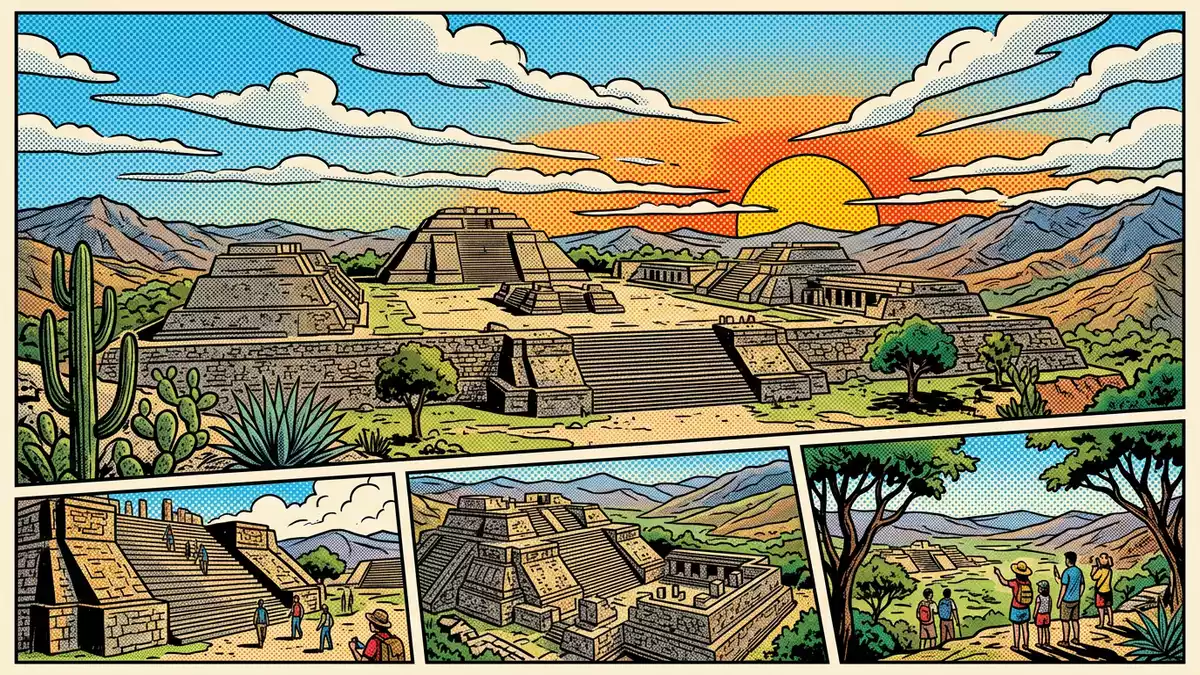
High above the valleys of Oaxaca, Monte Alban turns a flattened ridge into a sequence of plazas and terraces where Zapotec and Mixtec builders left one of Mexico’s great pre-Columbian cities. Founded in the first millennium BC and inscribed as part of the UNESCO World Heritage property “Historic Centre of Oaxaca and Archaeological Site of Monte Albán”, it spreads across a mountaintop with stepped platforms, pyramids and tombs defining a monumental stone landscape.
A Zapotec capital on a levelled mountain
Monte Alban stands on high ground in the Valley of Oaxaca, in the state of Oaxaca in southern Mexico, overlooking the present-day city of Oaxaca de Juárez and the surrounding central valleys.high ground in Oaxaca The ridge was reshaped into terraces and broad platforms so that plazas, stairways and truncated pyramids could occupy a continuous summit.
The site grew into a major Zapotec metropolis founded in the sixth century BCE and functioning as a capital between about 500 BCE and 800 CE, when its monumental architecture framed political, religious and residential life for thousands of inhabitants.ancient Zapotec metropolis Over more than 1,500 years it was occupied by successive peoples including the Zapotecs and later the Mixtecs, whose use of the site as a burial ground added richly furnished tombs to the existing structures.inhabited over a period of 1,500 years
The Great Plaza and its surrounding monuments
The architectural heart of Monte Alban is the Great Plaza, a broad rectangular space on the summit where stairways lead up to tall platform mounds at each end.Great Plaza and platform mounds Around this central space, terraces carry temples and palaces built in stone, their stepped profiles giving the impression of a carefully ordered stone horizon.
Among the monuments bordering the Great Plaza are a ball court for the Mesoamerican game, structures grouped into systems identified by archaeologists such as System II, and carved stone slabs known as “Los Danzantes”, whose relief figures belong to an early phase of the site’s history.temples, ball court and bas-reliefs Excavations have revealed numerous tombs, including richly furnished examples such as Tomb 7, which became a key reference for understanding Mixtec funerary art and metalwork.Tomb number 7
UNESCO recognition and the surrounding landscape
Monte Alban forms part of the World Heritage property officially titled the Historic Centre of Oaxaca and Archaeological Site of Monte Albán, inscribed on the UNESCO World Heritage List in 1987 as a cultural site under criteria i, ii, iii and iv.UNESCO World Heritage designation The inscribed property covers the archaeological zone and its buffer area, capturing terraces, dams, canals, pyramids and artificial mounds that illustrate a long regional chronology.
The protected area extends across multiple hills, including Monte Alban itself, El Gallo and Atzompa, where cultivation terraces descend the slopes and additional archaeological groups occupy neighbouring crests.three hills and cultivation terraces Standing on the Great Plaza, visitors see the surrounding valleys and mountain ranges that frame the central valleys of Oaxaca, situating the ancient city in a wider landscape of ridges, rivers and modern settlements.
Visiting Monte Alban: what travellers from Western Europe should know
- Monte Alban lies west of Oaxaca de Juárez in southern Mexico, in the Valley of Oaxaca, and is reached by road that climbs from the city into the surrounding hills.
- The archaeological zone occupies a mountaintop with broad plazas linked by long stairways, so exploring the site involves walking on uneven stone surfaces and climbing multiple flights of steps at altitude.
- The official language is Spanish and the currency is the Mexican peso. Entry requirements depend on your nationality; UK travellers can check the FCDO travel advice at gov.uk/foreign-travel-advice, Irish travellers the Department of Foreign Affairs at ireland.ie.
Searching for Monte Alban on social platforms
These links open searches for Monte Alban on each platform.
Frequently asked questions about Monte Alban
Where is Monte Alban located?
Monte Alban stands on a hilltop in the Valley of Oaxaca in southern Mexico, west of the city of Oaxaca de Juárez.
What can visitors expect at the site?
Visitors encounter a large archaeological zone with a central plaza, stepped pyramids, terraces, a ball court and tombs, all laid out on a levelled mountain ridge.
What makes Monte Alban distinctive?
Monte Alban is distinctive as a long-lived Zapotec capital founded in the first millennium BCE, recognised as part of a UNESCO World Heritage property with its own historic centre in Oaxaca.


