
Montjuic, the green hill that frames Barcelona’s skyline
Published on 09/17/2026 at 12:16 | Editorial responsibility: Rafael Müller, Editor-in-Chief AD HOC NEWS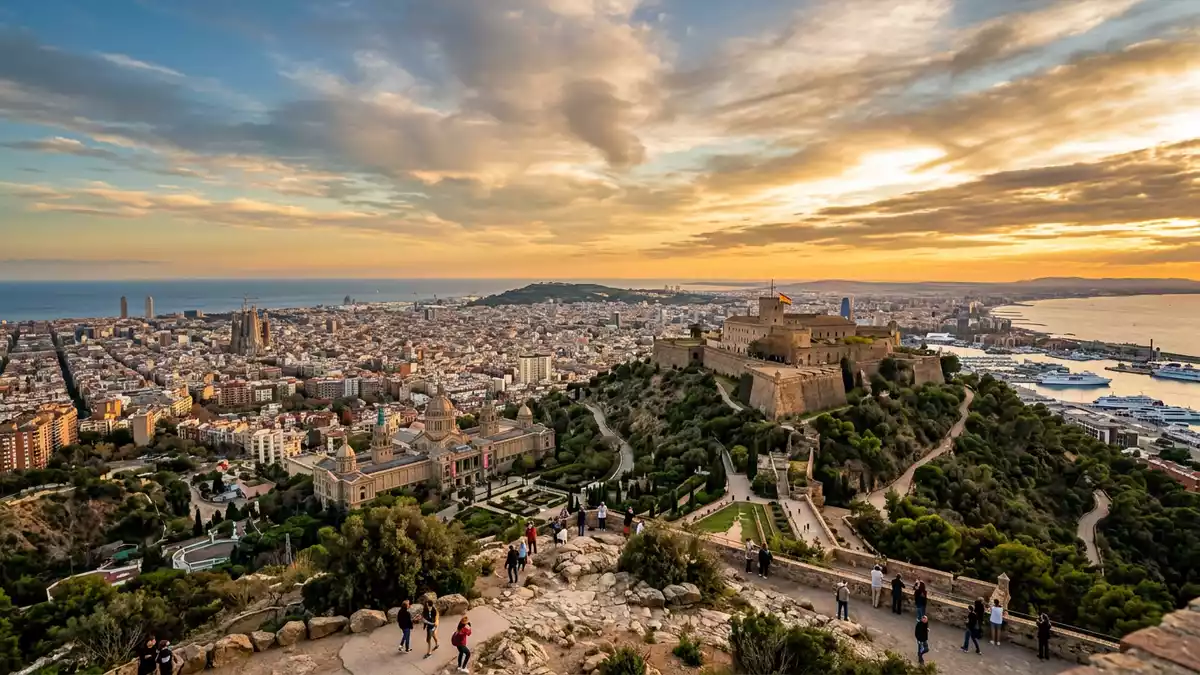
Montjuic is the broad, wooded hill that closes the southern edge of central Barcelona, rising between Plaça d’Espanya and the city’s commercial port. Its slopes carry parks, museums and sports arenas, while the summit is crowned by the stone outline of Castell de Montjuïc, a former military fortress dating back to the seventeenth century.
A hill shaped by stone, terraces and a fortress
Seen from the city, Montjuic forms a long ridge that lifts gradually from the built-up streets towards the harbour, with the highest point close to 173 m (568 ft) above sea level.located 173 metres above sea level The name “Montjuïc” is linked to a medieval Jewish cemetery on the hill, which gave rise to the description of the area as a “Jewish mountain” in Catalan.a medieval Jewish necropolis Much of the hill is still green, with broad paths and garden terraces cut into slopes that were once quarried for stone used in central Barcelona.
The summit is occupied by Castell de Montjuïc, a fortress whose foundations date to 1640, when the hill began to be enclosed within defensive walls.roots dating back from 1640 The castle’s present outline with bastions and ramparts was largely formed in the eighteenth century under the direction of military engineers such as Juan Martín Cermeño.modifications planned by Juan Martin Cermeño From the outer walls and platforms the view reaches across Barcelona’s grid of streets, the old harbour and the coastline of Catalonia.
Montjuic as Barcelona’s cultural hillside
Montjuic contains several of Barcelona’s major cultural institutions and landscaped spaces, concentrated on broad terraces partway up the slope. On the eastern side stands the Palau Nacional, the grand, historicist building that houses the Museu Nacional d’Art de Catalunya (MNAC), overlooking fountains and stairways that step down towards Plaça d’Espanya.Museu Nacional d’Art de Catalunya Nearby is the Magic Fountain of Montjuic, set in front of the Palau Nacional and framed by ornamental pools and avenues.
Across the hill, several gardens punctuate the slopes, including the Jardí Botànic, which assembles thousands of plant species from Mediterranean-climate regions in a network of paths and viewing points.Barcelona’s Botanical garden has over 2,000 plant species The Fundació Joan Miró, housed in a white modernist building, presents the work of the Catalan artist Joan Miró alongside contemporary art, while the open-air architectural museum Poble Espanyol reproduces streets and squares with building facades from across Spain on a single terrace.Poble Espanyol open-air museum Together these sites make Montjuic not just a viewpoint but a cultural district on a hillside.
From military stronghold to public vantage point
For centuries Montjuic’s height gave it strategic importance for the defence and control of Barcelona. A watchtower is documented on the hill in the eleventh century, used for signalling approaching ships, and the seventeenth-century fortifications were built amid the Revolt of Catalonia.fortify the summit of Montjuïc The Battle of Montjuïc in 1641 confirmed the fortress as a key element in Barcelona’s defence during conflicts between Catalonia, Spain and France.its first battle during the Catalan Revolt
Later the castle was used as a prison and a site of political repression, a role that left a lasting mark on its reputation in Barcelona.a tool of political repression for over two centuries In the twentieth century the hill also became a setting for major civic events: the 1929 International Exposition brought new exhibition halls and gardens, and the 1992 Summer Olympics placed stadiums, pools and the Anella Olímpica sports complex on its plateaus.Anella Olímpica Olympic Park Montjuic now combines this military and civic history with its role as a green public space overlooking Barcelona.
Visiting Montjuic: what travellers from Western Europe should know
- Montjuic rises south of central Barcelona between Plaça d’Espanya and the harbour, and is reached by metro and funicular from the city, with cable cars linking the upper slopes.
- The terrain includes long slopes, stairways and broad paths that climb to Castell de Montjuïc and across garden terraces, so time on foot involves gradients rather than level streets.
- Major landmarks on the hill include Castell de Montjuïc, the Palau Nacional and MNAC, the Magic Fountain, Poble Espanyol, several Olympic venues and the Fundació Joan Miró.
- Spain’s official language is Spanish alongside Catalan, and the currency is the euro (EUR).
Searching for Montjuic on social platforms
These links open searches for Montjuic on each platform.Frequently asked questions about Montjuic
Where is Montjuic in relation to Barcelona’s centre?
Montjuic forms the southern boundary of central Barcelona, rising between Plaça d’Espanya and the port and overlooking the city’s grid of streets.
What should visitors expect on a visit to Montjuic?
Visitors encounter garden terraces, major museums, sports venues and the historic Castell de Montjuïc fortress, together with broad views across Barcelona and the Mediterranean.
What makes Montjuic distinctive among Barcelona’s districts?
Montjuic combines a seventeenth- and eighteenth-century hilltop fortress, major cultural institutions and Olympic facilities on a single, prominent hillside above the city.


