
Monument Valley’s sandstone giants of Oljato
Published on 09/19/2026 at 08:54 | Editorial responsibility: Rafael Müller, Editor-in-Chief AD HOC NEWS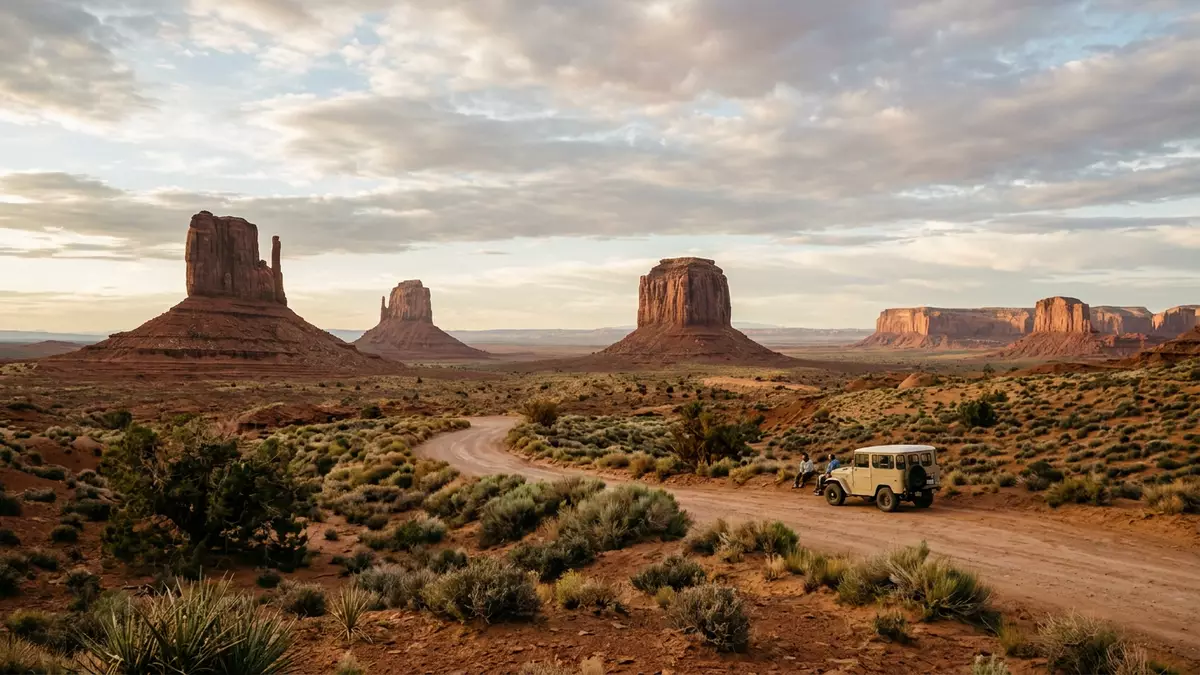
Monument Valley near Oljato in the United States is a high desert basin where sandstone towers stand above a broad rust-coloured plain on Navajo Nation land. The valley straddles the Arizona–Utah state line and forms part of Monument Valley Navajo Tribal Park, established as a protected area in the mid-twentieth century.
Sandstone towers on the Colorado Plateau
Monument Valley lies on the south-western edge of the Colorado Plateau, in San Juan County in Utah and Navajo County in Arizona, with the Navajo settlement of Oljato-Monument Valley nearby.Arizona–Utah border within the Navajo Nation The land is formally designated as Monument Valley Navajo Tribal Park rather than any national park, and it lies entirely within the sovereign territory of the Navajo Nation.Monument Valley Navajo Tribal Park
From the valley floor, sandstone buttes and mesas rise in sheer cliffs from low slopes of softer rock, giving the basin its distinctive skyline. Many of the towers are erosional remnants of a once more continuous plateau, consisting of lower slopes of Organ Rock Formation, vertical cliffs of De Chelly Sandstone and an upper caprock of Moenkopi and Shinarump units that slows the retreat of their tops.erosional buttes and mesas The combination of a flat plain and isolated stone towers gives Monument Valley a recognisable profile in wide views across the desert.
A Navajo Tribal Park and Diné landscape
Monument Valley is administered as a Navajo Tribal Park, established by the Navajo Nation’s tribal council in 1958 to protect both the landforms and their cultural significance.Tribal Park established 1958 The protected area spans 91,696 acres across the Arizona–Utah border and is marked on maps as Monument Valley Navajo Tribal Park, with administration based at Oljato-Monument Valley.protected Navajo Tribal Park
The Navajo name Tsé Bii? Ndzisgaii, sometimes translated as “valley of the rocks”, points to the relationship between the broad sandy basin and the stone forms rising from it.Tsé Bii? Ndzisgaii Within the park, named formations such as West Mitten Butte, East Mitten Butte, Merrick Butte and Sentinel Mesa stand above the valley floor and are associated with Navajo stories that see them as spiritual presences watching over the basin.West Mitten, East Mitten and Merrick Butte The combination of named features, Navajo language and protected status makes the valley a cultural landscape as well as a geological one.
Geology and the making of the valley floor
Geologically, the rock layers exposed in Monument Valley range from Permian to Triassic in age and form part of a thick sequence of sedimentary formations on the Colorado Plateau.Permian rocks of Monument Valley The lower slopes of many towers are carved from Organ Rock Shale, which weathers into red surfaces, while the cliffs above consist largely of De Chelly Sandstone, a windblown sandstone of Permian age that once formed part of an extensive dune field.Permian De Chelly Sandstone
Above the De Chelly Sandstone, resistant layers such as the Shinarump member of the Chinle Formation and Moenkopi Sandstone cap many mesas and buttes, protecting their tops from rapid erosion.Moenkopi and Shinarump caprock On the valley floor, sand and siltstone stained with iron oxide form broad plains known as Cedar Mesa Sandstone, giving the basin its characteristic red surface visible in distant views.Cedar Mesa Sandstone valley floor The combination of hard caps and softer lower units underlies the contrast between vertical towers and low eroded slopes that defines the valley’s form.
Visiting Monument Valley: what travellers from Western Europe should know
- Monument Valley lies on the Arizona–Utah border and is reached by road along US-163 near the settlement of Oljato-Monument Valley in the Navajo Nation.
- The terrain is high desert at around 1,700 m (5,564 ft) above sea level, with unpaved roads, sandy surfaces and viewpoints set on exposed rims above the valley floor.
- The official language of the surrounding Navajo Nation communities is English alongside Navajo, and the currency is the United States dollar.
- Entry requirements depend on your nationality; UK travellers can check the FCDO travel advice at gov.uk/foreign-travel-advice, Irish travellers the Department of Foreign Affairs at ireland.ie.
Searching for Monument Valley on social platforms
These links open searches for Monument Valley on each platform.Frequently asked questions about Monument Valley
Where is Monument Valley?
Monument Valley lies on the border between Arizona and Utah in the United States, within the Navajo Nation near the settlement of Oljato-Monument Valley.
What should visitors expect on a first visit?
Visitors encounter a high desert basin with sandstone buttes, mesas and viewpoints above a broad plain, reached by roads running through Navajo Tribal Park land.
What makes Monument Valley distinctive among desert landscapes?
The contrast between the flat valley floor and isolated sandstone towers, combined with its status as a Navajo Tribal Park on the Colorado Plateau, gives Monument Valley its distinctive character.


