
Mosquee Hassan II and Casablanca’s mosque above the Atlantic
Published on 09/23/2026 at 21:20 | Editorial responsibility: Rafael Müller, Editor-in-Chief AD HOC NEWS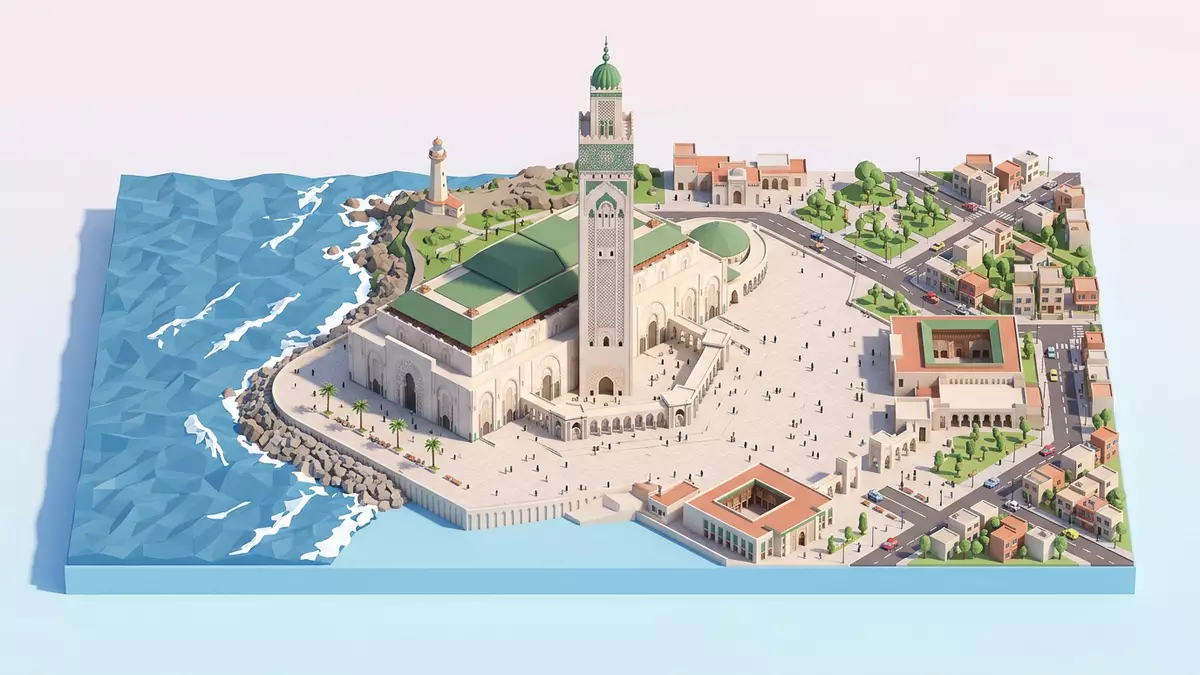
Mosquee Hassan II rises beside the Atlantic in Casablanca, with a 200 m (656 ft) minaret and a prayer hall connected to the sea-facing complex. Designed by French architect Michel Pinseau and inaugurated in 1993, it joins monumental scale with carved plaster, zellige tilework and cedar wood.
Mosquee Hassan II beside the Atlantic
The mosque occupies Casablanca’s coastal edge, where the Atlantic forms the western setting for its marble courtyards, arcades and broad esplanade. Its principal building is organised around a vast rectangular prayer hall, with the minaret forming the most visible vertical element.
The site combines religious spaces with architectural features associated with Moroccan domestic and civic design. Horseshoe arches, patterned tiles, carved surfaces, painted wood and decorative metalwork appear across the complex. The materials vary in colour and texture, while the overall composition remains strongly geometric.
Michel Pinseau and the 1993 inauguration
King Hassan II laid the foundation stone on 11 July 1986. The mosque was inaugurated on 30 August 1993, and its name commemorates the Moroccan king who commissioned the project. Michel Pinseau led the architectural design, working with Moroccan craftsmen and specialist workshops.
The building belongs to the late twentieth-century history of Moroccan Islamic architecture. Traditional forms appear alongside large-scale concrete construction and technical systems, including a retractable roof above the prayer hall. A source on the building records its completion in 1993 and names Michel Pinseau as architect: completion and architect.
The minaret, prayer hall and Moroccan craft
The minaret reaches 200 m (656 ft), giving the mosque a defining profile across Casablanca’s waterfront. A laser associated with its summit points towards Mecca, while the tower’s surface carries the restrained vertical emphasis of the wider composition.
Inside, the prayer hall covers about 20,000 m² and accommodates a large congregation. Cedar ceilings, marble columns, carved plaster and zellige surfaces connect the interior to Moroccan artisanal traditions. The complex also includes ablution facilities and a hammam, linking ceremonial, communal and practical functions within one architectural setting.
The sea-facing position, the retractable roof and the elevated minaret remain visible features of the design. The mosque’s recorded history places its inauguration on 30 August 1993 and identifies the collaboration between Pinseau’s office and Moroccan artisanal bodies: 1993 inauguration and design.
Visiting Mosquee Hassan II: what travellers from Western Europe should know
- Mosquee Hassan II stands on Casablanca’s Atlantic waterfront. Casablanca’s urban transport network connects the coastal district with the rest of the city.
- The complex includes broad exterior paving, marble courtyards and a large esplanade. The prayer hall has a retractable roof and extensive interior decoration.
- The official language is Arabic and the national currency is the Moroccan dirham.
- Entry requirements depend on your nationality; UK travellers can check the FCDO travel advice at gov.uk/foreign-travel-advice, Irish travellers the Department of Foreign Affairs at ireland.ie.
Searching for Mosquee Hassan II on social platforms
These links open searches for Mosquee Hassan II on each platform.
Frequently asked questions about Mosquee Hassan II
Where is Mosquee Hassan II?
Mosquee Hassan II stands on Casablanca’s Atlantic waterfront in Morocco. Its coastal position is part of the building’s visible setting.
What can visitors expect from the architecture?
The complex includes a large prayer hall, marble courtyards, a retractable roof, carved plaster, zellige tilework and cedar decoration. The minaret rises 200 m above the waterfront.
What makes the mosque distinctive?
Its combination of Atlantic location, monumental prayer hall, Moroccan craftsmanship and a 200 m minaret gives the building its recognisable architectural character.


