
Mosquee Hassan II and its Atlantic-facing prayer hall
Published on 09/24/2026 at 12:06 | Editorial responsibility: Rafael Müller, Editor-in-Chief AD HOC NEWS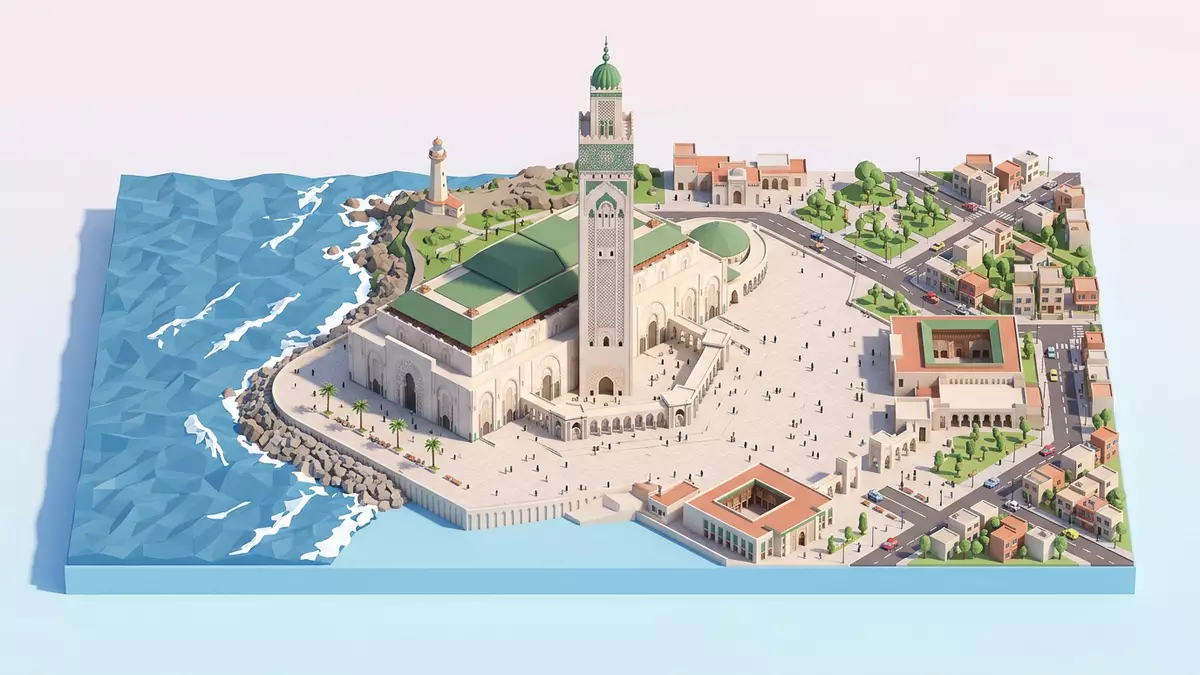
Mosquee Hassan II occupies Casablanca’s Atlantic edge, where a vast prayer hall and a tall minaret form a complex of stone, marble, wood and tile. Completed on 30 August 1993, the mosque was designed by French architect Michel Pinseau under the patronage of King Hassan II.
Mosquee Hassan II above the Atlantic
The mosque stands on a promontory looking towards the Atlantic Ocean, close to Casablanca’s harbour and El Hank Lighthouse. Its setting is part of its visible character: the broad complex meets the seafront, while the minaret rises above the low coastal skyline.
The main building measures 200 metres (656 ft) in length and 100 metres (328 ft) in width. Its prayer hall occupies the upper part of the complex, with surrounding courtyards and associated religious facilities extending across the site. The layout is a basilican plan, a form that differs from the T-shaped plan found in many North African mosques.
The mosque is linked to the name of King Hassan II, who commissioned the project. Construction began in July 1986, and the finished building belongs to the late twentieth-century history of Moroccan religious architecture. Its formal completion date was 30 August 1993, 30 August 1993.
Moroccan materials and detailed craft
Mosquee Hassan II brings together large-scale concrete construction and traditional Moroccan decoration. Pale marble, granite, cedar wood, carved plaster and zellij tilework appear across the exterior and interior, with geometric and floral patterns covering columns, walls and ceilings.
Marble came from Agadir, granite from Tafraoute and cedar from the Middle Atlas. These materials are joined by painted wood, sculpted plaster and coloured tilework. Horseshoe arches, carved surfaces and muqarnas contribute to the building’s Moroccan, Andalusian and Moorish visual language.
The prayer hall contains a succession of domes, chandeliers and ornamented structural elements. Mezzanine galleries with carved dark wood furnishings line the sides of the hall. Below the main floor are ablution spaces and a public hammam, while the wider complex includes a madrasa, museum, library and conference facilities.
The mosque’s decoration reflects the work of Moroccan artisans across several crafts. Zellij, carved plaster and painted cedar belong to established traditions of Moroccan architecture, while the scale of the complex places those details within a monumental twentieth-century building. Its materials remain legible at different distances, from the broad marble surfaces outside to the patterned interiors.
The minaret, roof and prayer hall
The minaret reaches 210 metres (689 ft), making it the mosque’s dominant vertical element. It is clad in pale stone and decorated with green tilework, with a laser at its summit directed towards Mecca. The tower’s height gives the complex a clearly defined silhouette above Casablanca’s Atlantic edge.
The prayer hall can hold 25,000 worshippers, while the surrounding outdoor areas provide space for a further 80,000. Together, these areas give the complex a stated capacity of 105,000 people during large religious gatherings.
A retractable roof covers the prayer hall. Its movement changes the relationship between the interior and the open sky, while the hall’s glass doors admit daylight along the northern side. The building therefore combines a large enclosed worship space with architectural elements that open towards the sky and sea.
The scale of the hall is matched by its surface detail. Carved plaster, painted wood, zellij and marble appear alongside structural columns and arches. The result is a building where the main visual impression comes from the meeting of immense dimensions and finely worked Moroccan ornament, Moroccan materials and craft.
Visiting Mosquee Hassan II: what travellers from Western Europe should know
- Mosquee Hassan II is on Boulevard Sidi Mohammed Ben Abdallah in Casablanca, between the harbour and El Hank Lighthouse. Casa-Port railway station is the nearest main rail reference.
- The approach leads across broad urban avenues towards a seafront complex. The site includes large paved outdoor areas, courtyards and substantial interior spaces.
- The official language is Arabic and the currency is the Moroccan dirham.
- Casablanca’s Atlantic coast forms the setting, with the mosque, harbour and El Hank Lighthouse occupying the same coastal area.
- Entry requirements depend on your nationality; UK travellers can check the FCDO travel advice at gov.uk/foreign-travel-advice, Irish travellers the Department of Foreign Affairs at ireland.ie.
Searching for Mosquee Hassan II on social platforms
These links open searches for Mosquee Hassan II on each platform.Frequently asked questions about Mosquee Hassan II
Where is Mosquee Hassan II?
Mosquee Hassan II is in Casablanca, Morocco, on the Atlantic coast near the harbour and El Hank Lighthouse. Its address is Boulevard Sidi Mohammed Ben Abdallah.
What can visitors expect at Mosquee Hassan II?
The complex contains a large prayer hall, courtyards, carved interiors, ablution spaces, a hammam and additional cultural facilities. Its architecture combines Moroccan craft traditions with a large modern structure.
What makes Mosquee Hassan II distinctive?
The mosque combines an Atlantic-facing setting, a 210-metre (689 ft) minaret, a retractable roof and extensive Moroccan decoration. Its prayer hall and surrounding outdoor areas provide space for 105,000 worshippers.


